Wize University Physics Textbook (Master) > Wave Optics
Double Slit Diffraction Modified
Popular Courses
PHYSICS 1201A/B
Western University
Intro to Physics
University Study Guides
Physics
General Course
PHYS 101
McGill University
Intro to Physics
University Study Guides
PHY 1122
University of Ottawa
PHYS 142
McGill University
ENGG 212
University of Calgary
PHYS 102B
University of Victoria
PHYS 111
University of Victoria
PHYS 1050
University of Manitoba
PHYS 101
Simon Fraser University
PHYS-1300
University of Windsor
PHY 1121
University of Ottawa
PHYS 121
University of Waterloo
PHYS 206
Concordia University
PHYS 227
University of Calgary
SC/PHYS 1411 3.00
York University
PCS 110
Toronto Metropolitan University
PHY 9B
University of California - Davis
Effective Path Difference
Sometimes you will encounter problems where there are materials other than air in a two-slit experiment. For example, a piece of glass may be placed in front of one of the slits, or a layer of water, etc.
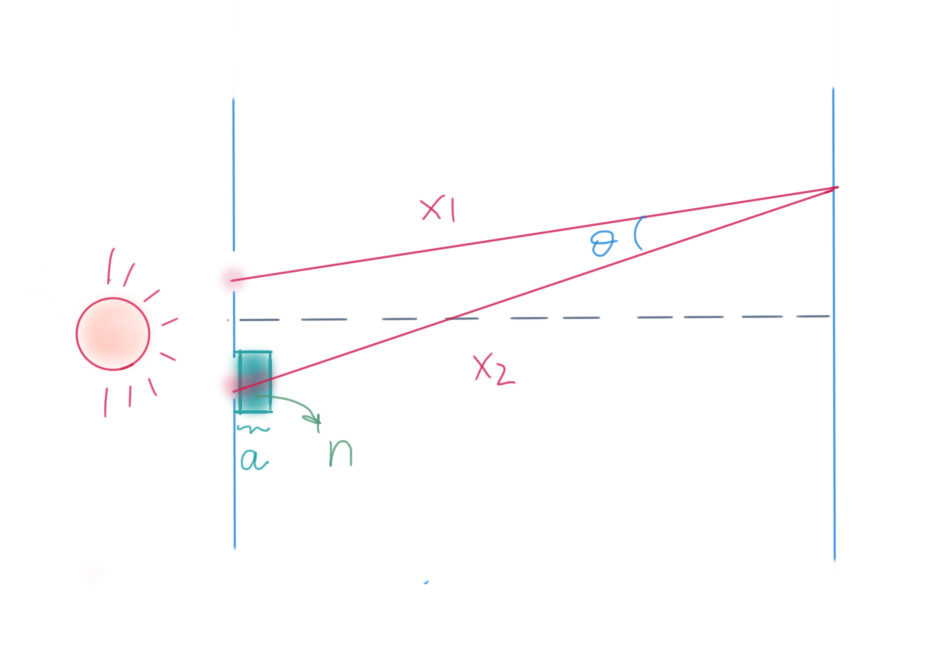
The the new effective path difference for the problem is given by:
where is the thickness of the material placed in front of the slit.
Wize Concept
Note that the angle is going to be different from what used to be without the different material in front of the slit.
Using the small angle approximation we get:
This means that the distance on the screen is now smaller than what it used to be without the material added in front of the slit, and the pattern in shifted downwards.
Wize Concept
If the same material is placed in front of both silts (e.g. the experiment is carried underwater), the fringes will be closer together than without the material there (the pattern is squeezed towards the center).
Exam Tip
Don't confuse the and the in the equation:
- is the index of refraction (specific to each material, always )
- is the order of interference (always an integer, )
Example: Two Media
Two identical light rays ( nm) are separated and then combined to interfere destructively. While they are separated, one of the rays travels through a material with index of refraction while the other still travels in air. What is the minimum thickness of the material?
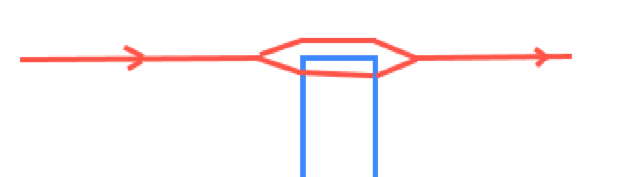
The speed of light inside the second material is , which means it's reduced by a factor of , and there will be more wavelengths inside that material than through air, over the same distance.
The minimum thickness occurs when exactly half a wavelength more is being fit inside the material compared to the light ray outside:
Here is the thickness of the material. Use for the wavelength inside the material:
Rearrange and solve for the thickness :
Plug the numbers is:
(m)
(nm)
Practice: Effective Path Difference
Consider a two-slit interference problem with distance between slits mm and distance to the screen m. Assume , that is, is very small. We shine a blue laser at the slits (nm).
a) At what height does the first complete minimum occur?
b) A layer of water (index of refraction ) of thickness is placed in front of the bottom slit. What is the smallest thickness of water that will have no impact on where we will find maxima in the interference pattern?
Effective Path Difference
Sometimes you will encounter problems where there are materials other than air in a two-slit experiment. For example, a piece of glass may be placed in front of one of the slits, or a layer of water, etc.
There are two equivalent methods to find the new effective path difference.
Method 1: Phase differences
Consider a setup where the bottom slit is covered by a layer of water of thickness . Like with other interference problems, we need to consider the phase difference between the two rays.
Let's use the wave equation for each of our two waves:
The wavelength and wave number of light will be modified in water:
where is the index of refraction of water (or any other material).
We will say they are initially in sync (that is, ). The phase difference is:
For example, if we apply this when looking at constructive interference, we need the phase angle to be a multiple of (we write ):
Exam Tip
Don't confuse the and the in this equation:
- is the index of refraction (specific to each material, always )
- is the order of interference (always an integer, )
Method 2: Speed of light reduced in a material
If light travels through water, its speed decreases to:
where is the index of refraction of water (or any other material).
We need to consider how much further ahead the light from the top slit got while the bottom-slit-light was going through water. In the extra time that it takes the light to go through the water thickness , the light travels a distance :
Again, for constructive interference in air we have . How does this equation change with a layer of water? We need to add the extra distance traveled by light to the path difference:
This is the new effective path difference for the problem.
Wize Concept
Note that the angle is now going to be different. Still very small, but different.