Wize University Physics Textbook (Master) > Wave Optics
Realistic Double Slit diffraction
Popular Courses
PHYSICS 1201A/B
Western University
Intro to Physics
University Study Guides
Physics
General Course
PHYSICS 1A03
McMaster University
PHYS 130
University of Alberta
PHYS 131
University of British Columbia
Intro to Physics
University Study Guides
PHYS 124
University of Alberta
PHY 1122
University of Ottawa
PHYS 142
McGill University
ENGG 212
University of Calgary
PHYS 102B
University of Victoria
PHYS 111
University of Victoria
PHYS 1050
University of Manitoba
PHYS 101
Simon Fraser University
PHYS-1300
University of Windsor
PHY 1121
University of Ottawa
PHYS 121
University of Waterloo
PHYS 227
University of Calgary
PHYS 206
Concordia University
Realistic Double Slits
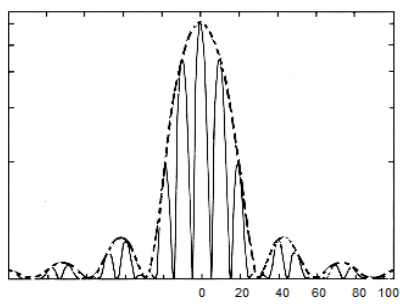
In real life, the two slits are never infinitely thin (they are not really point sources), they actually have a width.
- This means that each of the two slits will generate a single-slit diffraction pattern.
- The result is that we have a single-slit envelope with the pattern of dark and bright fringes from the actual two-slit interference contained inside each bright region.

- To get information about the distance between the two slits, you have to look at peaks generated by the double slit pattern (the narrow bright spots).
- To get information about the size or width of each slit, you have to look at the position of the first minimums for the bigger pattern where the central max of the envelope dies off.
Wize Concept
- We can see the single-slit envelope much better if the width of the slits is comparable to the distance between them.
- If the width of the lists is much smaller than the distance between them, the envelope is so spread out that we can't distinguish this single-slit pattern and we only see the fringes inside (from the double-slit interference).
Practice: Realistic Double Slits
The intensity pattern of a double-slit configuration at m is shown below.
The horizontal axis shows the displacement in mm. The wavelength is nm.
a) Find the angle from the center of slits at which the first spectral order maximum happens.
b) What is the distance between the two slits?
c) What is the width of each slit?