Popular Courses
PHYSICS 1202A/B
Western University
PHYSICS 1E03
McMaster University
PHYS*1300
University of Guelph
PHYSICS 1402A/B
Western University
PHYS 205
Concordia University
PHY 1122
University of Ottawa
PHYS 142
McGill University
ENGG 212
University of Calgary
PHY132H1
University of Toronto
PHY132H1
University of Toronto
PHYS-1300
University of Windsor
PHY 1121
University of Ottawa
PHY 1124
University of Ottawa
PHYS 121
University of Waterloo
PHYSICS 1102A/B
Western University
PHYS 227
University of Calgary
SC/PHYS 2020 3.00
York University
PHYSICS 1AA3
McMaster University
PHYS 116
Queen's University
PHY 9B
University of California - Davis

Mark Yourself Question
- Grab a piece of paper and try this problem yourself.
- When you're done, check the "I have answered this question" box below.
- View the solution and report whether you got it right or wrong.
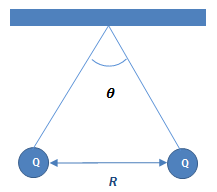
Two charges are hanging from the ceiling as shown, by a massless wire. Assume the two charges have the same magnitude. Derive an expression for Q that results in equilibrium.
Three point charges q1 = +4μc, q2 and q3 = +6μc are located as shown in diagram below. How much should charge q2 be to stabilize (net force zero) charge q3 on the left-hand side?
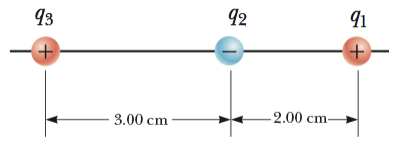
Consider three charges shown below.
a) What is the charge (magnitude and sign) of Q if is in equilibrium?
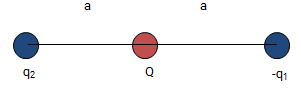
(Ignore the negative sign on q1 in the diagram; it is positive.)
b) What effect does the sign of q1 have on the result above? What effect does the magnitude of q1 have?
Part (a): enter in microcoulombs. If the charge is negative, enter a negative value.
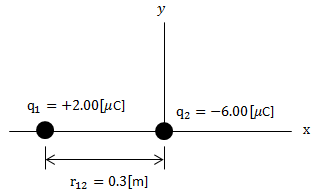
Two point charges are located as shown below.
a) Where should be a third negative chargebe placed on the x-axis such that the net forces on and be equal to zero?
b) What should the magnitude of the charge be?