Popular Courses
PHYSICS 1202A/B
Western University
PHYSICS 1E03
McMaster University
PHYS 223
University of Calgary
APSC 112
Queen's University
PHYSICS 1402A/B
Western University
PHYS 205
Concordia University
PHYS 118
University of British Columbia
PHYS 142
McGill University
ENGG 212
University of Calgary
PHY132H1
University of Toronto
PHY132H1
University of Toronto
PHYS-1300
University of Windsor
PHY 1121
University of Ottawa
PHY 1124
University of Ottawa
PHYS 121
University of Waterloo
PHYSICS 1102A/B
Western University
PHYS 227
University of Calgary
SC/PHYS 2020 3.00
York University
PHYSICS 1AA3
McMaster University
PHYS 116
Queen's University
Maxwell's Displacement Current
Maxwell's equations summarize almost everything there is to know about electromagnetism:
1. Gauss's Law:
2. No magnetic monopoles:
What does this mean? It means that there is no such thing as a magnetic monopole.
With electricity it is possible to have a single positive charge, or a single negative charge, and there can be field lines coming in/out of these charges. With magnetism, however, there cannot be a North pole without a South pole; magnetic fields don't "start" or "end" anywhere. (Even in a bar magnetic, the field keeps going through the magnetic from South through to North).
This can also be written in either of the following forms:
All magnetic fields obey this equation.
3. Faraday's Law:
4. Modified Ampere's Law (or Ampere-Maxwell Law):
What's this last term? This is called the displacement current, or Maxwell displacement current.
In all of the previous examples, the electric flux was constant, so this was always zero. The idea is that if you have a changing electric flux, this produces a magnetic field in the same way that a constant current will.

Mark Yourself Question
- Grab a piece of paper and try this problem yourself.
- When you're done, check the "I have answered this question" box below.
- View the solution and report whether you got it right or wrong.
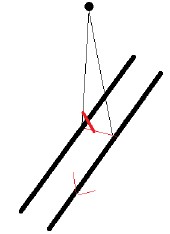
Two wires are suspended by two strings as shown. The angle of suspension for each wire is equal. The system is in equilibrium.
a) Are the currents flowing in the same or opposite directions?
b) Draw a free-body diagram for each wire, and resolve the forces into horizontal and vertical components.
Mark Yourself Question
- Grab a piece of paper and try this problem yourself.
- When you're done, check the "I have answered this question" box below.
- View the solution and report whether you got it right or wrong.
Practice: Cyclotron
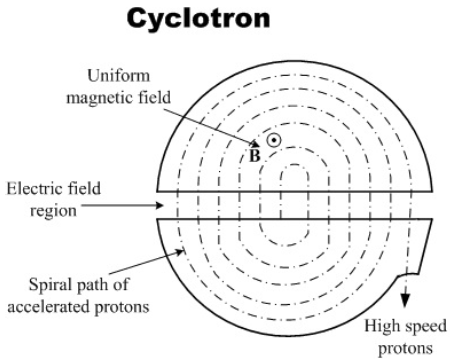
A cyclotron is a device that accelerates charged particles such as protons to very high speeds. It consists of two semicircular plates of radius R arranged like a circle, with a small gap between them, as shown below. The motion of the protons is confined to the plates, and the gap between them. There is a constant magnetic field pointing out of the page. There is an electric field inside the gap that switches directions periodically, so that each time a proton transits the gap, it is accelerated a little bit. The protons spiral with a larger and larger radius until they eventually exit the cyclotron.
a) What is the frequency at which the electric field in the gap must switch directions to make the cyclotron work properly?
b) What is the final velocity of the protons when they exit the cyclotron?
c) The TRIUMF particle accelerator is a cyclotron with a radius of 17.1m. It accelerates protons to a final kinetic energy of . Do what you would typically do in order to calculat ethe magnetic field strength in this situation. (Proton mass: )
d) (Bonus point) What is wrong with your answer to part (c)?