Wize University Physics Textbook (Master) > Magnetic Induction
Additional Practice
Popular Courses
PHYSICS 1202A/B
Western University
PHYSICS 1E03
McMaster University
PHYS 223
University of Calgary
PHYSICS 1402A/B
Western University
PHYS 205
Concordia University
PHYS 118
University of British Columbia
PHYS 142
McGill University
ENGG 212
University of Calgary
PHY132H1
University of Toronto
PHY132H1
University of Toronto
PHYS 102B
University of Victoria
PHYS-1300
University of Windsor
PHY 1121
University of Ottawa
PHYS 121
University of Waterloo
PHYSICS 1102A/B
Western University
PHYS 227
University of Calgary
SC/PHYS 2020 3.00
York University
PHYS 116
Queen's University
PHY 9B
University of California - Davis
PHY 131
Arizona State University - Tempe

Mark Yourself Question
- Grab a piece of paper and try this problem yourself.
- When you're done, check the "I have answered this question" box below.
- View the solution and report whether you got it right or wrong.
A metal bar of mass m slides without friction over two rails a distance D apart in the region that has a uniform magnetic field of magnitude B0 and direction perpendicular to the rails (see below). The two rails are connected at one end to a resistor whose resistance is much larger than the resistance of the rails and the bar. The bar is given an initial speed of v0. It is found to slow down.
How far does the bar go before coming to rest?
Assume that the magnetic field of the induced current is negligible compared to B0.
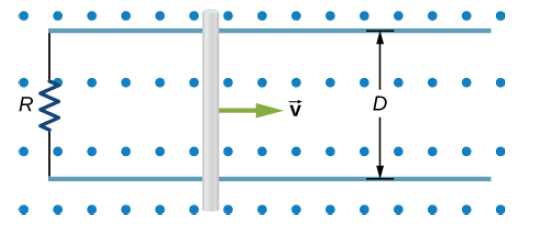
(Source: OpenStax Physics Volume 2)
Mark Yourself Question
- Grab a piece of paper and try this problem yourself.
- When you're done, check the "I have answered this question" box below.
- View the solution and report whether you got it right or wrong.
Two conducting wires are located in a uniform magnetic field pointing directly out of the page. One wire is along the x-axis. The other wire has a parabolic form, of height above the x-axis.
A vertical bar with resistance (parallel to the y-axis) with constant speed moves along the first two wires. It starts at and moves to the left, towards the origin.
a) What is the current in the bar?
b) What is the direction of the induced current in the vertical bar (up or down)?
The accompanying figure shows a single-turn rectangular coil that has a resistance of 2.0 Ω. The magnetic field at all points inside the coil varies according to B = B0e−αt, where B0 = 0.25 T and α = 200 Hz.
What is the current induced in the coil at (a) t = 0.001 s, (b) 0.1 s, (c) 1.0 s? Also, what is the direction of the induced current (same for all three values)?
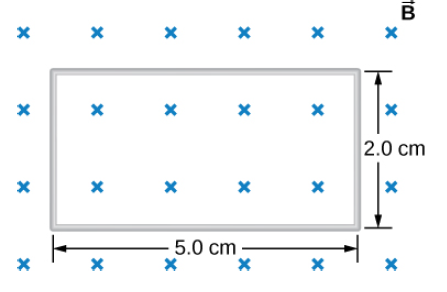
(Source: OpenStax Physics Volume 2)