Wize University Physics Textbook (Master) > Sound & Hearing
Constructive vs Destructive Interference
Popular Courses
MCAT
General Course
Intro to Physics
University Study Guides
Physics
General Course
PHYSICS 1A03
McMaster University
PHYSICS 1202A/B
Western University
PHYSICS 1E03
McMaster University
PHYS*1300
University of Guelph
Intro to Physics
University Study Guides
PHYS 124
University of Alberta
PHYS 131
McGill University
APSC 112
Queen's University
PHYSICS 1402A/B
Western University
PHYS 205
Concordia University
PCS 120
Toronto Metropolitan University
PHYS 142
McGill University
ENGG 212
University of Calgary
PHY132H1
University of Toronto
PHY132H1
University of Toronto
PHYS 102B
University of Victoria
PHYS 111
University of Victoria
Constructive and Destructive Interference
- For two waves propagating from similar sources but traveling different paths, the phase would be different
- The interference pattern between two waves depends on their phase differences
For two waves, generated by two similar in phase sources, the phase difference is equal to:
- is the wave number
- is the path difference travelled by two waves
Conditions over the phase difference in order to have constructive or destructive interference:
Constructive Interference:
Destructive Interference:
Conditions over the path difference in order to have constructive or destructive interference:
Case 1: In Phase Sources:
When the sources are in phase, the waves look the same when they are emitted, and we have:
Constructive Interference (in phase): , so we get:
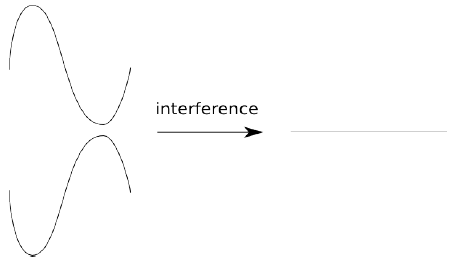
The waves are in phase and their interference is fully constructive.

Destructive Interference (in phase): , so we get:
- Alternate formula: , from which we get
The waves are out phase and their interference is fully destructive.
Case 2: Out of Phase sources:
When the sources are out of phase, the waves look the opposite when they are emitted, and we have:
Constructive Interference (out of phase):
Destructive Interference (in phase):
Wize Concept
When the waves are out of phase, they are shifted by or half a wavelength with respect to each other. That's why the "" value is shifted by half an integer.
Exam Tip
- Begin with the formulas for constructive interference, in phase.
- Count how many shifts you have (e.g. out of phase sources, reflections on rigid boundaries).
- For each shift, swap the equations once.
Interference Shortcuts
In Phase Sources () Out of Phase Sources ()
Constructive: Destructive:
Destructive: Constructive:
Sound Wave Interference
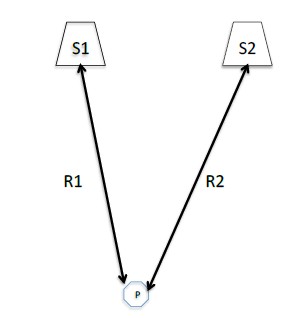
If two speakers with the same frequency are located a distance and from point , then the type of interference that occurs depends on the path difference between the two sound waves at that point.
For sources that are in phase:
Constructive Interference: the path difference is an integer number of wavelengths:
Destructive Interference: the path difference is a half-integer number of wavelengths:
Wize Concept
For sources that are out of phase:
- The pattern shifts by half a wavelength when the sources are out of phase, so the formulas also shift by half an integer.
- This means that the equations are switched for constructive and destructive interference.
Exam Tip
- Draw triangles: the unknown length is often the hypothenuse, so use the Pythagorean theorem to find it ()
- Use the equation to switch between frequency and wavelength
Watch Out!
Read the question carefully: make sure you use the appropriate version of the equations based on whether the sources are in phase or out of phase.
Example: Speakers Out of Phase
You are standing m from one of the two speakers as shown. The two speakers are out of phase. For which frequencies in the hearing range ( Hz to kHz) do you hear a minimum signal? (Speed of sound is m/s)
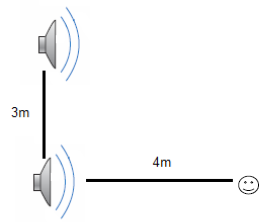
To find the path difference, we first need to find the path length from the top speaker to the observer:
Now we'll find the path difference:
We have destructive interference, and the sources are out of phase, so we have to use:
Let's substitute and convert from wavelength to frequency using :
since we'll need to find the possible values for the given range of frequencies.
For we have:
For we have:
Therefore we could have , but since can only be an integer we get:
Let's find the corresponding frequencies:
(Hz)
(Hz)
.
.
.
(Hz)
Practice: Walking Between Speakers
Two speakers, both of frequency Hz, are placed m apart. An observer, initially positioned at one of the two speakers, walks along a line perpendicular to the line joining the two speakers. Use m/s.
a) How far must the observer walk before reaching the first point of constructive interference with the smallest non-zero path difference?
b) How far must the observer walk before reaching the first point of destructive interference with the smallest non-zero path difference?