Wize University Statics Textbook (Master) > Force Vectors
Scalars and Force Vectors
Scalars & Vectors - Definitions & Examples
Vectors (2D)
Vectors (3D)
Examples: Scalars and Vectors (Sine and Cosine Laws)
Practice: Scalars and Vectors (Sine and Cosine Laws)
Practice: Scalars and Vectors (Catesian Format, Sine Law)
Example: Scalars and Vectors (Rectangular Components)
Practice: Scalars and Vectors (Rectangular Components)
Popular Courses
PHYS 115
Queen's University
ENGG 130
University of Alberta
CIV100H1
University of Toronto
PCS 211
Toronto Metropolitan University
ENGG 202
University of Calgary
ENGSCI 1022A/B/Y
Western University
GNG 1105
University of Ottawa
PHYS 124
University of Alberta
APSC 111
Queen's University
PHYS 111
University of Waterloo
PCS 120
Toronto Metropolitan University
ENGR 242
Concordia University
PHYS 117
University of British Columbia
PHYC 1190
Dalhousie University
ENGG 212
University of Calgary
ENGR 141
University of Victoria
PHYS-1300
University of Windsor
PHY 1121
University of Ottawa
CE 221
Michigan State University
PHY 1124
University of Ottawa
0:00 / 0:00
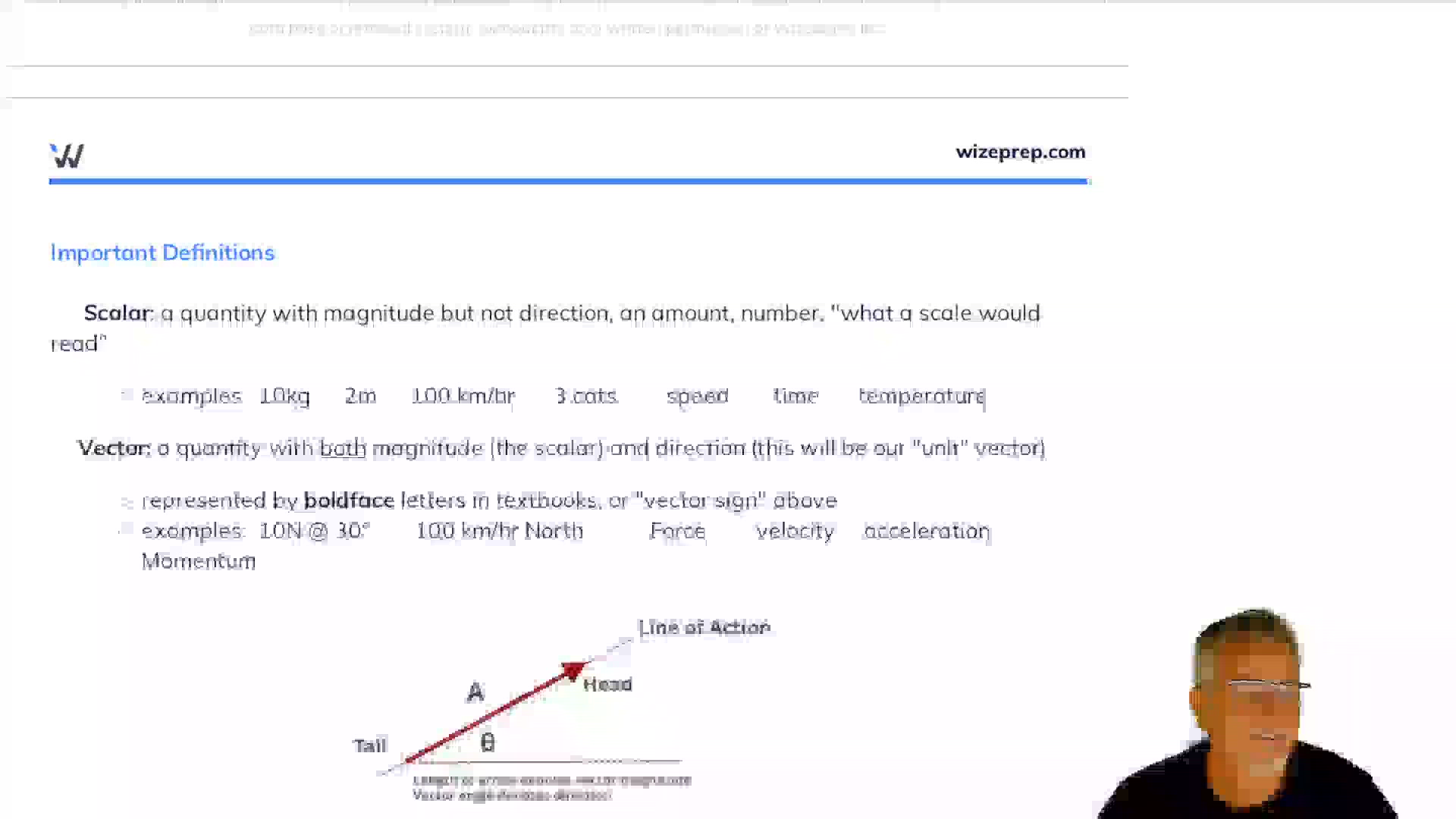
Important Definitions
Scalar: a quantity with magnitude but not direction, an amount, number, "what a scale would read"
- examples: 10kg 2m 100 km/hr 3 cats speed time temperature
Vector: a quantity with both magnitude (the scalar) and direction (this will be our "unit" vector)
- represented by boldface letters in textbooks, or "vector sign" above
- examples: 10N @ 30° 100 km/hr North Force velocity acceleration Momentum

0:00 / 0:00
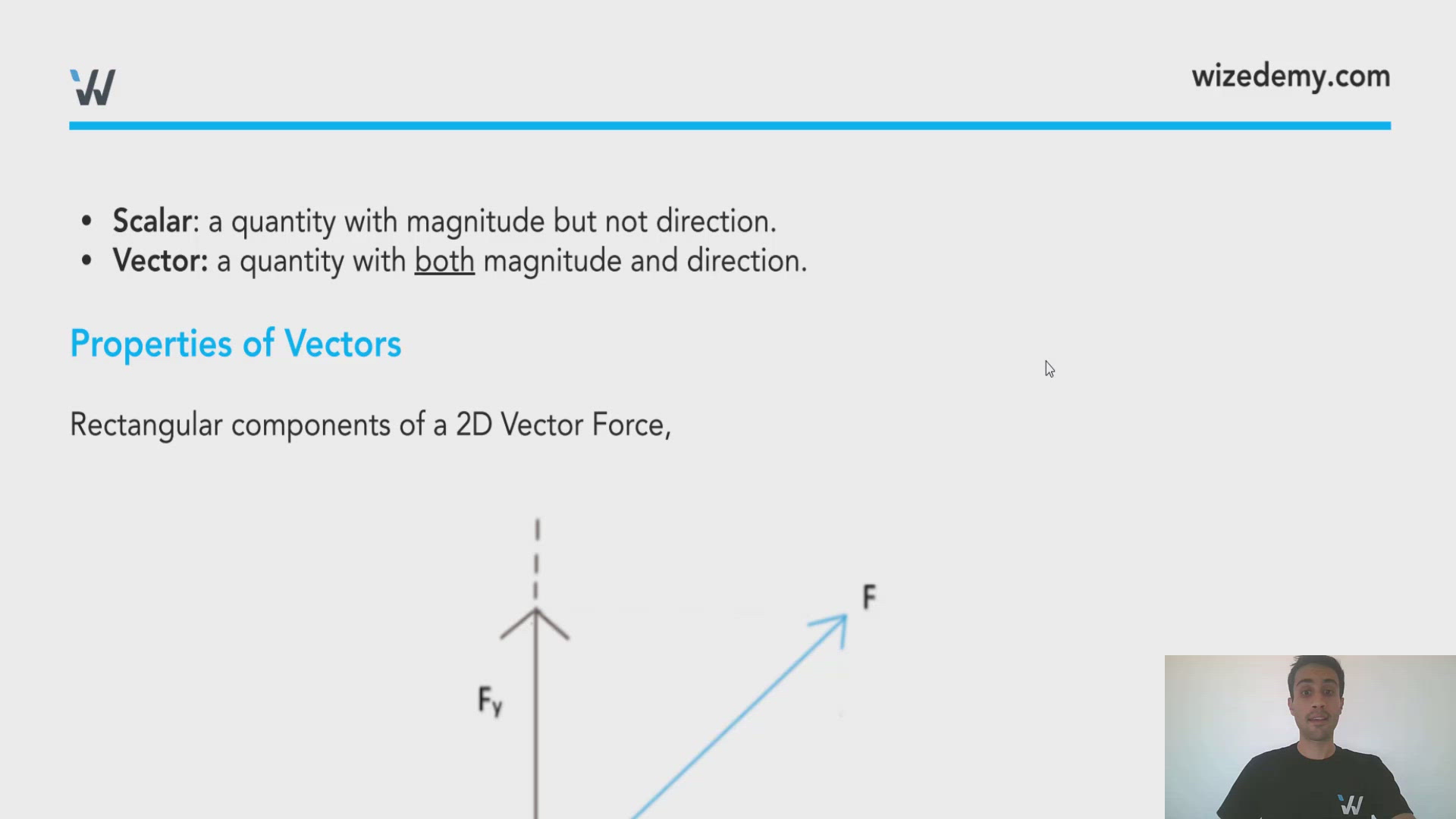
- Scalar: a quantity with magnitude but not direction.
- Vector: a quantity with both magnitude and direction.
Properties of Vectors
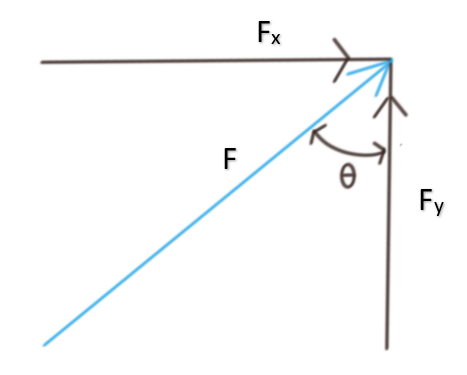
Rectangular components of a 2D Vector Force,

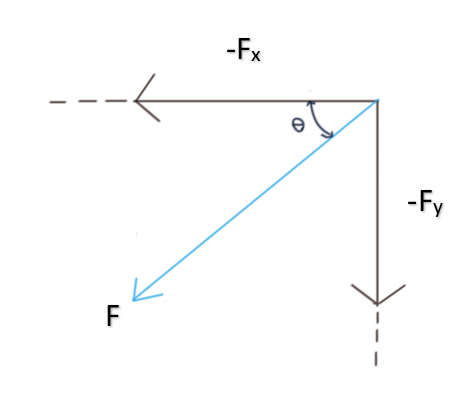
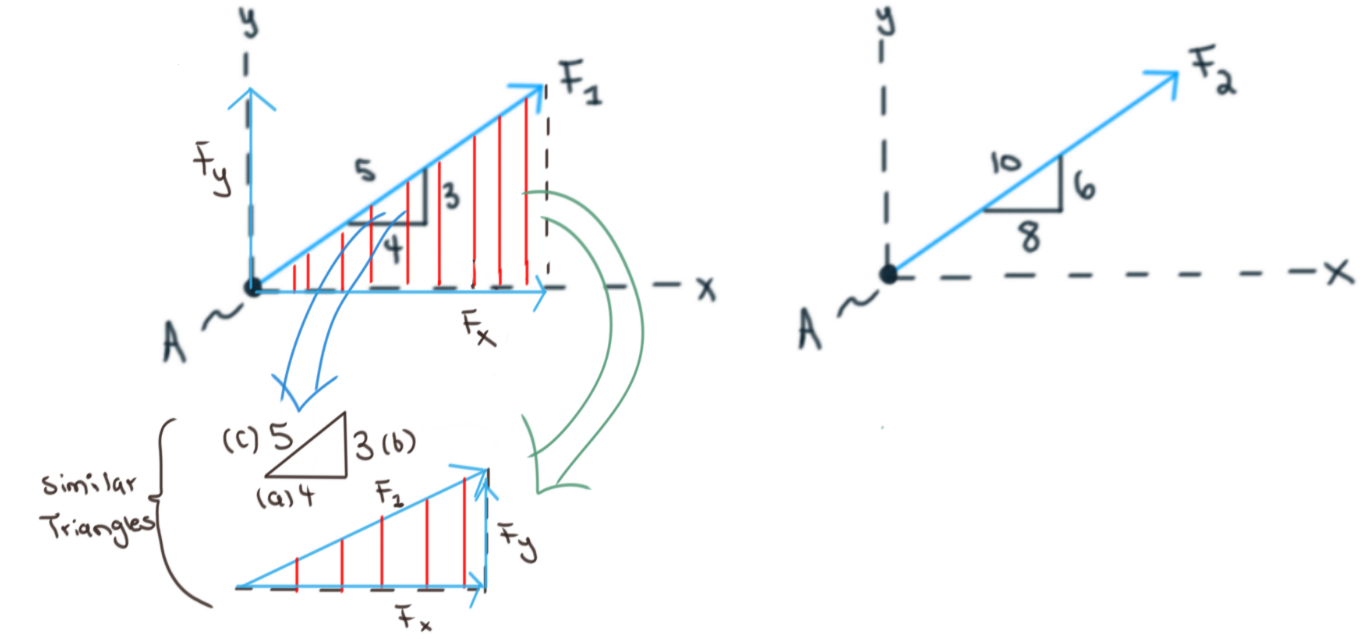
Using a small slope triangle,
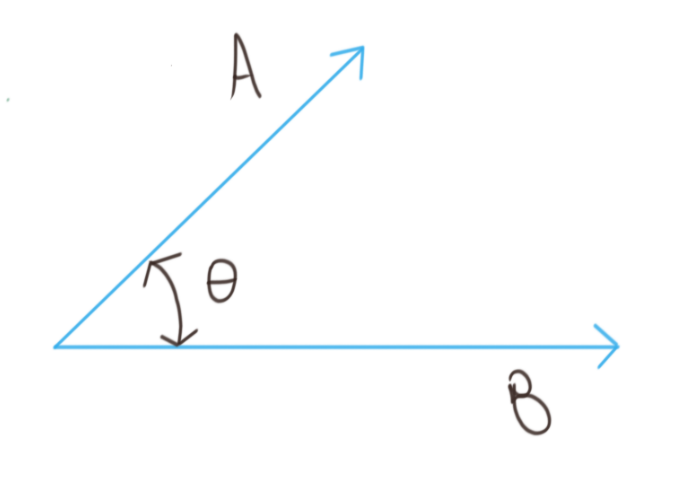
Dot product,
Vector Manipulation
Things you should know:
- How to break down a vector into perpendicular components
- How to break down a vector into non-perpendicular component
- Projecting a vector along a line
- Finding the angle between two vectors
Q: How to break down a vector into perpendicular components?
A: Basic Trigonometric rules, aka. SOH CAH TOA
Q: How to break down a vector into non-perpendicular components?
A: Sine and cosine laws
Q: How to project a vector along a line
A: Using the dot product
Q: Finding the angle between two vectors
A: Modified dot product
0:00 / 0:00
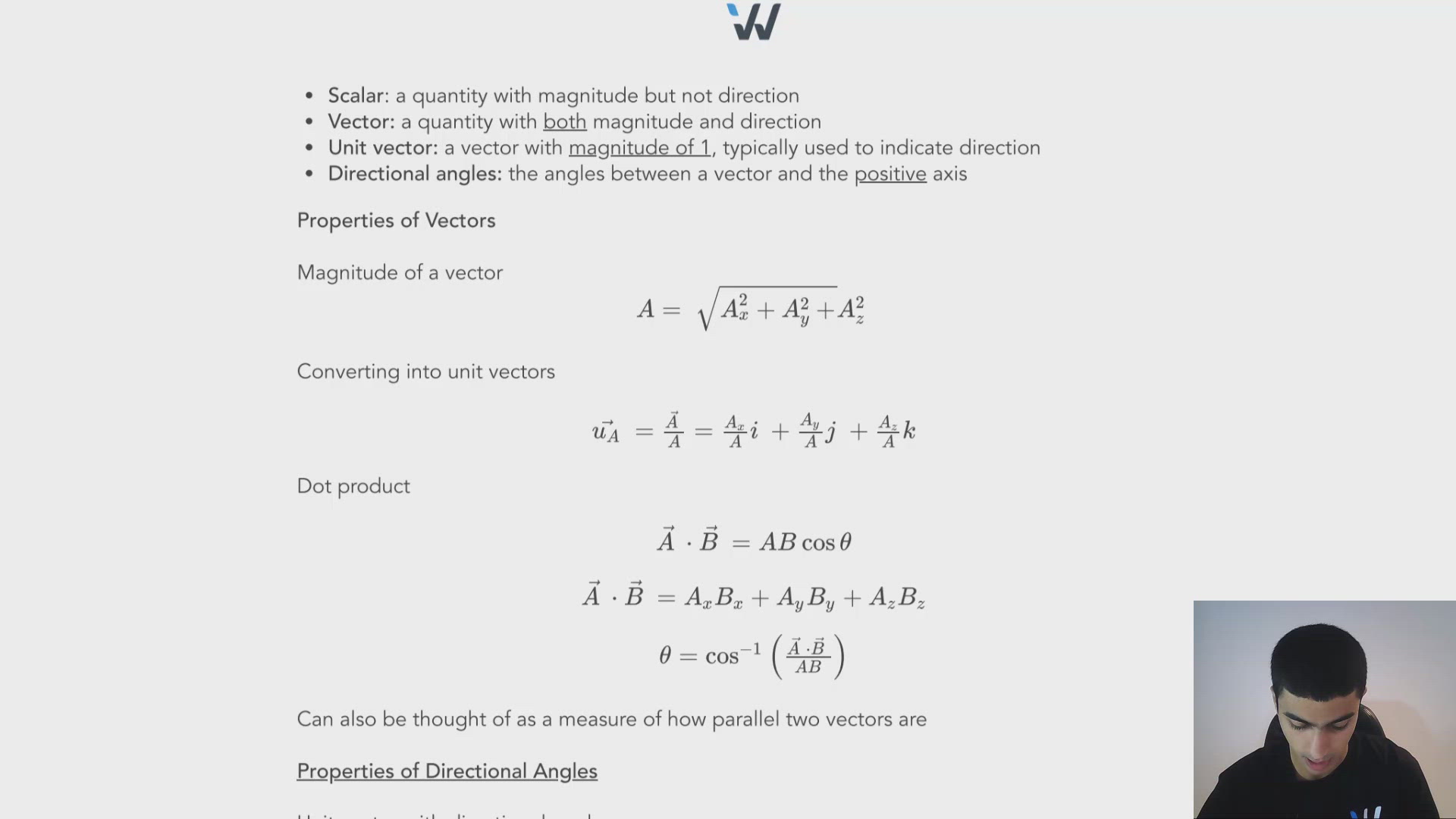
- Scalar: a quantity with magnitude but not direction
- Vector: a quantity with both magnitude and direction
- Unit vector: a vector with magnitude of 1, typically used to indicate direction
- Directional angles: the angles between a vector and the positive axis
Properties of Vectors
Magnitude of a vector
Converting into unit vectors
Dot product
Can also be thought of as a measure of how parallel two vectors are
Properties of Directional Angles
Unit vector with directional angles
Relationship between directional angles
Vector Manipulation
Things you should know:
- How to break down a vector into perpendicular components
- How to break down a vector into non-perpendicular component
- Projecting a vector along a line
- Finding the angle between two vectors
Q: How to break down a vector into perpendicular components?
A: Basic Trigonometric rules, aka. SOH CAH TOA
Q: How to break down a vector into non-perpendicular components?
A: Sine and cosine laws
Q: How to project a vector along a line
A: Using the dot product
Q: Finding the angle between two vectors
A: Modified dot product
0:00 / 0:00
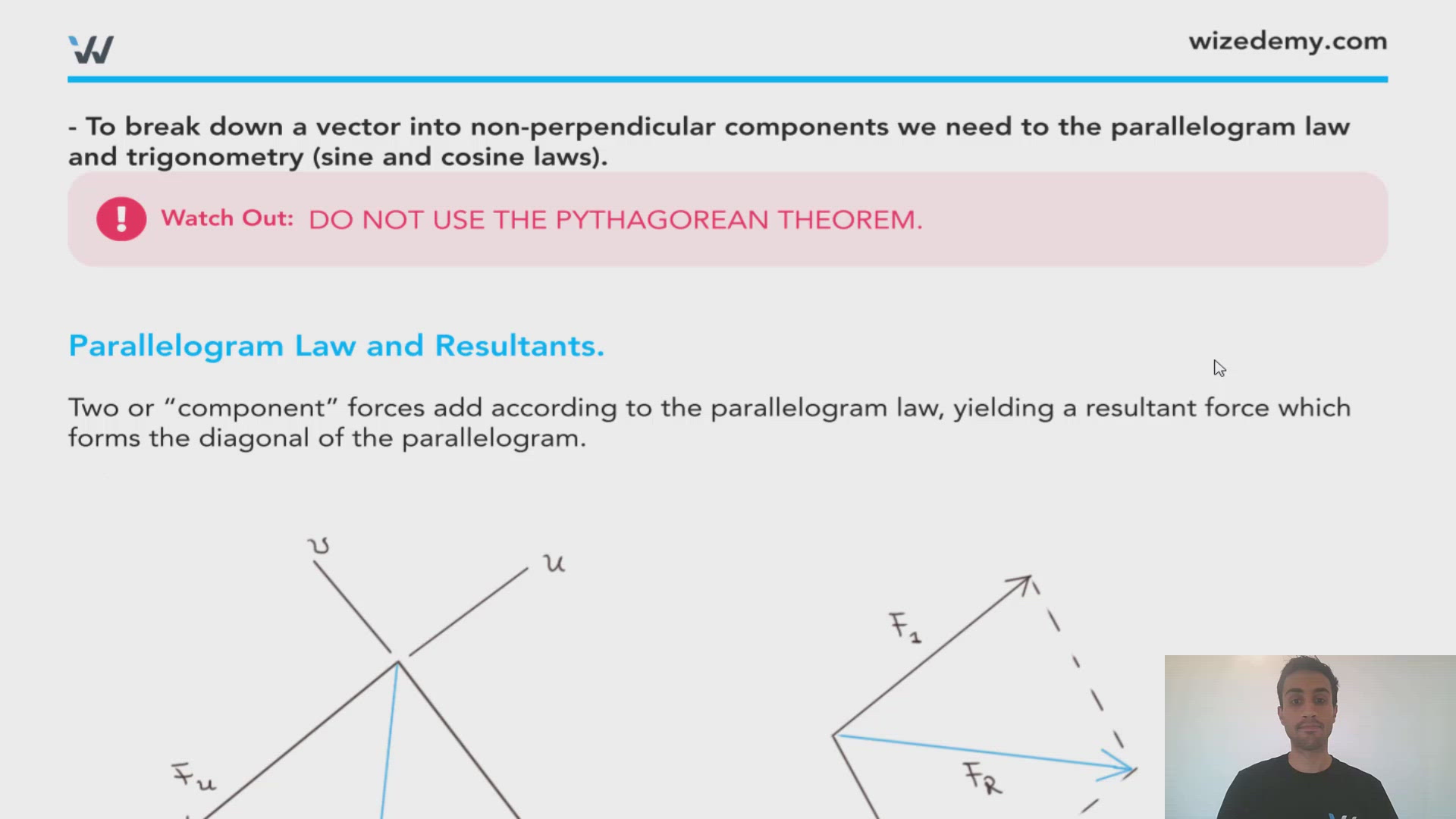
- To break down a vector into non-perpendicular components we need to the parallelogram law and trigonometry (sine and cosine laws).
Watch Out!
DO NOT USE THE PYTHAGOREAN THEOREM.
Parallelogram Law and Resultants.
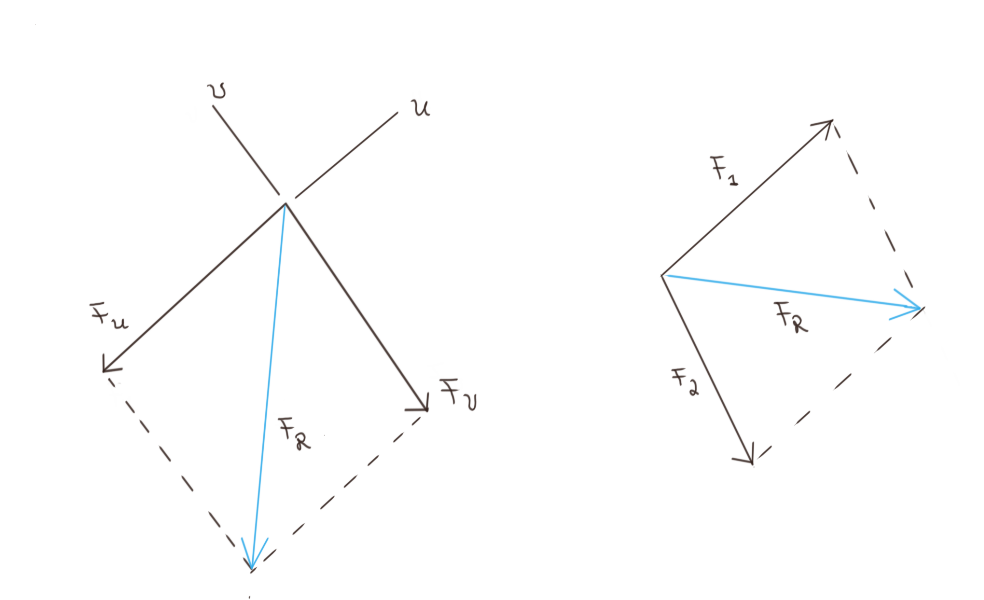
Two or “component” forces add according to the parallelogram law, yielding a resultant force which forms the diagonal of the parallelogram.
Example
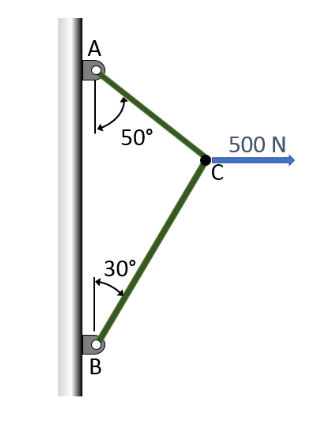
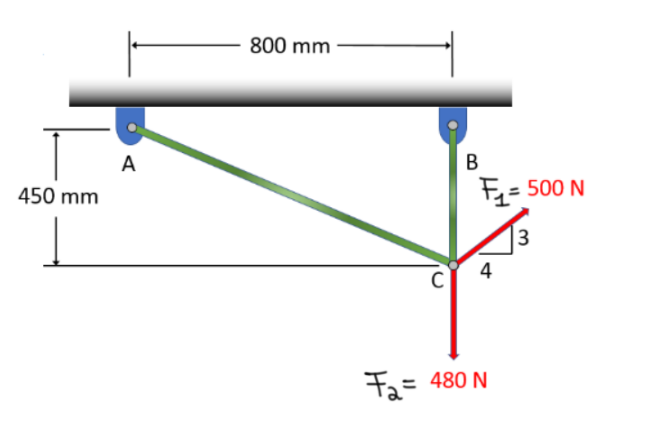
Determine the components of the force along lines AC and BC:
Begin by reconstructing into a triangle:
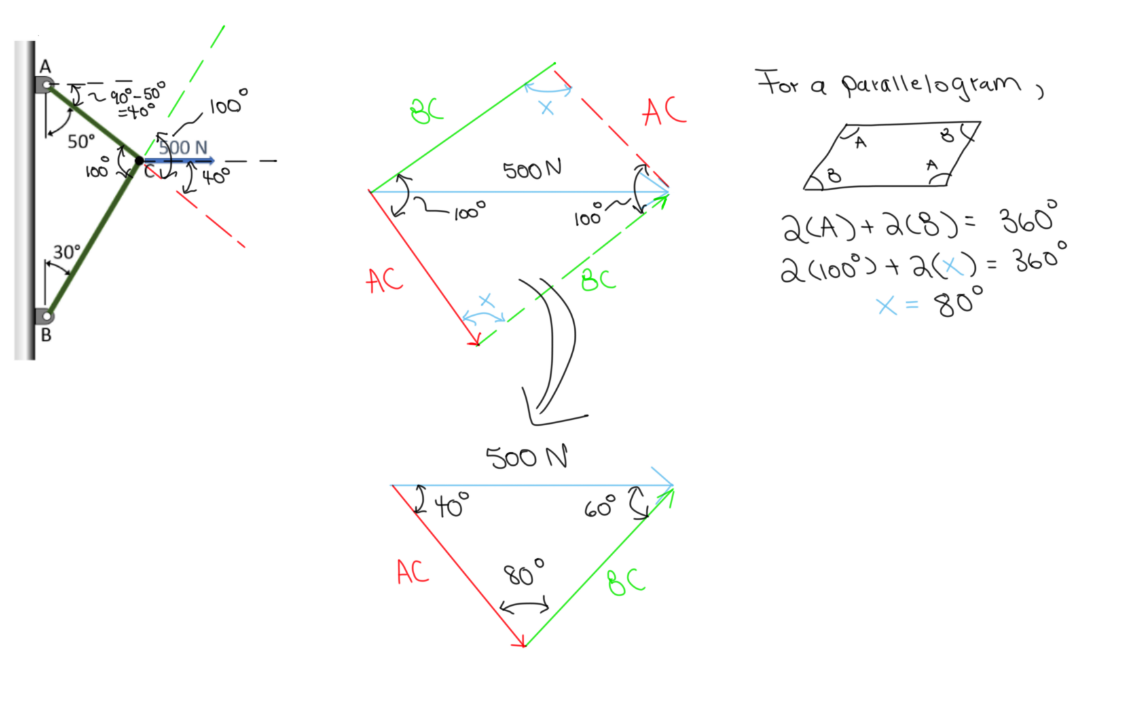
By Sine law:
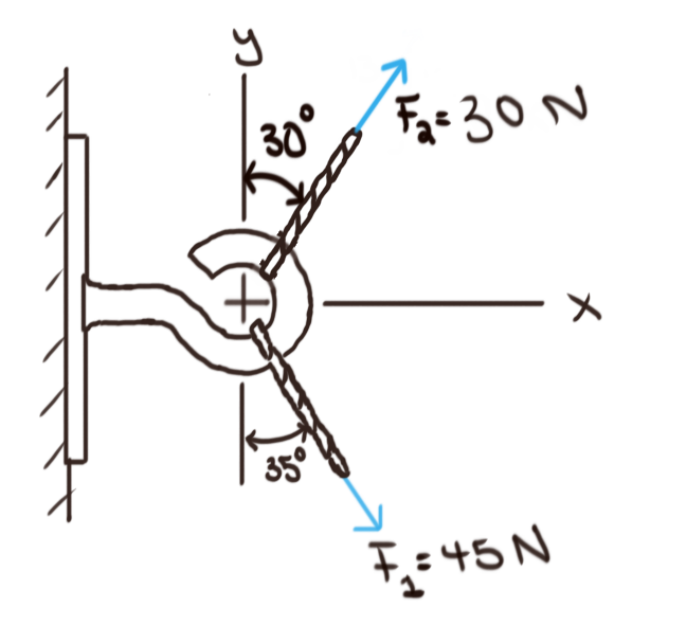
The screw eye illustrated is subjected to two cable forces, as indicated. Determine the equivalent force consisting of a single resultant force.
Practice Question
Determine the resultant force along lines AC and BC:
0:00 / 0:00
Rectangular Components of a Force.
- Can be represented in two ways: Scalar or Cartesian Vector notation.
- To find rectangular components we use the parallelogram law where we resolve the magnitude force into its respective x and y components.
Example (we will come back to this later!)
Resolve F2 and F3 into their respective x and y components.
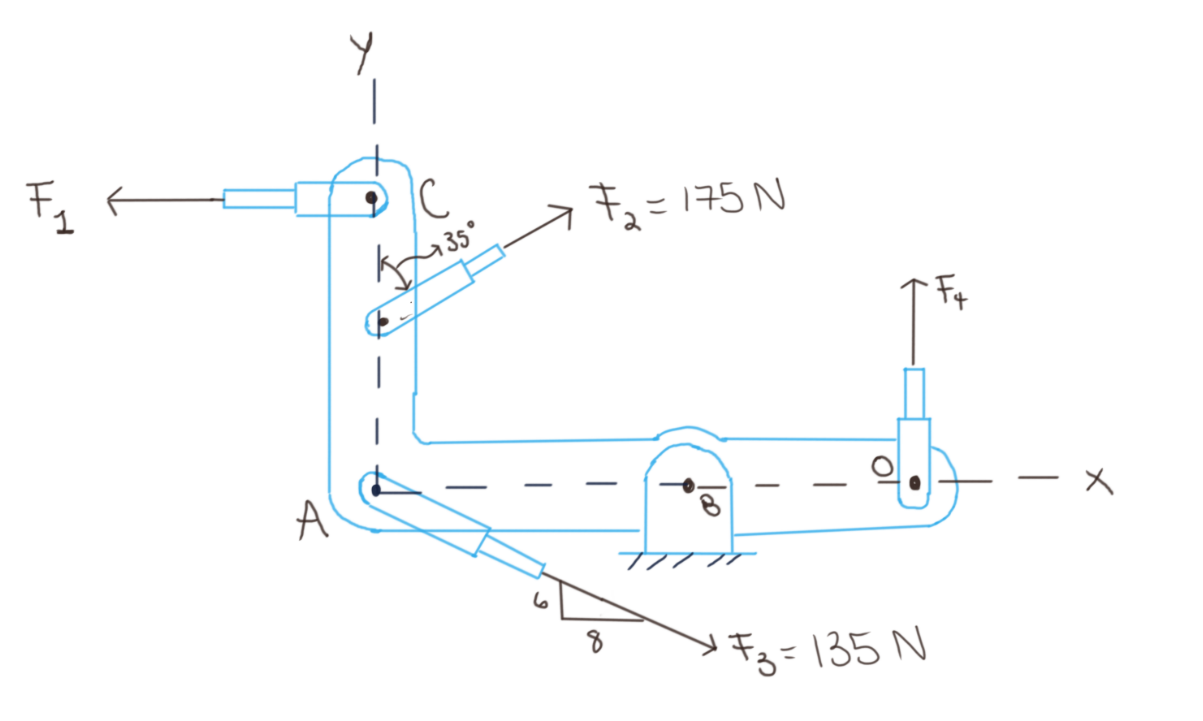
For force vector F2 = 175N,

Figure (a),
Figure (b),
Figure (c),
For force vector F3 = 135N,
We use similar triangles of the given slopes,
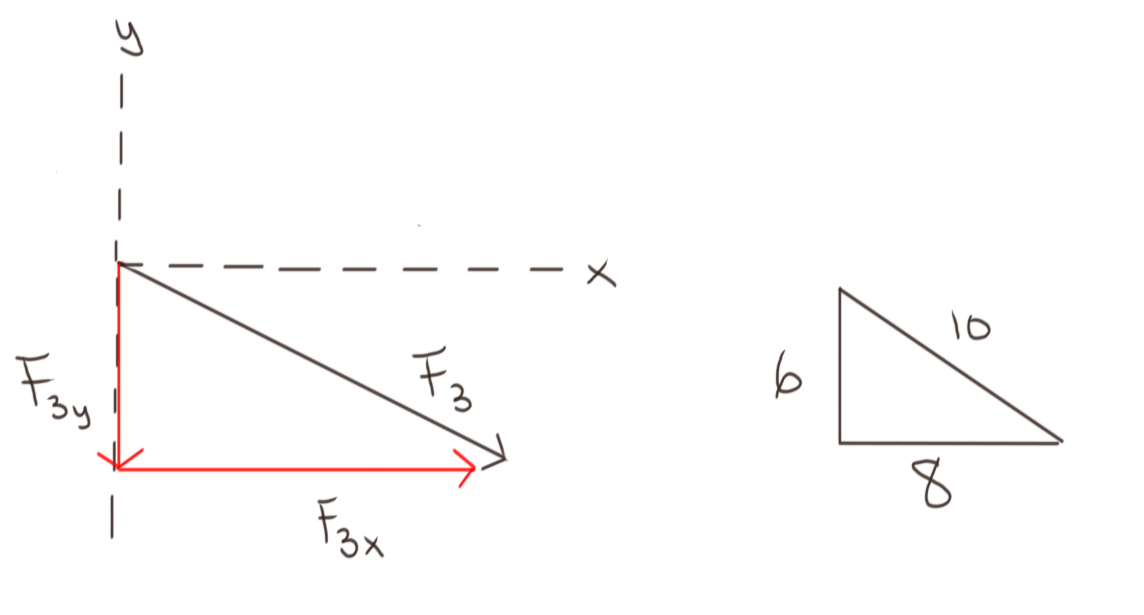
Given Similar Triangles (based on the figure above.)
Cross multiply and solve for F3y,
Cross multiply and solve for F3x,
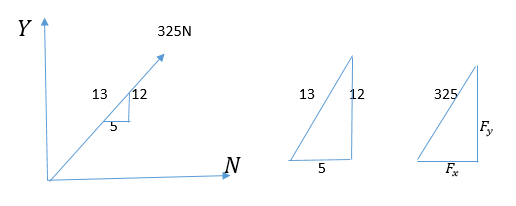
Example
Represent the 325N force into its x and y components.

Practice Question
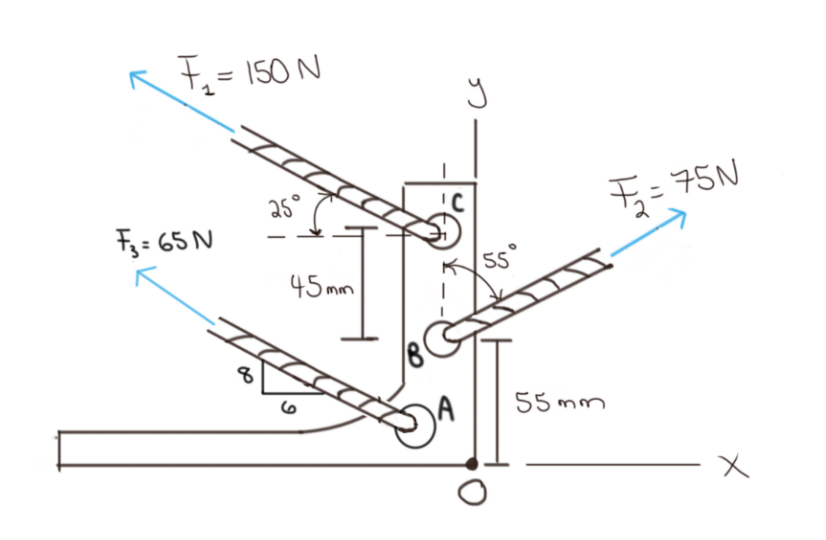
The following bracket illustrated is subjected to three cable forces. Resolve each force into its corresponding x and y components.