Wize University Statics Textbook (Master) > Force Vectors
Things to know about Vectors - Building & Manipulation
Popular Courses
ENGG 130
University of Alberta
CIV100H1
University of Toronto
PCS 211
Toronto Metropolitan University
ENGG 202
University of Calgary
ENGSCI 1022A/B/Y
Western University
GNG 1105
University of Ottawa
PHYS 124
University of Alberta
PCS 120
Toronto Metropolitan University
ENGR 242
Concordia University
PHYS 117
University of British Columbia
PHYC 1190
Dalhousie University
ENGG 212
University of Calgary
ENGR 141
University of Victoria
PHYS-1300
University of Windsor
PHY 1121
University of Ottawa
CE 221
Michigan State University
PHY 1124
University of Ottawa
PHYS 121
University of Waterloo
PHYS 227
University of Calgary
GENG-1110
University of Windsor
0:00 / 0:00
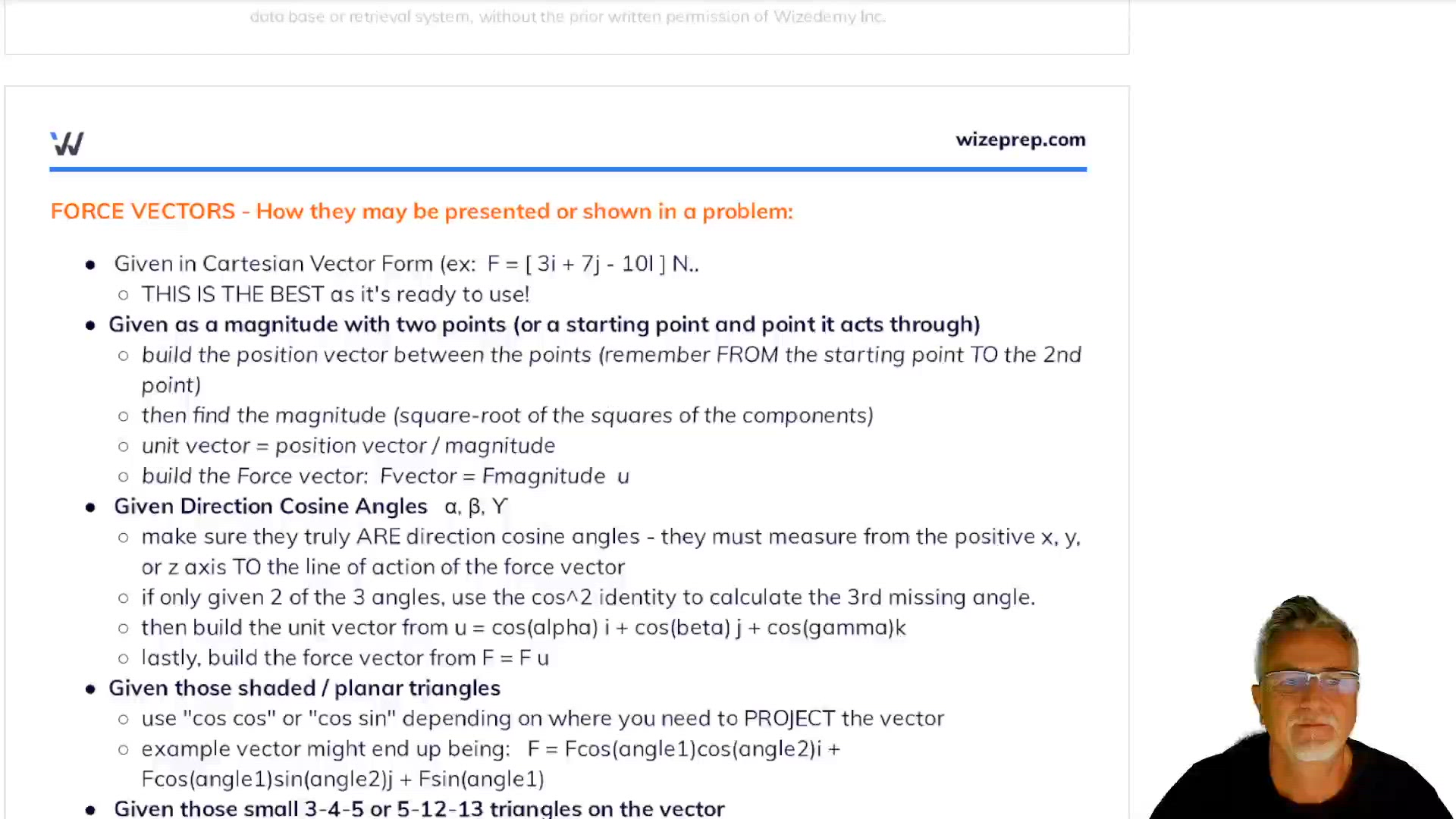
FORCE VECTORS - How they may be presented or shown in a problem:
- Given in Cartesian Vector Form (ex: F = [ 3i + 7j - 10l ] N..
- THIS IS THE BEST as it's ready to use!
- Given as a magnitude with two points (or a starting point and point it acts through)
- build the position vector between the points (remember FROM the starting point TO the 2nd point)
- then find the magnitude (square-root of the squares of the components)
- unit vector = position vector / magnitude
- build the Force vector: Fvector = Fmagnitude u
- Given Direction Cosine Angles α, β, ϒ
- make sure they truly ARE direction cosine angles - they must measure from the positive x, y, or z axis TO the line of action of the force vector
- if only given 2 of the 3 angles, use the cos^2 identity to calculate the 3rd missing angle.
- then build the unit vector from u = cos(alpha) i + cos(beta) j + cos(gamma)k
- lastly, build the force vector from F = F u
- Given those shaded / planar triangles
- use "cos cos" or "cos sin" depending on where you need to PROJECT the vector
- example vector might end up being: F = Fcos(angle1)cos(angle2)i + Fcos(angle1)sin(angle2)j + Fsin(angle1)
- Given those small 3-4-5 or 5-12-13 triangles on the vector
- either find the angle you need to use sin/cos -OR- use the ratio instead of cos(angle), etc.
- then build the force vector.
Other things you should know how to do / deal with:
- How to break down a vector into perpendicular or rectangular components
- use: Basic Trigonometric rules, aka. SOH CAH TOA
- How to break down a vector into non-perpendicular component (in non-right triangles)
- use: Law of Sine & Law of Cosine
- Projecting a vector along a line
- use: Use the dot product
- Finding the angle between two vectors
- Modified dot product