Wize University Physiology Textbook > Cardiovascular Physiology
Vascular Function
Popular Courses
MCAT
General Course
DAT
General Course
Grade 11 Biology
Ontario High School
Grade 11 Biology
Canada High School
Intro to Physiology
University Study Guides
PHYSIOL 1021
Western University
Biology 20
Alberta High School
PHYSIOL 2130
Western University
Intro to Physiology
University Study Guides
PSL300H1
University of Toronto
PHYSL 210
University of Alberta
Life Sciences 11
British Columbia High School
PHGY 210
McGill University
PHGY 215
Queen's University
KNES 259
University of Calgary
PHGY 216
Queen's University
BIOL 273
University of Waterloo
BIOL 260
University of British Columbia
PHYSIOL 3120
Western University
KNES 260
University of Calgary
0:00 / 0:00
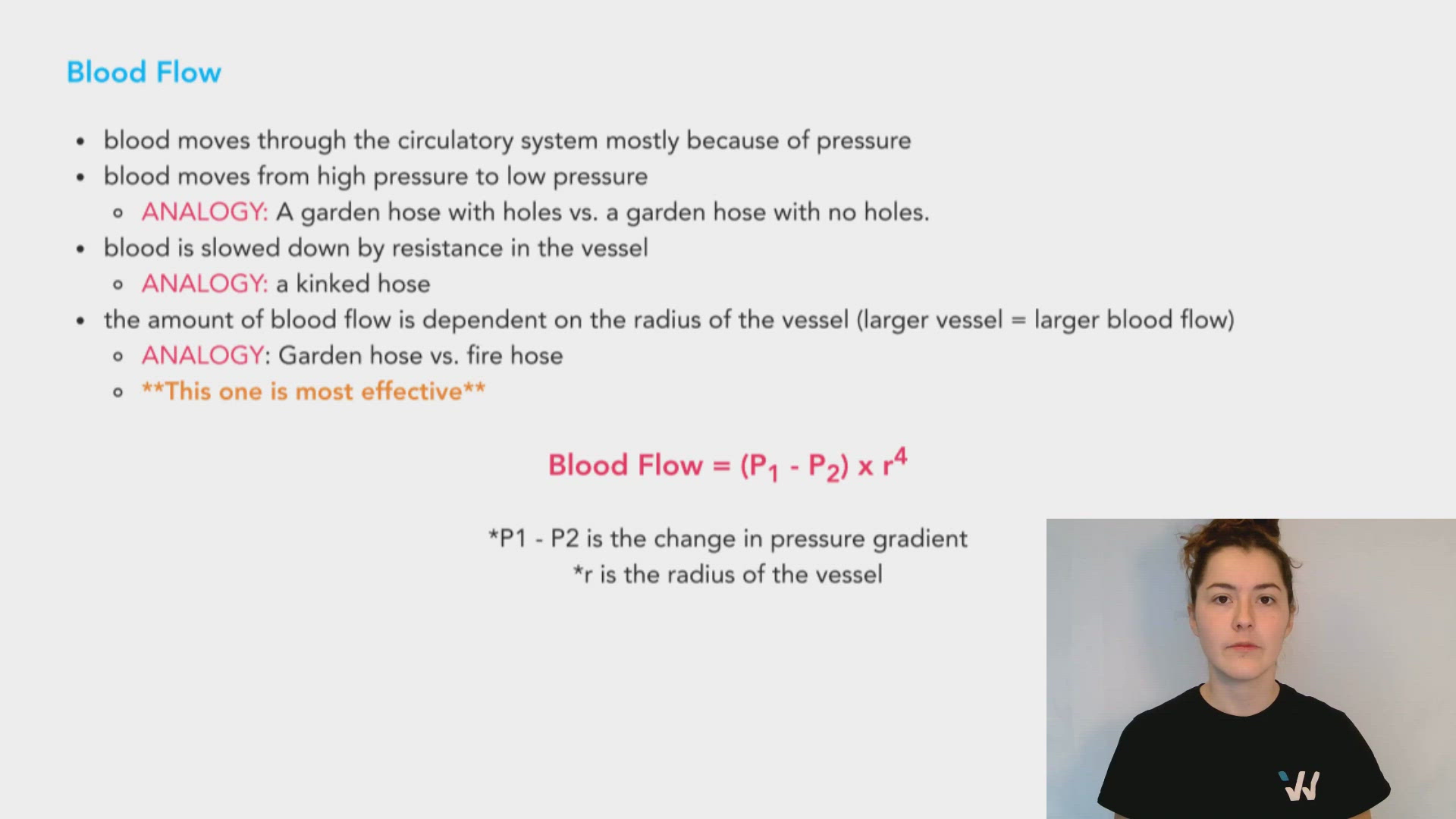
Blood Flow
- blood moves through the circulatory system mostly because of pressure
- blood moves from high pressure to low pressure
- ANALOGY: A garden hose with holes vs. a garden hose with no holes.
- blood is slowed down by resistance in the vessel
- ANALOGY: a kinked hose
- the amount of blood flow is dependent on the radius of the vessel (larger vessel = larger blood flow)
- ANALOGY: Garden hose vs. fire hose
- **This one is most effective**
Blood Flow = (P1 - P2) x r4
*P1 - P2 is the change in pressure gradient
*r is the radius of the vessel
Blood Vessels
- arteries (arterioles) – carry blood away from the heart towards capillaries
- capillaries – microscopic vessels penetrate tissues, single layer of cells for exchange between blood and interstitial fluid
- veins (venules) – return blood to heart from capillaries
Blood Pressure
- highest close to the heart where all the blood is pushed through a single artery/vein
- lowest at the capillaries because they have such a high surface area

You are running an experiment in a lab in research of blood flow in arterioles. You set up one large tube to represent the artery which drains into 3 smaller tubes which represent the arterioles. You note the pressure gradient through all three arterioles is the same. If you wanted lower blood flow in one of the arterioles without altering the pressure gradient, what could you do?
0:00 / 0:00
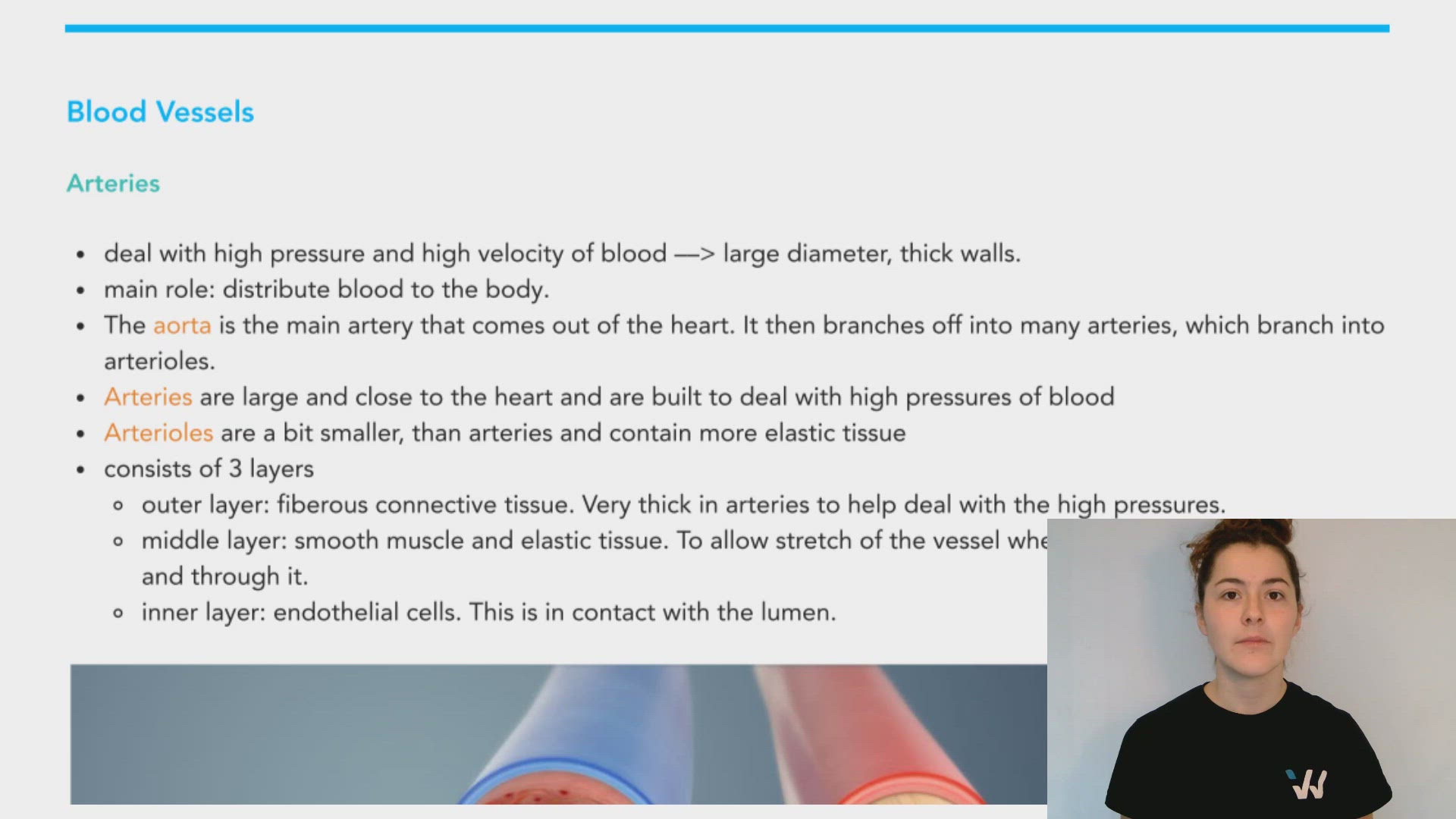
Blood Vessels
Arteries
- deal with high pressure and high velocity of blood ––> large diameter, thick walls.
- main role: distribute blood to the body.
- The aorta is the main artery that comes out of the heart. It then branches off into many arteries, which branch into arterioles.
- Arteries are large and close to the heart and are built to deal with high pressures of blood
- Arterioles are a bit smaller than arteries and contain more elastic tissue
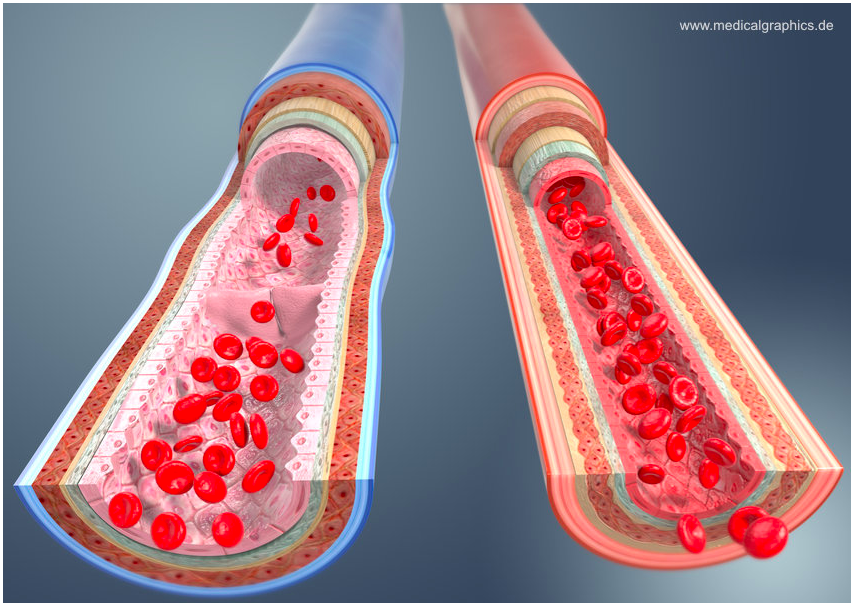
- consists of 3 layers
- outer layer: fiberous connective tissue. Very thick in arteries to help deal with the high pressures.
- middle layer: smooth muscle and elastic tissue. To allow stretch of the vessel when lots of blood is pumped in and through it.
- inner layer: endothelial cells. This is in contact with the lumen.
Capillaries
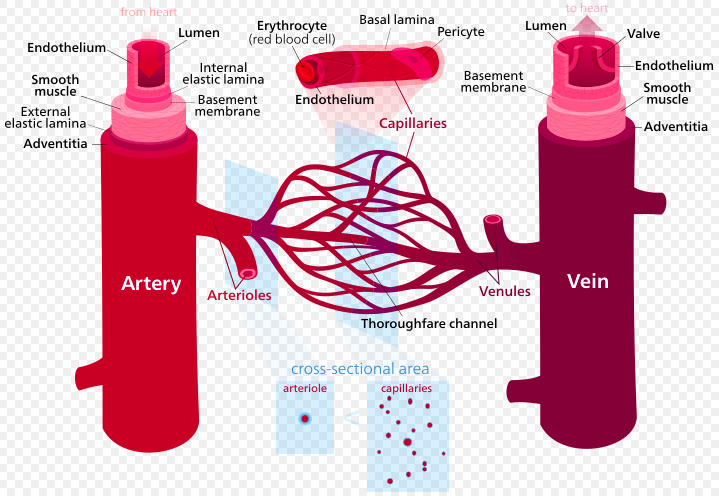
- main role: to exchange material from the blood with the tissues of the body.
- only a single endothelial layer in wall thickness.
- very tiny diameter ––> RBC must line up in single file to get through
- very slow velocity of blood ––> this is so there can be proper exchange of materials
Veins
- main role: blood collection from capillaries so it can get back to the heart.
- largest veins at the heart: superior vena cava and inferior vena cava
- after the capillary bed we have venules, followed by veins (larger)
- contain valves - The pressure is low in veins and venules. The valves prevent back flow of blood and keep it moving towards the heart.
Comparisons
As capillaries converge into fewer vein vessels, what would you most likely see?
0:00 / 0:00
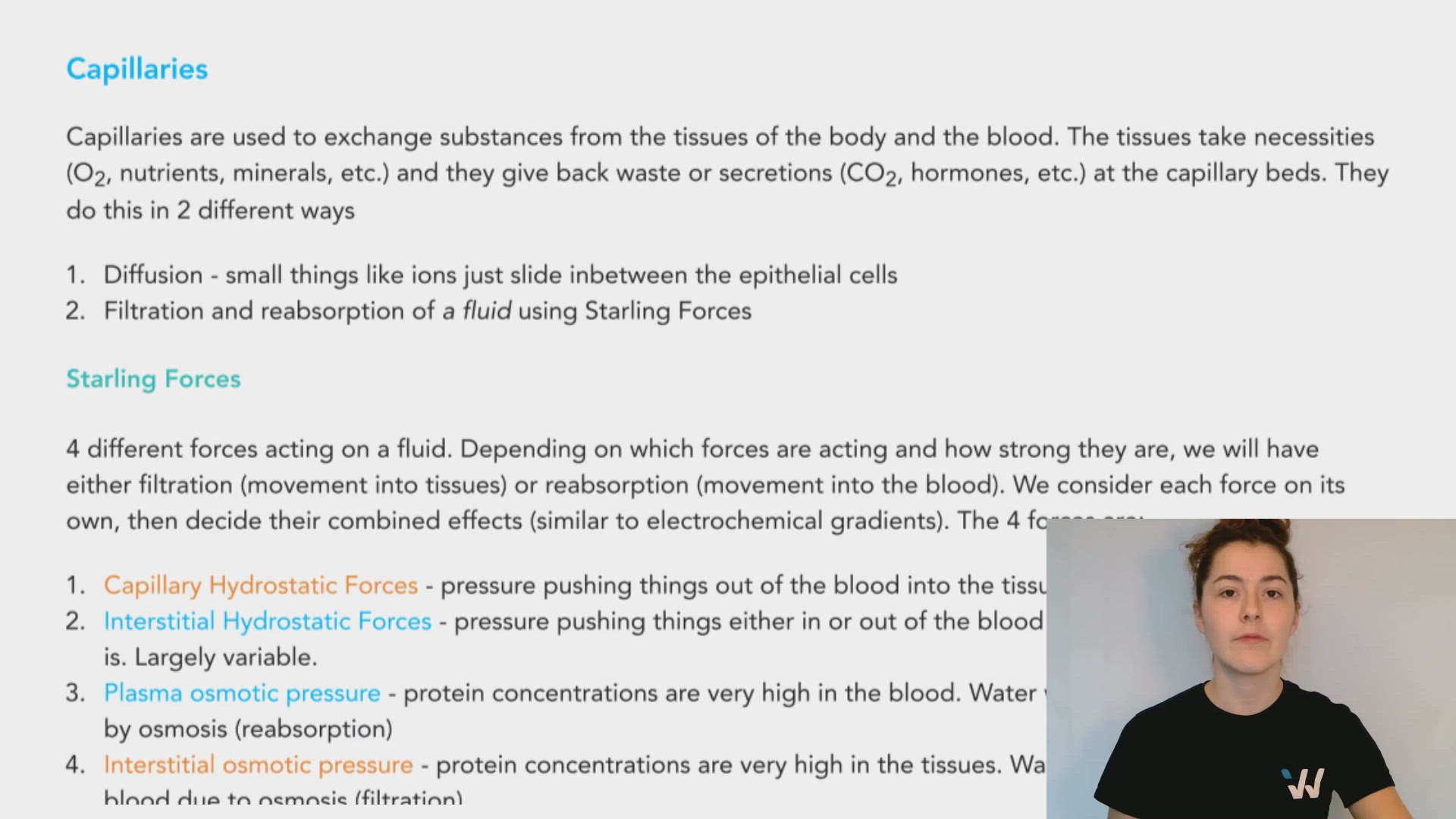
Capillaries
Capillaries are used to exchange substances from the tissues of the body and the blood. The tissues take necessities (O2, nutrients, minerals, etc.) and they give back waste or secretions (CO2, hormones, etc.) at the capillary beds. They do this in 2 different ways.
- Diffusion - small things like ions just slide between the epithelial cells
- Filtration and reabsorption of fluids using Starling Forces
Starling Forces
4 different forces acting on a fluid. Depending on which forces are acting and how strong they are, we will have either filtration (movement into tissues) or reabsorption (movement into the blood). We consider each force on its own, then decide their combined effects (similar to electrochemical gradients). The 4 forces are:
- Capillary Hydrostatic Forces - pressure pushing things out of the blood into the tissues
- Interstitial Hydrostatic Forces - pressure pushing things either into the blood out of the tissue. Largely variable.
- Plasma osmotic pressure - protein concentrations are very high in the blood. Water will be drawn into the blood by osmosis (reabsorption)
- Interstitial osmotic pressure - protein concentrations are very high in the tissues. Water will be drawn out of the blood due to osmosis (filtration)
*forces pushing things out of blood
*forces that can push things into the blood
*Kf is the filtration coefficient (usually 1)
*a positive number signifies filtration
*a negative number signifies reabsorption
Starling Calculation Steps
Step 1: assume Kf = 1
Step 2: fill in numbers into correct place
Step 3: calculate within both sets of brackets
Step 4: calculate within big brackets
Step 5: don't forget the units! (mmHg)
Step 6: determine which direction it moves. Positive means it goes out of the capillary (filtration), negative means it goes in (absorption)

Mark Yourself Question
- Grab a piece of paper and try this problem yourself.
- When you're done, check the "I have answered this question" box below.
- View the solution and report whether you got it right or wrong.
A capillary bed has the following Starling Force quantities:
Capillary pressure: 15mmHg
Interstitial Fluid pressure: -3
Plasma osmotic pressure: 10mmHg
Interstitial Fluid osmotic pressure: 25mmHg
What is the net fluid movement and which direction will it move?