Wize University Statistics Textbook > Probability
Introduction to Probability
Popular Courses
MATH 208
Concordia University
COMM 214
Concordia University
STAT 151
University of Alberta
AP Statistics Exam Prep Course
AP Exam Prep
Statistics
General Course
Intro to Statistics
University Study Guides
COMM 215
Concordia University
Geometry
US High School
STAT 213
University of Calgary
DATASCI 1000A/B
Western University
STA 100
University of California - Davis
Grade 12 Data Management
Ontario High School
High School Statistics
US High School
STAT 200
University of British Columbia
Intro to Statistics
University Study Guides
STATS 2035
Western University
STAT 161
University of Alberta
STAT 263
Queen's University
STAT*2040
University of Guelph
ENDG 319
University of Calgary

0:00 / 0:00
Events & Sample Spaces
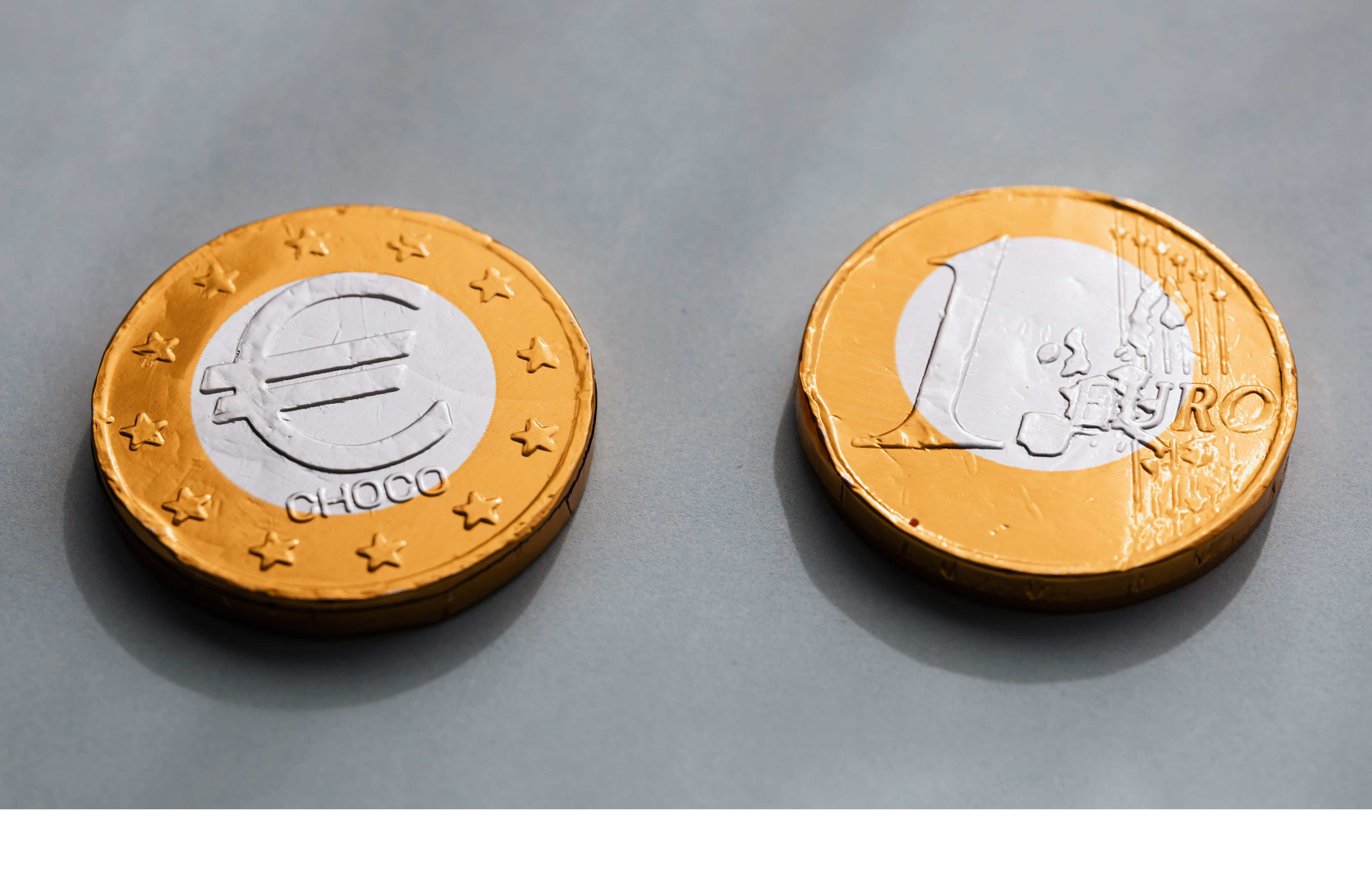
Experiment - process where you observe or measure the outcome, and the outcome cannot be predicted with certainty - it happens by chance
Trial - one run of the experiment
Event - a subset (combination) of outcomes that you are interested in (e.g. Event A, Event B...)
Sample space - a set of descriptions (S) that cover all possible outcomes of the experiment
Sample Space Examples
- Flipping a coin S = {Heads, Tails}
- Rolling a dice and flipping a coin S = {(1&H), (2&H), (3&H), (4&H), (5&H), (6&H), (1&T), (2&T), (3&T), (4&T), (5&T), (6&T)}

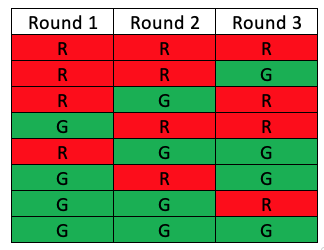
- Drawing a ball from a bag with 1 Red and 1 Green ball (repeating with replacement 3 times) S = {RRR, RRG, RGR, GRR, RGG, GRG, GGR, GGG} these are all the possible outcomes

0:00 / 0:00
Types of Probability
The probability of an event E is the chance or likelihood that the event E will happen is denoted by .
Theoretical Probability
It is calculated by dividing the number of desired outcomes by the total number of all possible outcomes that could occur in theory.
The theoretical probaiblity that event E occurs is
Example
- You flip an ordinary coin twice.
- The sample space (a set showing all possible outcomes) is .
- The probability that you get tails twice is
Relative Probability
It is calculated by dividing the number of desired outcomes by the number of trials in an actual experiment.
The relative probability that event E occurs is
Example
- We toss an ordinary coin 200 times (# trials) and get heads 60 times (# observations).
- Based on this experiment, we conclude that the probability of heads is
- Since the probabilities of 'Heads' and 'Tails', in this experiment, are not equally likely (i.e. the events have equal probability), then we consider this an unfair or biased coin.
In the long run with infinitely many trials, the relative probability will approach closer and closer to the theoretical probability (actual probability). This is called the Law of Large Numbers.
Subjective Probability
It is the probability that’s guessed by an individual based on their knowledge.
Example
- You believe that you will ace your exam after this session with a 70% probability.
0:00 / 0:00
Probability Language & Notation
Union
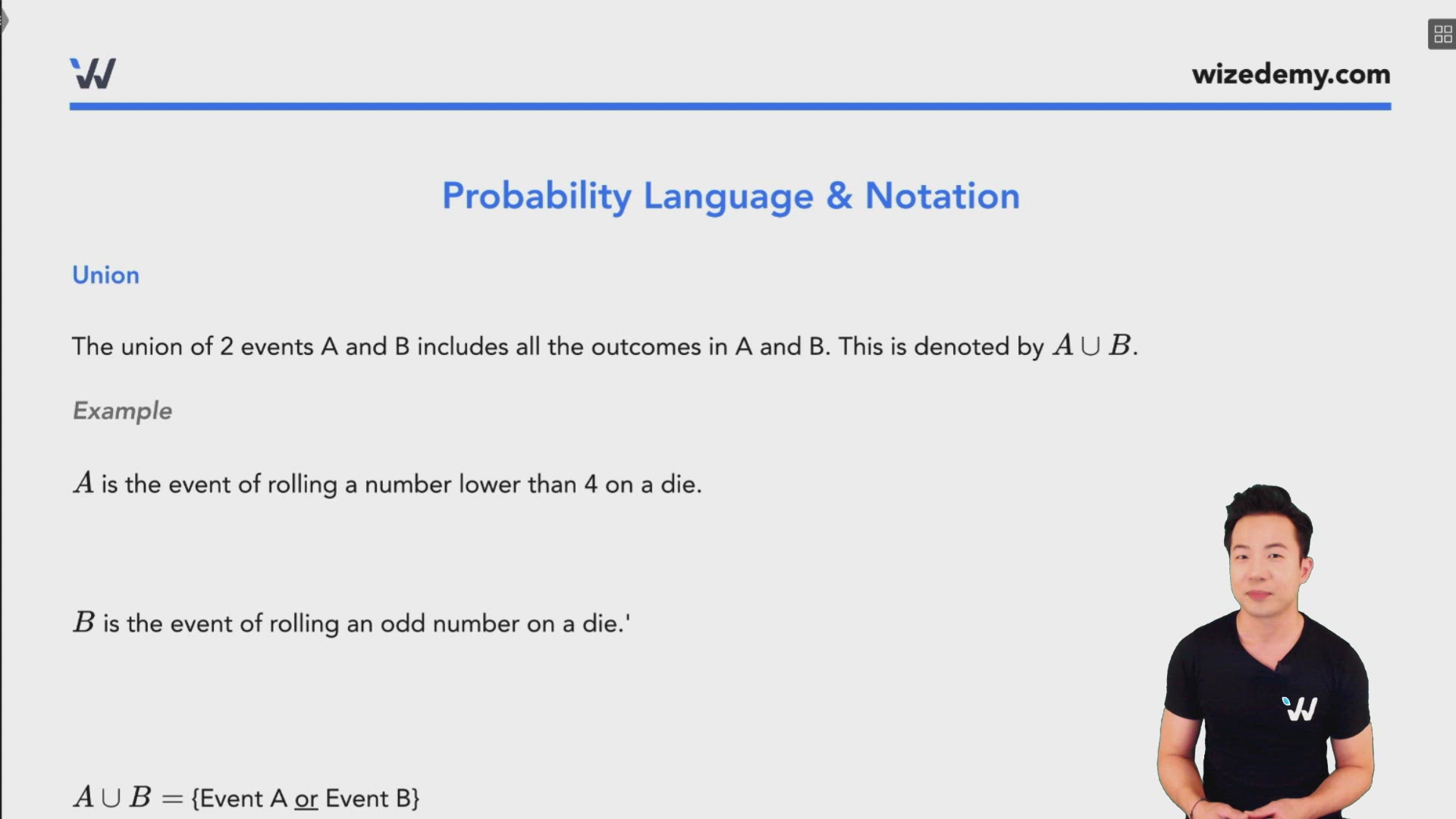
The union of 2 events A and B includes all the outcomes in A and B. This is denoted by .
Example
is the event of rolling a number lower than 4 on a die.
is the event of rolling an odd number on a die.'
{Event A or Event B}
Notice that we listed '1' and '3' only once each.
Wize Tip
The keyword associated with unions is "or".
Intersection
The intersection of 2 events A and B includes all the outcomes that are overlapping in both A and B. This is denoted by .
Example
is the event of rolling a number lower than 4 on a die.
is the event of rolling an odd number on a die.
{Event A and Event B}
Notice that only '1' and '3" overlap in both events.
Wize Tip
The keyword associated with intersections is "and"
Complement
The complement of Event A includes all the outcomes that are not in Event A. This is denoted by or or .
Examples
is the event of rolling an even number on a die.
is the event of not rolling an even number on a die
is the event that you pass your exam
is the event that that you do not pass your exam
the event that two people will get along
is the event that two people will not get along

0:00 / 0:00
Example: Probability Language
Consider these sets:
Find the following:
{1, 2}
{1, 2, 3, 4, 5, 6}
{6}

0:00 / 0:00
Independent vs. Mutually Exclusive Events
Independent Events
Events A and B are independent if the occurrence of one does not affect the probability of the other to occur.
Example
Flipping "heads" from a coin does not affect the probability of rolling a "5" on a die; it's still P("5") =
Mutually Exclusive Events (a.k.a. Disjoint)
Events A and B are mutually exclusive if they cannot both occur at the same time.
Note: ( the empty set)
Example 1
A John was a home with his wife at 5pm
B John was at the bank at 5pm
It is impossible for A and B to occur at the same time mutually exclusive
Example 2
A Susan can't find her keys.
B Susan spills her coffee.
It is possible for both A and B to occur not mutually exclusive
0:00 / 0:00
Example: Independent Events
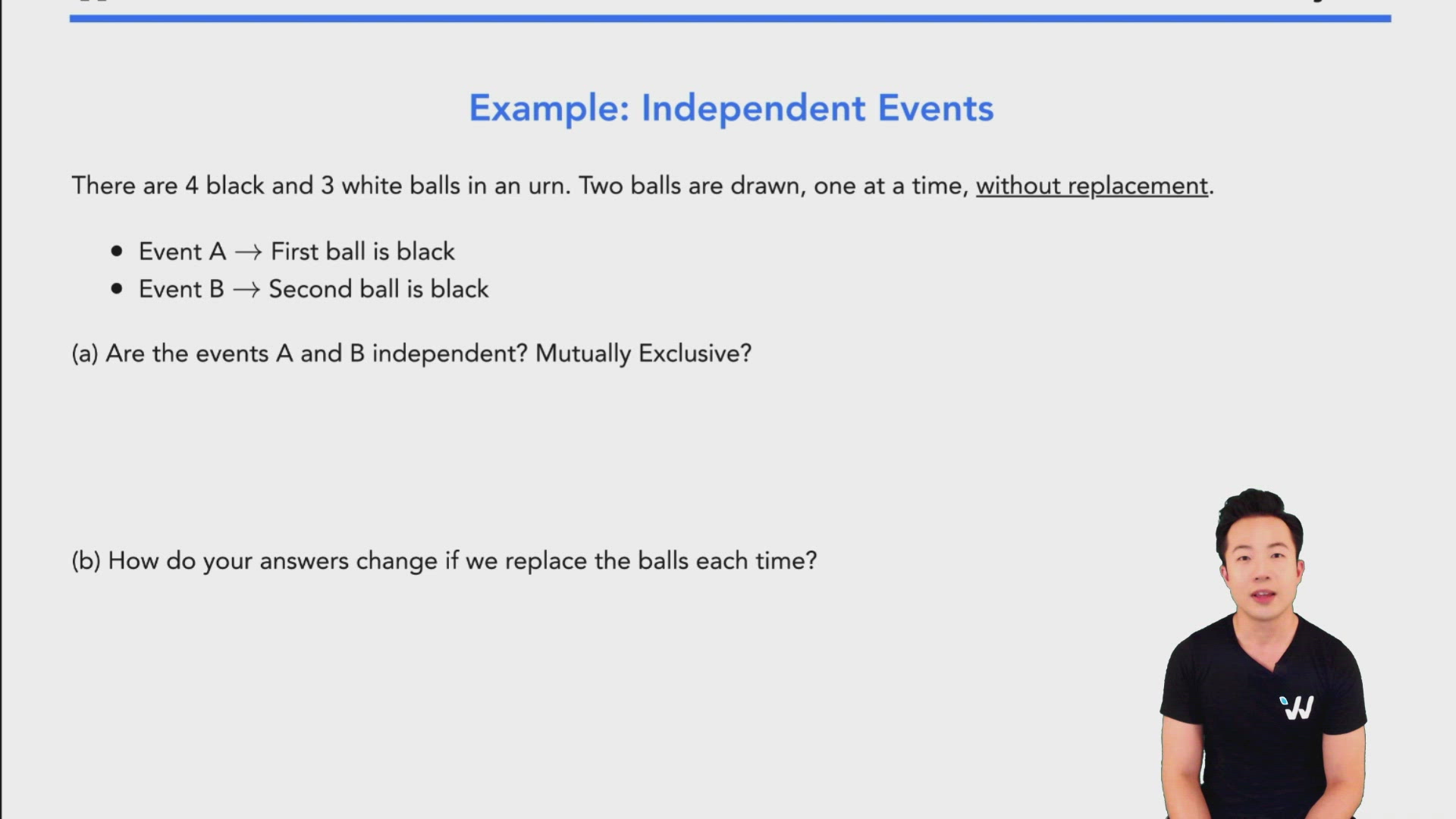
There are 4 black and 3 white balls in an urn. Two balls are drawn, one at a time, without replacement.
- Event A First ball is black
- Event B Second ball is black
(a) Are the events A and B independent? Mutually Exclusive?
A and B affect each other so they are not independent.
They can both happen so not mutually exclusive.
(b) How do your answers change if we replace the balls each time?
By replacing them the events are independent because Event A will not affect Event B, but they still are not mutually exclusive because they can both still happen.
Independent vs. Mutually Exclusive Events
You have two fair dice: Die #1 and Die #2.
Let Event A = the sum of the two dice is an odd number
Let Event B = the dice are the same number
Which of the following is true? (Check all the apply.)