Wize University Statistics Textbook > Discrete Random Variables
Linear Transformation of Data
Popular Courses
AP Statistics Exam Prep Course
AP Exam Prep
Statistics
General Course
Intro to Statistics
University Study Guides
COMM 191
University of British Columbia
STA 100
University of California - Davis
Grade 12 Data Management
Ontario High School
Intro to Statistics
University Study Guides
STAT 161
University of Alberta
ECON 221
Concordia University
STAT 251
University of British Columbia
COMM 162
Queen's University
Grade 12 Statistics
Canada High School
MATH 203
McGill University
STA 2391
University of Ottawa
STAT-2910
University of Windsor
Stats 8
Oregon State
STAT 1000
University of Manitoba
ENGR 371
Concordia University
STAT 252
University of Victoria
COMM 1503
Dalhousie University
0:00 / 0:00
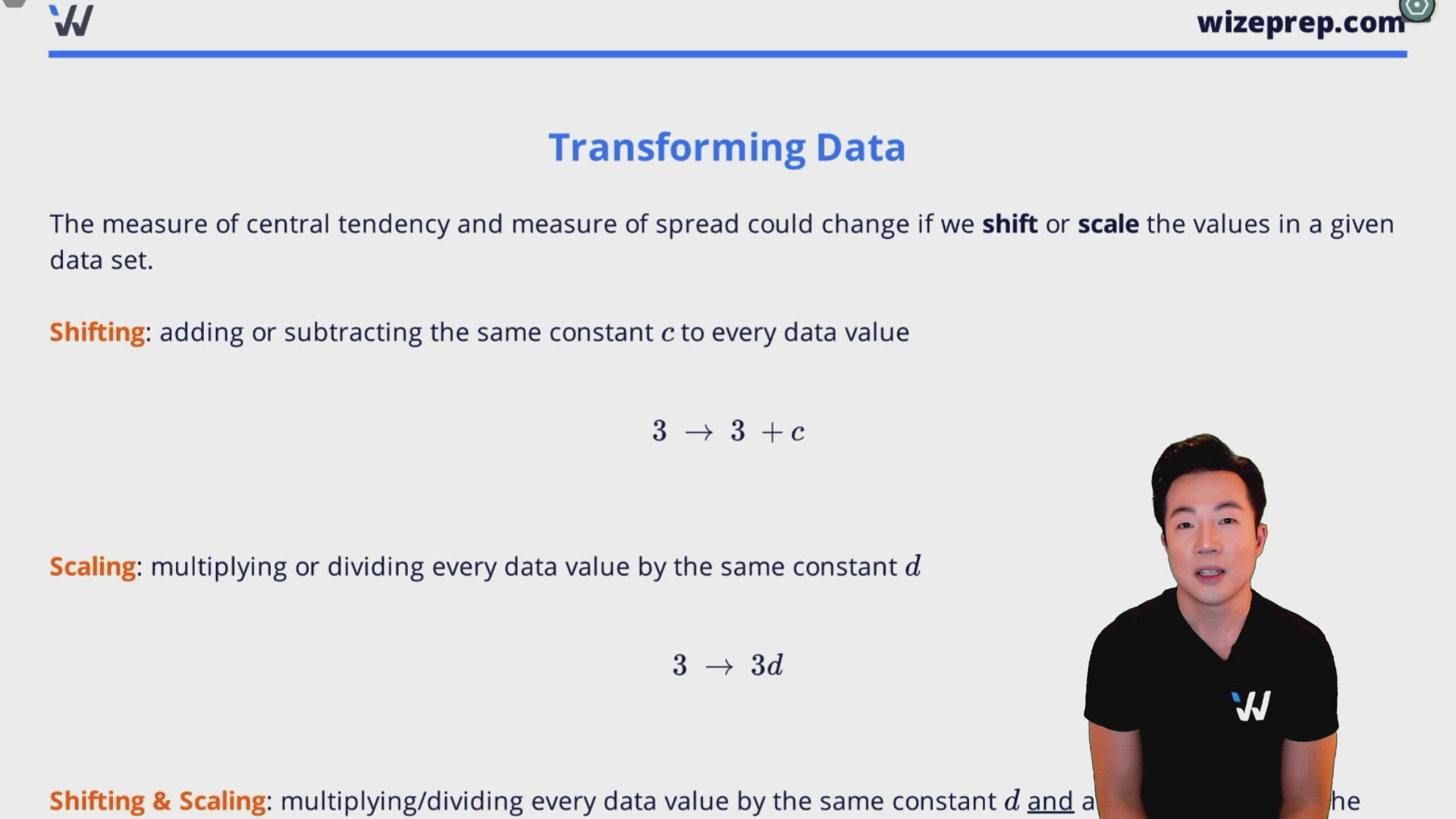
Transforming Data
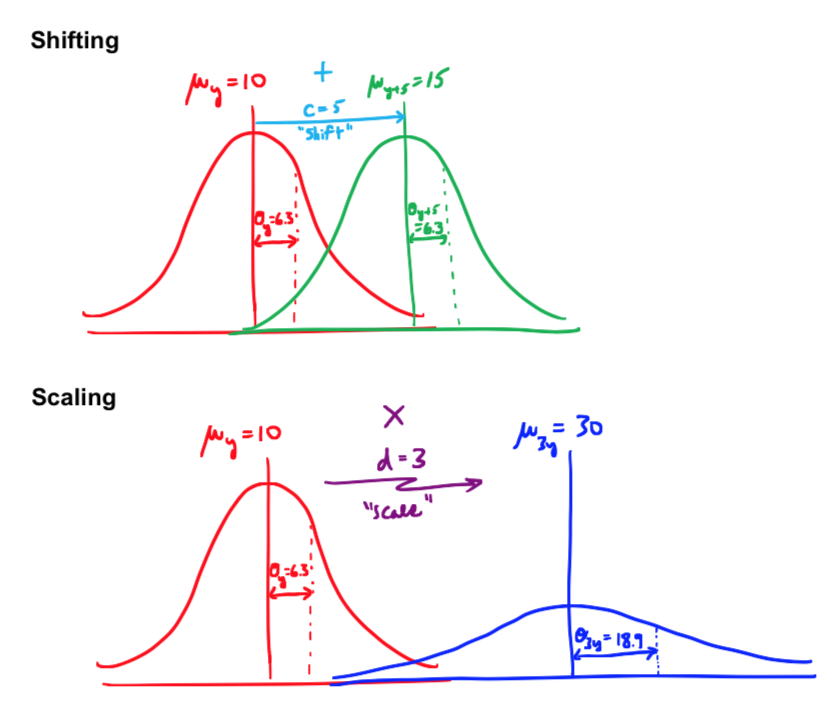
The measure of central tendency and measure of spread could change if we shift or scale the values in a given data set.
Shifting: adding or subtracting the same constant to every data value
Scaling: multiplying or dividing every data value by the same constant
Shifting & Scaling: multiplying/dividing every data value by the same constant and adding/subtracting the same constant
Example
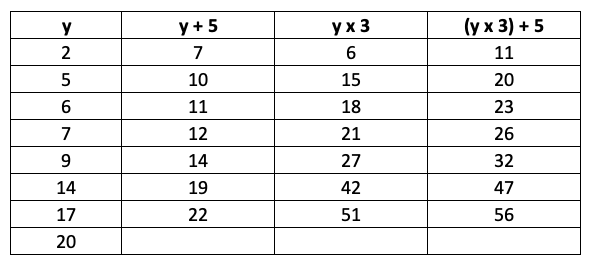
25, 60, 65
What happens to the data set?
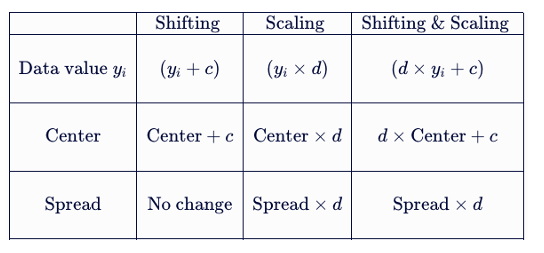
Watch Out!
When we talk about transforming the spread, we are talking about range, IQR, and standard deviation, but NOT variance!
If is a negative value, multiply the spread by the absolute value .
Example
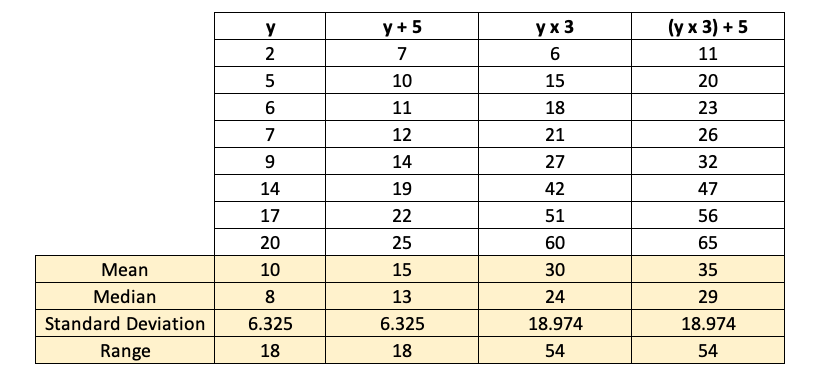
You multiply all values in a data set by and then add four. The resulting mean is 34 and the resulting standard deviation is 25.
Determine the mean and standard deviation of the original data.

0:00 / 0:00
Linear Transformation
Given a linear equation where is the shifting constant and is the scaling constant, then:
Wize Concept
The standard deviation is the square-root of the variance .
Example
Suppose that a data set has a mean of 8 and a standard deviation of 3. You wish to multiply all of the numbers by 4 and then subtract 3.
Determine the new mean and standard deviation.
We are transforming
Let represent the first data set and let represent the new data set.
Then
- New mean:
- New standard deviation:

0:00 / 0:00
Example: Linear Transformation
Jenny is a hairdresser at Swish Salon. She pays the salon a fixed fee of $5,000 to rent a chair (this is subtracted from her profit). In addition, the salon gets 15% of her revenue (which means she keeps 85% of her revenue). Suppose Jenny makes an average of $60,000 in revenue with a standard deviation of $8,000. What is the mean and standard deviation of her profit?
Hint: Profit = Revenue - Costs
(fixed cost, subtracted from profit)
(she keeps 85% of the revenue because the salon gets 15% of the revenue)
Mean(profit):
SD(profit):
You are working overseas in Tokyo in as a consultant. Your average annual earning is ¥5,000,000 with a standard deviation of ¥1,500,000. The exchange rate is ¥1 = $0.009 USD. Each year, you must pay your agency a fixed fee of $10,000 USD.
Find the mean and standard deviation of your annual net earnings in US dollars.