Popular Courses
COMM 214
Concordia University
STAT 151
University of Alberta
AP Statistics Exam Prep Course
AP Exam Prep
Statistics
General Course
Intro to Statistics
University Study Guides
COMM 215
Concordia University
STAT 213
University of Calgary
COMM 191
University of British Columbia
DATASCI 1000A/B
Western University
STA 100
University of California - Davis
Grade 12 Data Management
Ontario High School
High School Statistics
US High School
STATS 2244A/B
Western University
STAT 200
University of British Columbia
Intro to Statistics
University Study Guides
STATS 2035
Western University
STAT 161
University of Alberta
QMS 210
Toronto Metropolitan University
STAT 263
Queen's University
STAT*2040
University of Guelph
0:00 / 0:00
Correlation
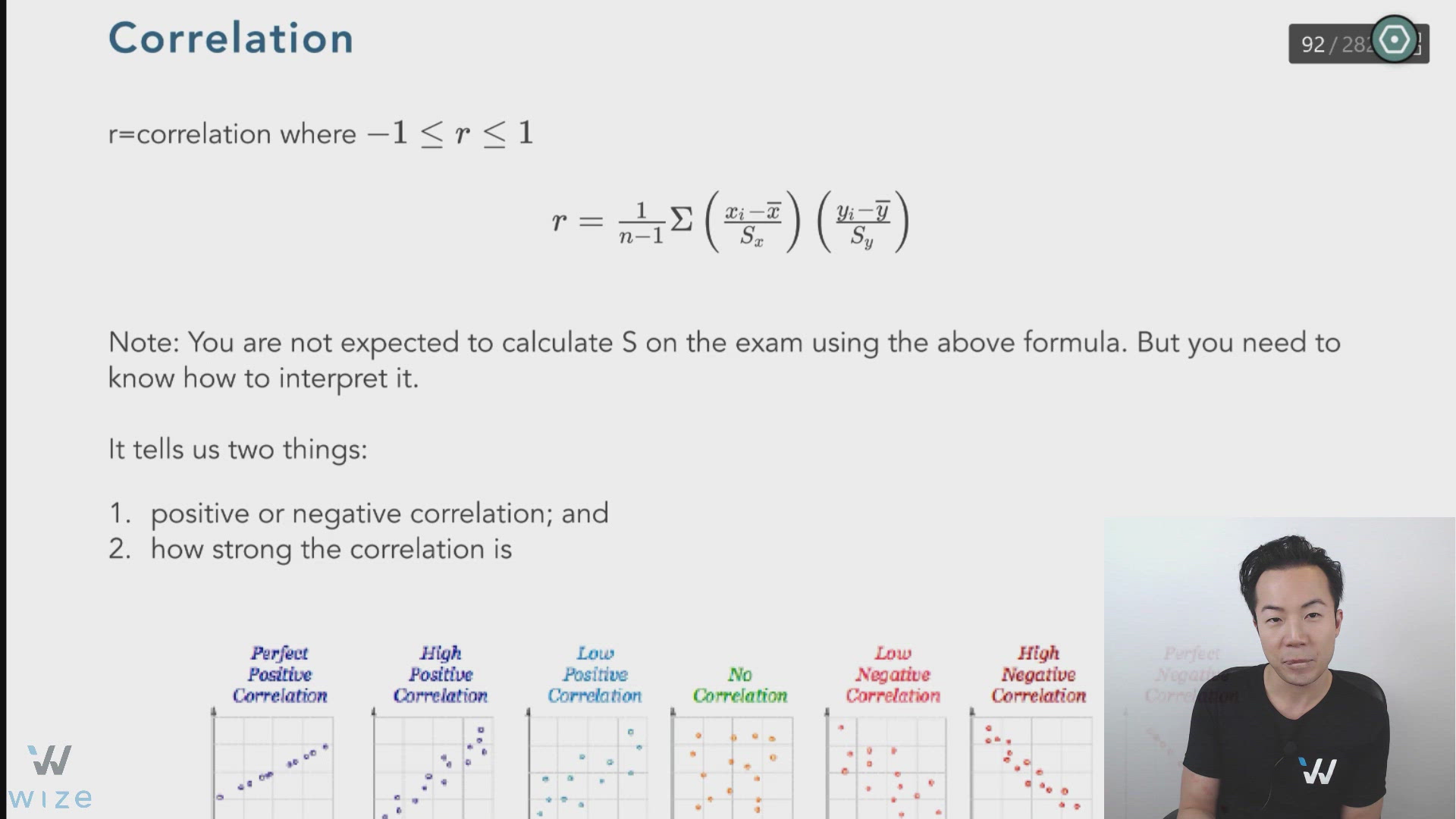
The correlation coefficient measures the direction and strength of the linear relationship between two quantitative variables:
- Direction (positive, negative, neither)
- Strength (strong, moderate, weak, no) correlation where
Exam Tip
There are multiple ways to calculate . (See: Solving for Correlation)
Range of Correlation Values
The correlation coefficient must be a value between and , inclusive.
- The closer is to , the stronger the negative linear relationship between and
- The closer is to , the stronger the positive linear relationship between and
- The closer is to , the weaker the linear relationship between and
- When , that means there is no linear correlation.

Credit: https://www.mathsisfun.com/data/correlation.html
Characteristics of Correlation
- We can only correlate quantitative data.
- If you switch X and Y, the correlation value does not change.
- Correlation coefficient has no units.
- Correlation is based on linear models only.
- Correlation does not imply causation!
Answer the following questions.
(i) Paul wants to find the correlation between iPhone models (i.e. iPhone 3, 4, 5, 6, 7, 8, X, etc.) and battery life. What is wrong here?