
Validating Your Sources for Online Research
Okay, we have all heard about so-called fake news at this point, and we all know that everything we find and read on the internet isn’t always true. But how can we evaluate online sources for school and make sure that we’re accessing appropriate information?
It’s not always easy to tell a fake news site or a reliable source of information from ones that aren’t so reliable.
If you are asked to conduct research for school, college or university, this used to mean that you want to the library and found books and hard copies of journal articles on the related topic.
These were already vetted by other scholars, so that you could feel comfortable and confident that they were filled with the kind of information you could rely on to help you get the grades that you want, bolstering your arguments for your teachers and professors, and helping you to showcase your own research abilities.
It’s not so easy anymore.
Now we can get a lot more information a lot easier, but not all of that information is any good. In response to all this, we’ve gathered together our top recommendations for conducting online research to reliable sources.
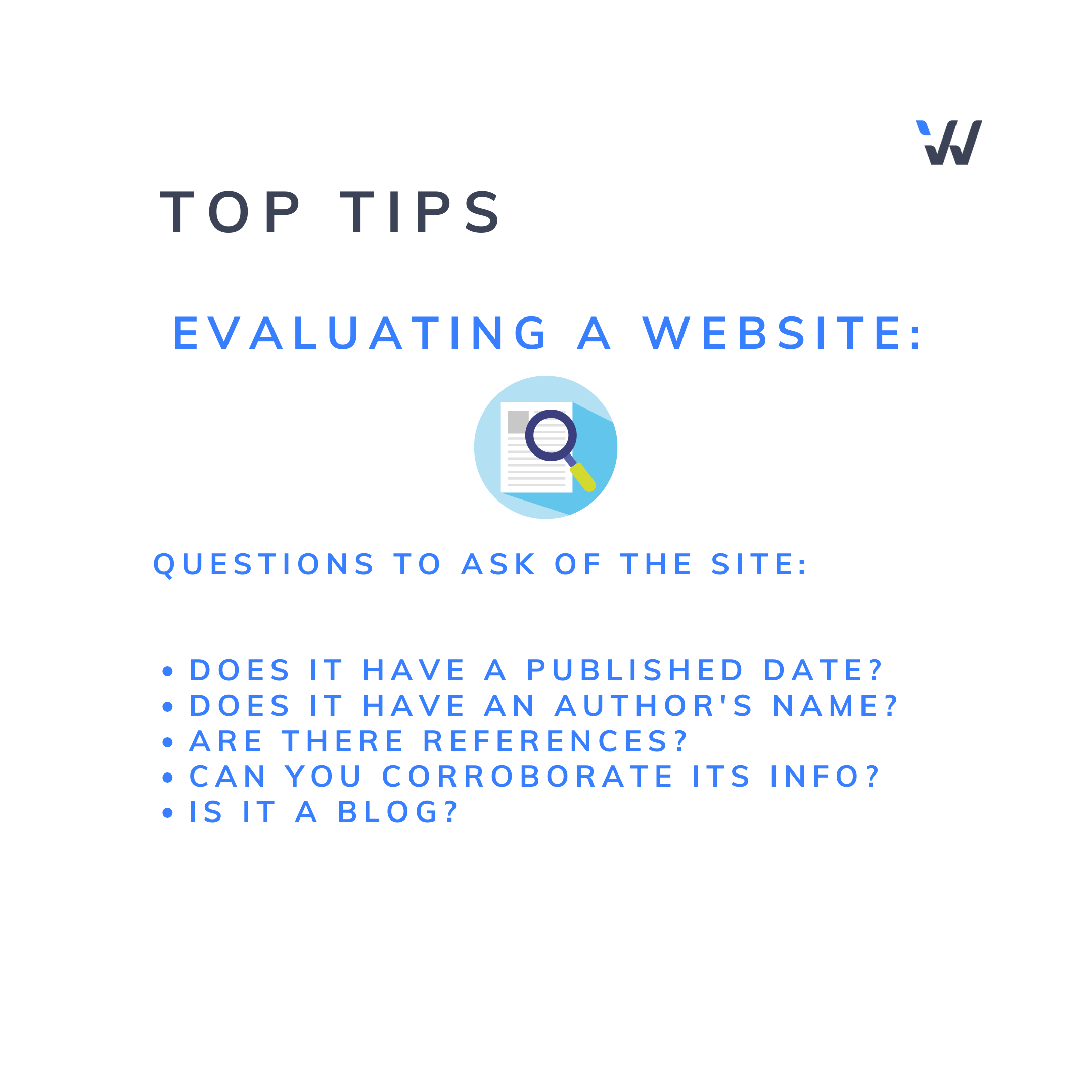
Here are my 6 tips for avoiding fake news when conducting online research:
Once you've searched your topic and found a number of resources, now you must consider how reliable they are. You can do this by...
1. Checking the Date
What is the date of the post or information? Is it old or out dated? Is there no date. While the presence or absence of a date on a post in and of itself will not determine if the information therein is valid or valuable, the absence of a publication date makes it hard to track down whether or not the information is current, and therefore it might be suspect.
2. Checking the Author
Is there an author attributed to the information? Can you look them up? Can you find out anything about them? Would they be someone you would trust to deliver factual information? If you cannot find any information about the author, then how can you determine whether or not they are an authority or a reliable source?
Again, the absence of an author to cite on a given site isn't necessarily enough on its own to invalidate the site, but it should make you wonder.
3. Checking any References
If the site you are looking to as a resource has no other citations, no other links, or no other sources for the information it is presenting as a source, then you might wonder about where that site got its data from.
Can you find any of the information through JSTOR or ProQuest or any of the other databases accessibly through your school's library? Use Google Scholar rather than a mere Google search in order to scope out your online research to materials that have at least been vetted before being presented to you.
4. Checking the Association or Affiliation
Is the site associated with a reputable organization? Has a think tank or government or university posted or put their name behind the information gathered on the site?
Alternatively, if the association is particularly politicized, then we might know that there is a specific agenda or slant to the information therein. For instance, if we get information from a site that is trying to sell us something, then clearly we know that all the information presented is driven by a sales agenda.
But what about other sites where what they're "selling" may be a political idea or a way of seeing the world? We need to be critical of taking these at face value too.
5. Check if it's a Blog or not
Blogs in and of themselves aren't suspect; however, a blog (like this one!) does not have to go through any peer review or even editorial review. We don't always know what processes companies or organizations have to determine what gets published on their blogs.
As a result how do we know if a blog post can be trusted? Be critical of blogs you encounter. Some of them provide fantastic information (like ours!), but some may be suspect.
Top three tips for online research:
- Find research through your educational institution’s library portal.
- Use Google Scholar to limit your search to reliable sources.
- Engage in lateral reading to validate your findings.
While we can find whatever information we want anywhere on the internet, it doesn’t mean we should. Since anyone, literally anyone, can post anything online, there is a bunch of information out there that is at best simply wrong, and at worst designed to mislead.
If you are conducting research for school, there are a few things you should do to make sure that you are getting the right information the right way.
- Find research through your educational institution’s library portal: Schools, colleges, universities, museums, libraries, and other organizations where learning and research form the cornerstone of their work all have specific portals that allow signed in users to access validated scholarly sources. These include SCOPUS-ranked journals and the articles therein as well as peer reviewed books and other scholarly sources.
- Use Google Scholar to limit your search to reliable sources: When you do a simple google search, Google’s algorithms search anything and everything out there, but if you use Google Scholar to limit the search to scholarly materials. You may still need to log into some of the databases through your institution to read the full text of the materials of interest to you, but at least you’ll be sure that you’re getting things that have been pre-vetted.
- Engage in lateral reading to validate your findings: If you find something to be true or argued convincingly in one reputable source -- a source with an author and citations -- then see if you can’t find another source that agrees with or engages with those findings or points of view. See if you can find more than one source echoing the same or similar insights. After all, a key principle of scientific inquiry is repeatability. If an experiment can’t be repeated with the same findings, then those findings may well be suspect. Similarly if no one agrees or supports a view that you find, it may be that the view is unsupportable.
 📷
📷For other tips on online research our friends at Wize have online study guides to help you improve grades, a post dedicated to the top 6 tips to validate online sources, and their English course has some tips about online research you can check out.
Avoid falling victim to quoting fake news in your school papers!

Study with Us
The help you need to get the grades you want.
Previous Blog
What Are High Yield MCAT Topics?
Next Blog