
 Aaron Lindh
Test-optional means you can apply without SAT or ACT scores. Whether you should take a test still depends on your college list, scholarship eligibility and entry year. Start with those requirements before deciding whether testing belongs in your plan.
The high school years, especially junior year (grade 11), are full of activities: school, homework, extracurriculars, not to mention the college search and application process. It’s difficult to find time to do everything, especially if you’d like to sleep once in a while.
When something appears optional, especially something that doesn’t sound appealing, choosing not to do it becomes reasonable. So, why go through the cost, time and headache of choosing a test, preparing and taking the SAT or ACT?
What Does Test-Optional Mean?
First, check what each college means by its testing policy:
- Test-blind or test-free: the college does not consider SAT or ACT scores for admission. Check separately whether scores have another use, such as placement or scholarships.
- Test-optional: you can choose whether to submit SAT or ACT scores for admission. Read the college’s guidance on how submitted scores are considered.
- Test-required: the college generally requires the specified scores. Check its exceptions and the rules for your applicant category.
- Test-flexible: scores are required, but the school accepts alternatives to the SAT or ACT, such as Advanced Placement or International Baccalaureate scores.
For example, the University of California does not consider SAT or ACT scores for admission or scholarships. The University of Michigan is test-optional for students seeking entry in fall 2027 and says it will review its policy on an ongoing basis. Harvard requires the SAT or ACT, with specified alternatives in exceptional cases involving access or financial barriers. NYU is test-optional and test-flexible: if you choose to submit scores, you can submit from a list of accepted scores, including SAT, ACT, AP, and IB.
These examples do not establish the rules for a later entry year. If you are in grade 11 and planning to enter college in fall 2028, check again when the requirements for your cycle are published.
Test-optional admissions are not new: Bowdoin has used the approach since 1969. What matters for your decision is the current policy at each college you are considering.
Should You Still Take the SAT or ACT?
One reason to take the SAT or ACT is to keep a test-required college among your options. As you research universities, you may discover a school that is a great fit but requires a score. Further, a school that is currently test-optional or test-blind may change policies and become test-required by the time you are ready to apply.
Admission is only one part of the decision. Imagine that a college on your list allows applications without scores, but a scholarship you want requires one. You may still have a reason to test, provided you also meet that scholarship’s other eligibility requirements. This is an illustrative situation, not a rule that applies to every college.
What If Every College on Your List Is Test-Optional?
If each college’s test-optional policy applies to your program and applicant category, you can apply without scores. Testing may still be useful for an eligible scholarship, placement or an additional college you later consider. Check those uses before weighing the time and cost of testing. Further, a high test score may help indicate your readiness for college and enhance your chances of admission even at a test-optional college.
Should You Submit Scores to Test-Optional Colleges?
Taking a test and deciding whether to submit a score are separate decisions. At a test-optional college, check the institution’s own guidance and how it evaluates the rest of your application.
You may see higher admission rates among students who submitted scores, but that alone does not show that submitting caused the difference. Stronger applicants may also be more likely to submit. A strong score is not a guarantee of admission.
Can SAT or ACT Scores Affect Scholarships?
Another reason to consider testing is that some scholarships use test scores among their eligibility requirements. For example, Florida’s Bright Futures Academic and Medallion awards combine testing requirements with coursework, GPA, service or work hours, and other eligibility rules. Residency and citizenship or eligible-noncitizen requirements also apply.
Private scholarships may also use SAT or ACT scores. The Engebretson Foundation considers scores alongside academic criteria and financial need; its scholarship is limited to US citizens and has additional application requirements. Meeting a score threshold alone does not secure an award.
Check the requirements and deadlines for your graduation or entry year. If you are applying to US colleges from Canada, confirm which funding options are available to your citizenship and residency category.
Can SAT or ACT Scores Affect Course Placement?
Some colleges also use SAT or ACT scores in placement-related decisions. At the University of Texas-Austin, qualifying math scores can exempt certain newly admitted students outside the College of Natural Sciences from the UT Math Assessment.
Incoming first-year students in that college must take the assessment. The details depend on the program and current rules, so do not assume a score will let you skip a course or graduate sooner.
Your Next Step: Check Three Colleges
Choose three colleges you are curious about. Copy this checklist for each one and use the college’s official admissions, scholarship and placement pages to fill it in.
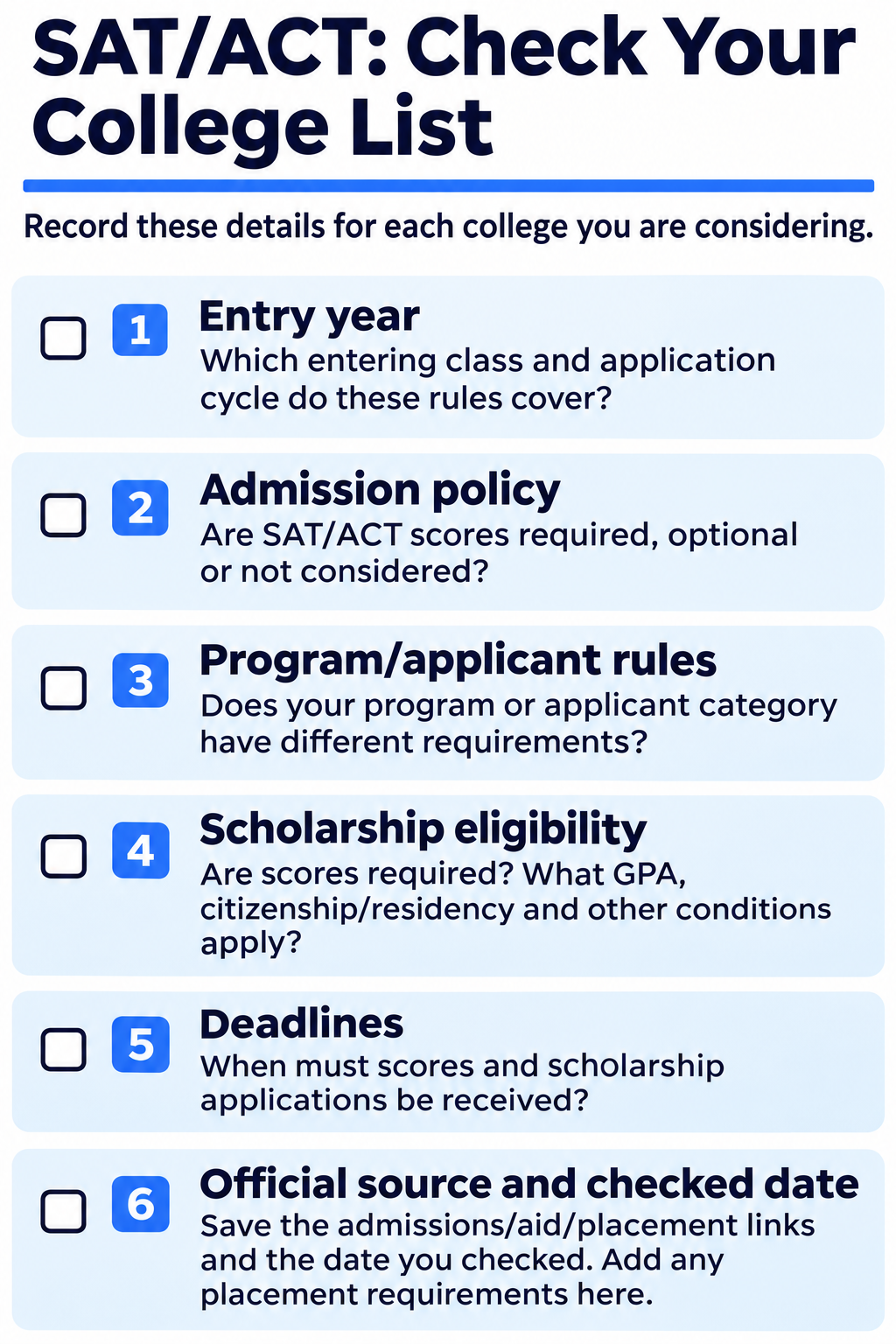
Then decide whether testing would keep a useful option open, meet an applicable scholarship requirement or serve another goal. For parents, this is a way to discuss the decision together before adding preparation to an already busy week.
Want help choosing your next prep step? Book a free 20-minute SAT/ACT advising session with a Wizeprep academic advisor to discuss test choice, your timeline and preparation options.
Decided to explore testing? Here’s how to use your first SAT or ACT practice-test score to choose what to work on next.
About the Author
Aaron Lindh is the Director of SAT/ACT at Wizeprep with twenty years of experience as a test-preparation teacher, tutor and book author.