
Productivity
Inequality, Accessibility, and a Level Playing Field: What Can EdTech Do?
Inequality, Accessibility, and a Level Playing Field: What Can EdTech Do?
In a fourth-season episode of The Wire, Bunny Colvin, a former police officer, takes a group of underprivileged middle-school students to an upscale steakhouse. Before the dinner, the students are excited and speculate boisterously about the fine fare they plan to enjoy. The actual fine-dining experience, though, is alienating for the teenagers.
The environment is foreign to them. As they lack familiarity with the conventions of eating at such restaurants, it is also intimidating. Afterwards, one student asks Colvin to take them to McDonald’s.
The Wire’s depiction of Baltimore middle-school students at a steakhouse is instructive for understanding other situations in which economically disadvantaged people gain entry to elite institutions.
The issue is particularly pressing in the context of higher education. Educational technology has great potential to increase accessibility and improve the learning experience for students who face a range of obstacles to academic success. At Wize Writer (formerly Essay Jack), this responsibility is central to our mission.
There is a marked correlation between socio-economic status and admission to elite universities. For example, the student body at Harvard University is disproportionately composed of students from the very top of the income scale. This disparity is not limited to Harvard. A study conducted by the U.S. Department of Education tracked 10th grade students who had similar test scores but different economic backgrounds. After 10 years, fewer high-achieving students of low socio-economic status earned bachelor’s degrees than their peers of middle and high socio-economic status. At elite universities and colleges in the United States, students from the wealthiest 25% of the population outnumber students from the poorest 25% by nearly 25 to 1. According to a study by the Brookings Institution, very few high-achieving but low-income students even apply to selective institutions.
Various programs and initiatives seek to address this state of affairs and remove barriers to entry.
As the example from The Wire deftly demonstrates, though, removing financial barriers is not a panacea. Colvin bought dinner for his group of teenagers, but they were still discouraged by the feeling of exclusion they encountered. A 2013 article in Forbes quoted a low-income student at Brown University who perfectly expressed how this applies to higher education:
“I think the hardest part is not even financial – it’s trying to know about most of the things that your peers know about.”
One institution that recognizes this difficulty is the University of North Carolina. Since 2004, UNC’s Carolina Covenant has promised that low-income students can graduate without debt. But the Carolina Covenant goes beyond financial assistance. It provides a course on financial literacy, business-etiquette dinners and workshops on time management, note taking and study skills.
These soft skills, essential to academic and professional success, are less obvious advantages of middle- and upper-class upbringings.
When I got to university, I knew the basics of writing an academic essay. My first essays were far from perfect, but when a professor assigned an essay, I knew how to use a library catalogue and databases for research; how to take notes; how to structure the assignment; and how to provide attribution. I had a rough understanding of the norms and conventions of persuasive academic writing due to my education and upbringing.
Arriving at a university without such knowledge can produce a vicious cycle, as one advantage that privileged students have is simply the expectation of support and the awareness of where to find it.
Not knowing these things makes students from less-advantaged families more likely to drop out and thus less able to pay back student loans, which exacerbates economic inequality.
This is where Wize Writer comes in.
Professors expect essays that conform to academic standards. They have increasingly less time and fewer resources to impart these conventions to students. This only increases the likelihood that some students will experience their first semesters the way Colvin's students experienced the steakhouse.
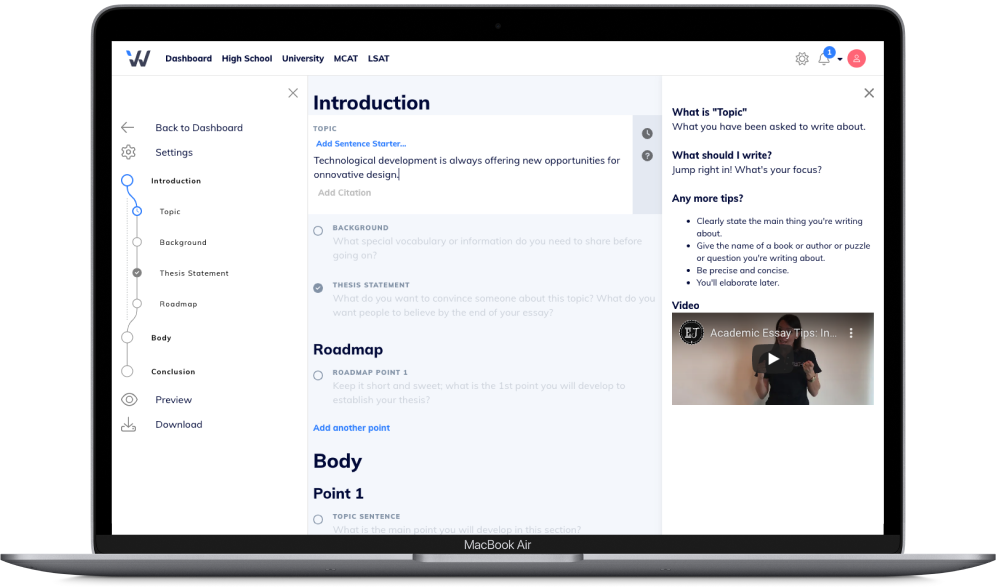
Wize Writer goes far beyond providing assistance in writing an essay. It closes this educational gap.
Students who use Wize Writer do not only learn how to structure their essay. Through tips, prompts and explanations, Wize Writer also teaches them the reasons behind the norms and requirements of formal writing.
Wize Writer does not just remind students to provide citations. It teaches them when, why and how to provide attribution. This is why numerous instructors have incorporated Wize Writer into their teaching.
I once said that “education is about empowerment, empowerment for all different kinds of learners, whatever their different abilities and needs.” Wize Writer stemmed from my commitment to equity and diversity as a scholar, educator, and entrepreneur.
In that article from which the quotation above is taken, I was speaking specifically about accessibility for students with learning disabilities, and the structure and guidance provided by Wize Writer helps students overcome many of the challenges that stem from learning disabilities.
It is a practical tool that helps students focus, divides an overwhelming assignment into manageable tasks and gives students with learning difficulties the step-by-step support they need to be successful.
But my vision of empowerment through Wize Writer applies equally to students facing many different roadblocks to success.
All of the resources here on Wizeprep are examples of how EdTech can level the playing field for economically disadvantaged students as well as students living with learning disabilities.

Study with Us
The help you need to get the grades you want.
Previous Blog
The Best 3 Types of Agendas for College
Next Blog
Keeping a Balance in the Madness of Exam Time
Other posts you might like:
Productivity
The Best 3 Types of Agendas for College
The Best 3 Types of Agendas for College College is a mess. And if you’re not on top of your lists of... Read More
S
Sara Tirmizi