
Muscle Physiology
Sliding-Filament Theory
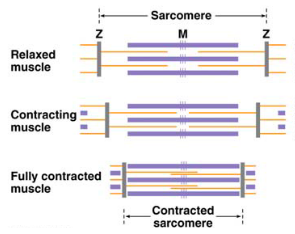
- thick filaments (myosin) move past thin filaments (actin)
- sarcomeres shorten while filaments remain same length
- requires actin-myosin binding sites, ATP and Ca2+
Role of Ca2+ in muscle contraction
- allows for myosin binding on actin, by shifting the troponin-tropomyosin complex

The actin-myosin ATP cycle
The myosin head is ready to bind actin once it has hydrolyzed ATP
- Pi is released (now, strong bond between actin and myosin is able to form - this is called a cross-bridge)
- Power stroke happens
- ADP is released
- Now, muscle is in contracted state
- ATP binds myosin again, causing release of actin ––> back to the relaxed state
- no ATP available? No relaxation. This is what happens during rigor mortis.
