Wize University Physiology Textbook > Skeletal Muscle Physiology
Neuromuscular Junction
Popular Courses
MCAT
General Course
DAT
General Course
Intro to Physiology
University Study Guides
PHYSIOL 1021
Western University
PHYSIOL 2130
Western University
Intro to Physiology
University Study Guides
PSL300H1
University of Toronto
PHYSL 210
University of Alberta
PHGY 210
McGill University
PHGY 215
Queen's University
KNES 259
University of Calgary
PHGY 216
Queen's University
BIOL 273
University of Waterloo
BIOL 260
University of British Columbia
PHYSIOL 3120
Western University
KNES 260
University of Calgary
BIOL 116
Case Western Reserve University
PPT 301
University of North Dakota
ANAT 212
McGill University
HTHSCI 2FF3
McMaster University

0:00 / 0:00
What happens at the Neuromuscular Junction (NMJ)?
- action potential in motor neuron – induces release of acetylcholine into neuromuscular junction.
- muscle cell is depolarized, creating an end plate potential (EPP)
- opening of Na+ voltage gated channels causes a muscular action potential.
- this causes voltage-gated channels in sarcoplasmic reticulum to release into cytosol which bind troponin and pull off tropomyosin
- pumped back into sarcoplasmic reticulum after muscle contraction
1 Motor neuron AP will ALWAYS cause at least 1 AP on the muscle cell

Excitation Coupling
- This is the relationship between excitation of a muscle and the actual contraction itself.
- The connection between the two is done using Ca+ ions
- Important terms to know:
- Sarcoplasmic Reticulum: an organ that covers the myofibril like a sock. It reacts to voltage changes in the T-tubules.
- T-tubule: a ring that goes around the myofibril. This is where the AP can propagate.
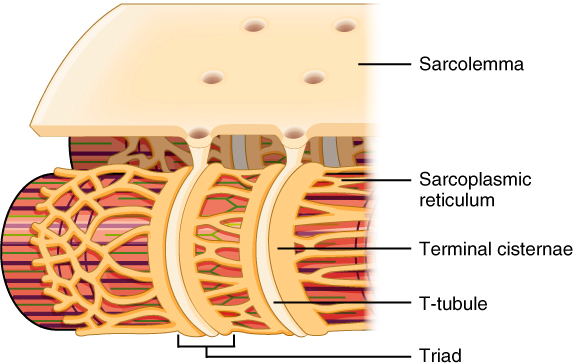
en.wikipedia.org
Which of the following is/are FALSE regarding the NMJ?
A friend of yours is suffering from a disease related to disfunction of her muscles. Her immune system is attacking and destroying the end plates of her muscle cells. Why is this a serious problem and what symptoms might she have?