Wize University Physiology Textbook > Skeletal Muscle Physiology
Muscle Contractions
Popular Courses
MCAT
General Course
DAT
General Course
Intro to Physiology
University Study Guides
PHYSIOL 1021
Western University
PHYSIOL 2130
Western University
Intro to Physiology
University Study Guides
PSL300H1
University of Toronto
PHYSL 210
University of Alberta
PHGY 210
McGill University
PHGY 215
Queen's University
KNES 259
University of Calgary
PHGY 216
Queen's University
BIOL 273
University of Waterloo
BIOL 260
University of British Columbia
PHYSIOL 3120
Western University
KNES 260
University of Calgary
BIOL 116
Case Western Reserve University
PPT 301
University of North Dakota
ANAT 212
McGill University
HTHSCI 2FF3
McMaster University

0:00 / 0:00
Muscle Physiology
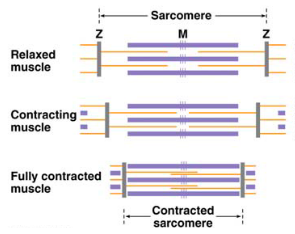
Sliding-Filament Theory
- thick filaments (myosin) move past thin filaments (actin)
- sarcomeres shorten while filaments remain same length
- requires actin-myosin binding sites, ATP and Ca2+
Role of Ca2+ in muscle contraction
- allows for myosin binding on actin, by shifting the troponin-tropomyosin complex

The actin-myosin ATP cycle
The myosin head is ready to bind actin once it has hydrolyzed ATP
- Pi is released (now, strong bond between actin and myosin is able to form - this is called a cross-bridge)
- Power stroke happens
- ADP is released
- Now, muscle is in contracted state
- ATP binds myosin again, causing release of actin ––> back to the relaxed state
- no ATP available? No relaxation. This is what happens during rigor mortis.
Wize Tip
This cycle will continue as long as Ca+ and ATP are available

What is true about muscle contractions after death?
If an AP from an alpha motor neuron does not reach the muscle, what will happen to the actin-myosin-ATP cycle?