Wize University Physiology Textbook > Skeletal Muscle Physiology
Full Muscle Contractions
Popular Courses
MCAT
General Course
DAT
General Course
Intro to Physiology
University Study Guides
PHYSIOL 1021
Western University
PHYSIOL 2130
Western University
Intro to Physiology
University Study Guides
PSL300H1
University of Toronto
PHYSL 210
University of Alberta
PHGY 210
McGill University
PHGY 215
Queen's University
KNES 259
University of Calgary
PHGY 216
Queen's University
BIOL 273
University of Waterloo
BIOL 260
University of British Columbia
PHYSIOL 3120
Western University
KNES 260
University of Calgary
BIOL 116
Case Western Reserve University
PPT 301
University of North Dakota
ANAT 212
McGill University
HTHSCI 2FF3
McMaster University
0:00 / 0:00
Muscle Spindle and Reflex Function
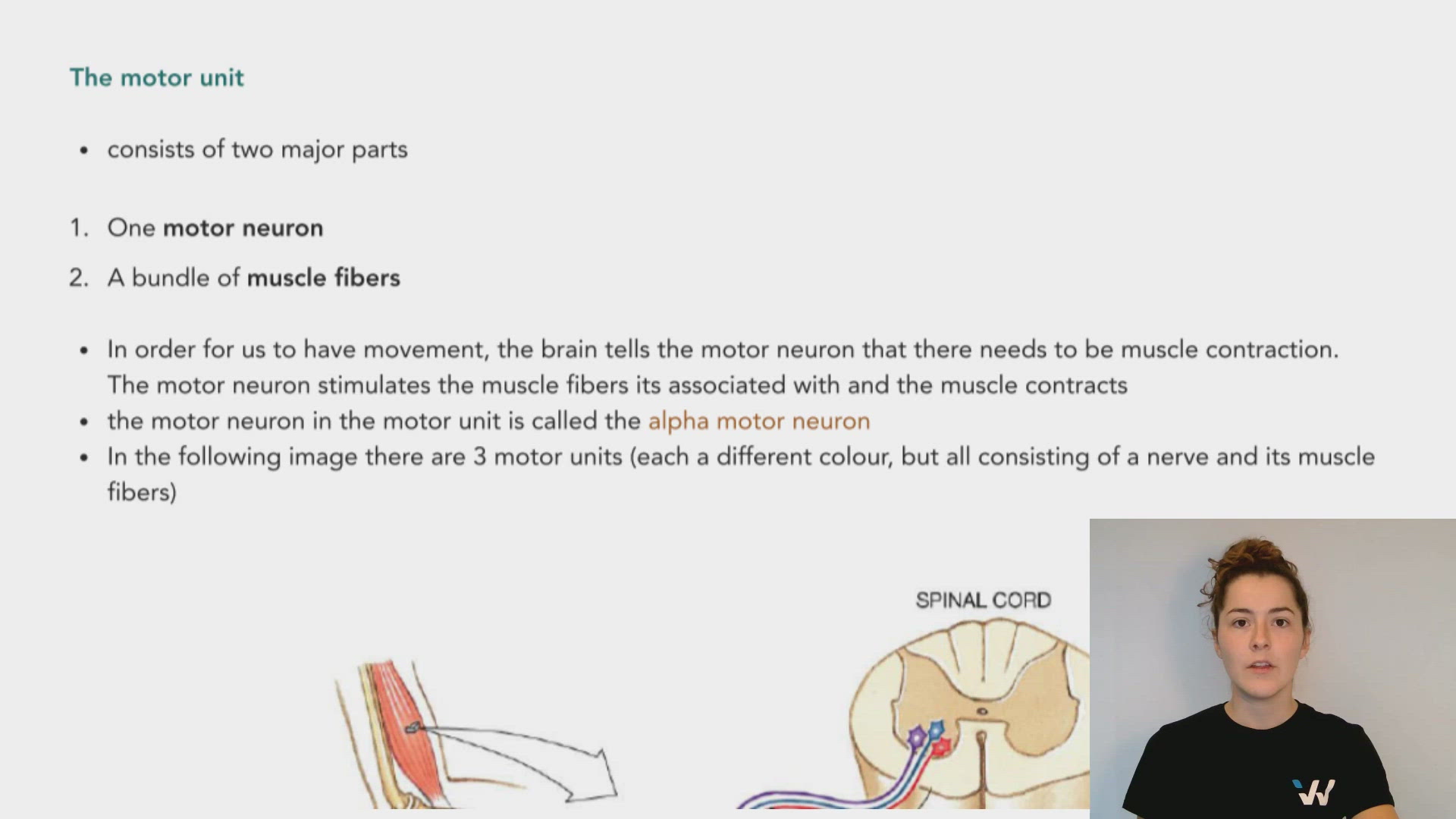
The motor unit
- consists of two major parts
- One motor neuron
- A bundle of muscle fibers
- In order for us to have movement, the brain tells the motor neuron that there needs to be muscle contraction. The motor neuron stimulates the muscle fibers its associated with and the muscle contracts
- the motor neuron in the motor unit is called the alpha motor neuron
- In the following image there are 3 motor units (each a different colour, but all consisting of a nerve and its muscle fibers)

- each muscle fiber has intrafusal and extrafusal components
- the extrafusal part is contractable (can change its length when stimulated)
- stimulated to contract by alpha motor neurons
- the intrafusal part is not contractable at the center, but their ends are contractable
- the center is surrounded by nerves called 1a afferent neurons that sense stretch
- the ends of the intrafusal parts are stimulated to contract by gamma motor neurons

Important Components
We have two main components creating innervation of muscle cells
- Muscle Spindles - responsible for monitoring and responding to the length/stretch of the muscle
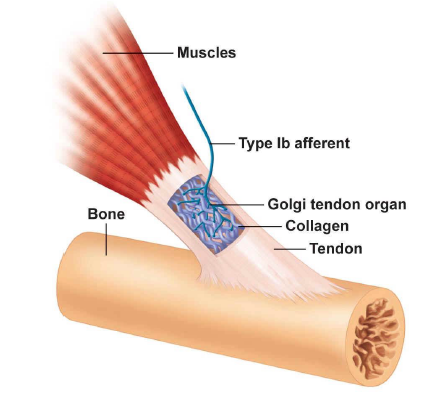
- Golgi Tendon Organs - responsible for monitoring the tension in the muscle
We have 4 important nerves associated with muscle cell innervation
- alpha motor neuron - causes contraction of extrafusal fibers
- gamma motor neuron - causes contraction of intrafusal fibers
- 1a afferent neuron - senses stretch in the intrafusal fibers
- 1b afferent neuron - senses tension in the tendon of the muscle
Muscle spindles
- located in the muscle body
- nerves associated with the spindle
- alpha motor neuron
- gamma motor neuron
- 1a afferent neuron
- the sensory information about muscle stretch is coming from 1a afferent neuron. This is located in the intrafusal fibers.
- there is NO AFFERENT (SENSORY) neuron associated with the extrafusal fibers

The above image is showing the steps of a muscle contraction. First the extrafusal fibers contract which stimulates the gamma motor neuron to cause muscle spindle contraction
Golgi Tendon Organ
- detects tension during contraction (in understandable terms, it detects the heaviness of something)
- located in the tendon
- protects us against lifting things that are too heavy for our muscles and causing injury.
- relays its information to the 1b afferent sensory nerve which passes on info to the CNS
- 1b sensory information has the ability to inhibit the alpha motor neuron, thus inhibiting muscle contraction and protecting us from harm.
Big Picture - The Stretch Reflex
What happens when you lift something up?
- the muscle stretches, activating 1a afferent nerve
- the interneuron connects the 1a afferent nerve signal to the alpha motor neuron response
- alpha motor neuron fires, causing extrafusal muscle contraction
- this extrafusal contraction stimulated the gamma motor neuron to contract the intrafusal fibers
- the contraction of the muscle body causes increased tension on the muscle tendon, activating the golgi tendon organs
- golgi tendon organs activated 1b afferent neurons
- the signal causes inhibition of alpha motor neurons ––> the muscle relaxes
Wize Concept
The golgi tendon organ is activated when their is enough tension. It must pass the tension threshold before it can inhibit motor neurons. If the golgi tendon organ wasn't present and we could lift whatever we wanted, the end result could be ripping muscles off of bones (ouch!)
0:00 / 0:00
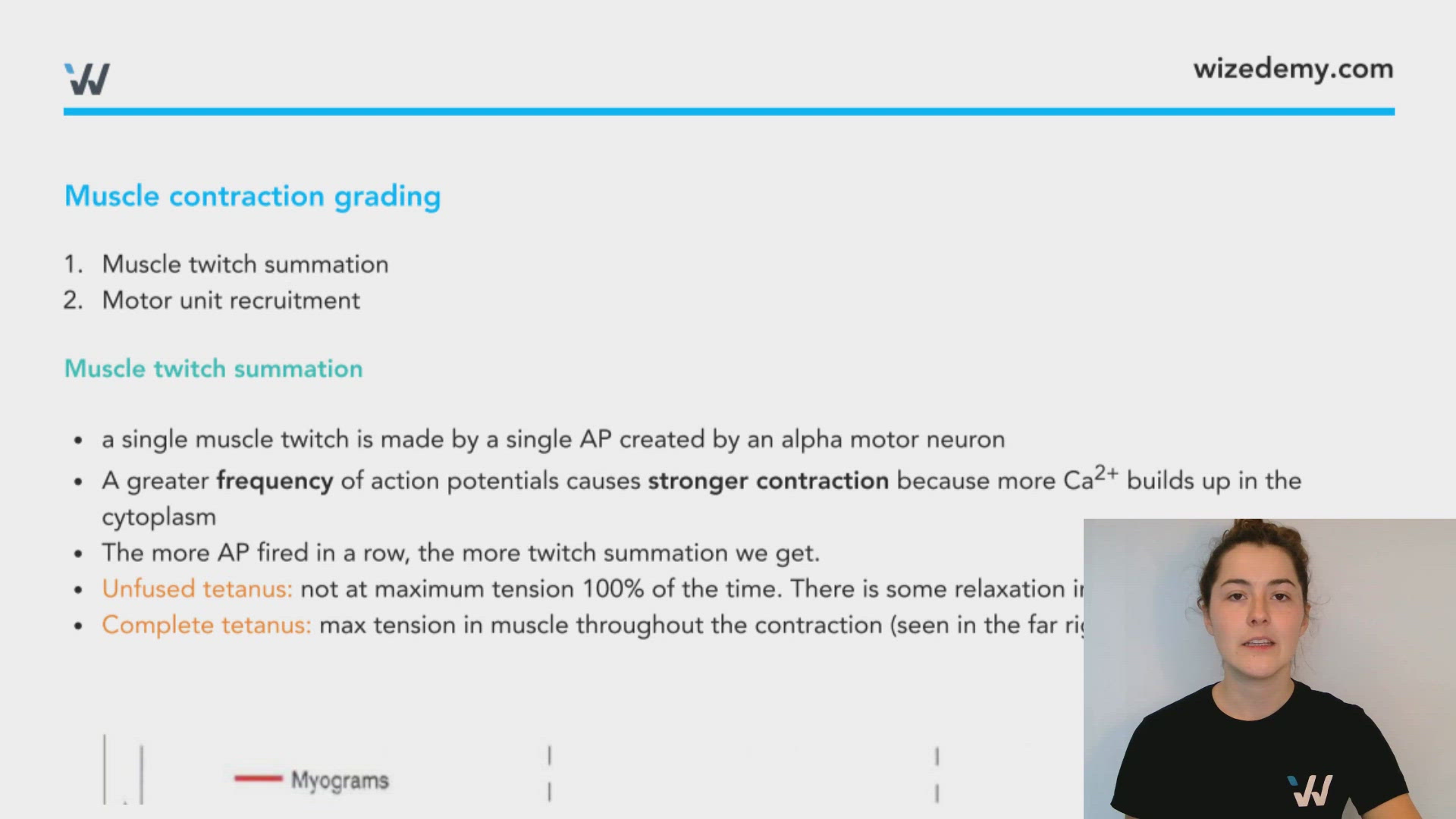
Muscle contraction grading
- Muscle twitch summation
- Motor unit recruitment
Muscle twitch summation
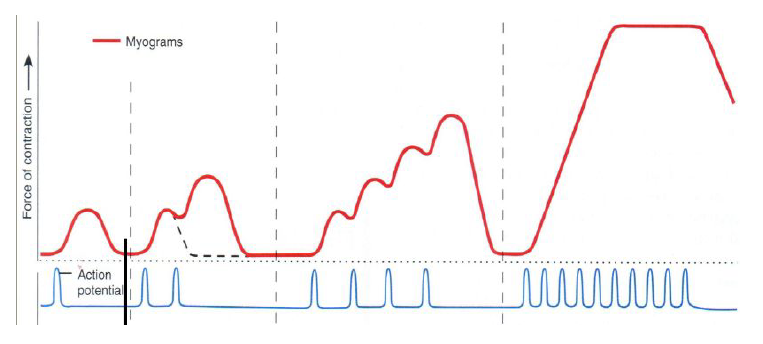
- a single muscle twitch is made by a single AP created by an alpha motor neuron
- A greater frequency of action potentials causes stronger contraction because more Ca2+ builds up in the cytoplasm
- The more AP fired in a row, the more twitch summation we get.
- Unfused tetanus: not at maximum tension 100% of the time. There is some relaxation in the muscle
- Complete tetanus: max tension in muscle throughout the contraction (seen in the far right in the image below)
Recruitment of motor units
- Each motor unit includes one neuron and all muscle fibers it innervates
- Using more motor units at a time can cause stronger whole muscle contraction
0:00 / 0:00
Explain what a muscle twitch is, how it relates to an AP from an alpha motor neuron, and what happens during complete tetanus.
A muscle twitch is the contraction of a single muscle fiber in response to a single AP from an alpha motor neuron. Complete tetanus happens when multiple APs fire one after another form the alpha motor neuron which results in additive contractions of the muscle fiber. If there are enough APs, the muscle fiber will reach a place of no relaxation and 100% tension. This is called complete tetanus.