Bond Pricing
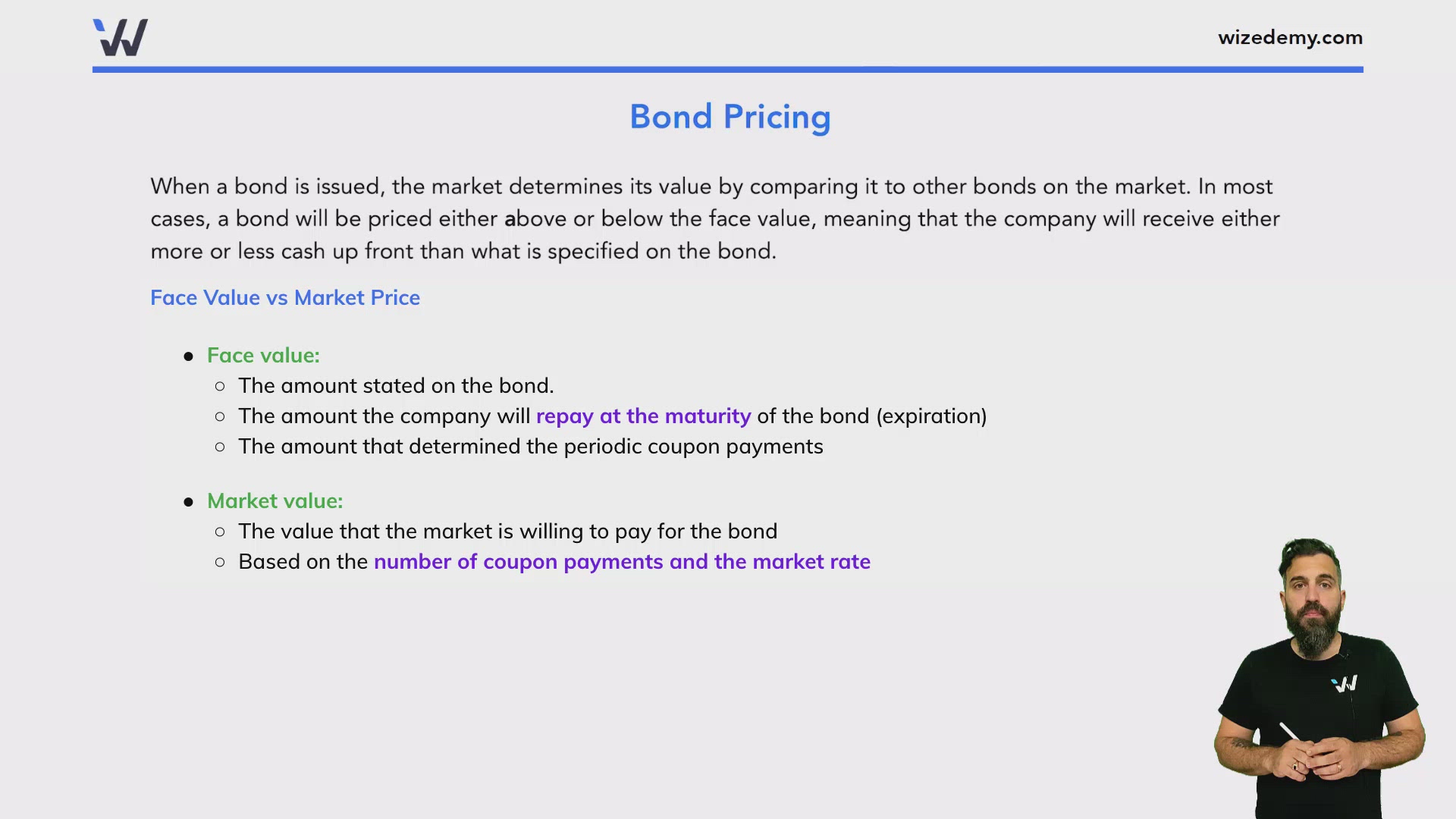
When a bond is issued, the market determines its value by comparing it to other bonds on the market. In most cases, a bond will be priced either above or below the face value, meaning that the company will receive either more or less cash up front than what is specified on the bond.
Face Value vs Market Price
- Face value:
- The amount stated on the bond.
- The amount the company will repay at the maturity of the bond (expiration)
- The amount that determined the periodic coupon payments
- Market value:
- The value that the market is willing to pay for the bond
- Based on the number of coupon payments and the market rate
The Market Rate
- Also called the yield or yield to maturity.
- The rate that determines the value of new bonds.
- The rate of return that investors expect to earn on a bond investment.
Comparing the Rates
- Coupon rate > Market rate: ________ bond
- Market value of the bond is greater than the face value.
- More cash is received when the bond is sold (premium received).
- Coupon rate < Market rate: ________ bond
- Market value of the bond is lower than the face value.
- Less cash is received when the bond is sold (discount given).
- Coupon rate = Market rate: ________bond
- Market value of the bond is equal to the face value.
- The face value is received in cash when the bond is sold.
Calculating Market Value and Issue Price
- Market value is the ________ of all future payments.
- Future payments: Coupon payments and face value
- Use the present value factor tables.
- Rate: Periodic market rate
- Periods: Number of payments



Recording a Bond Issuance
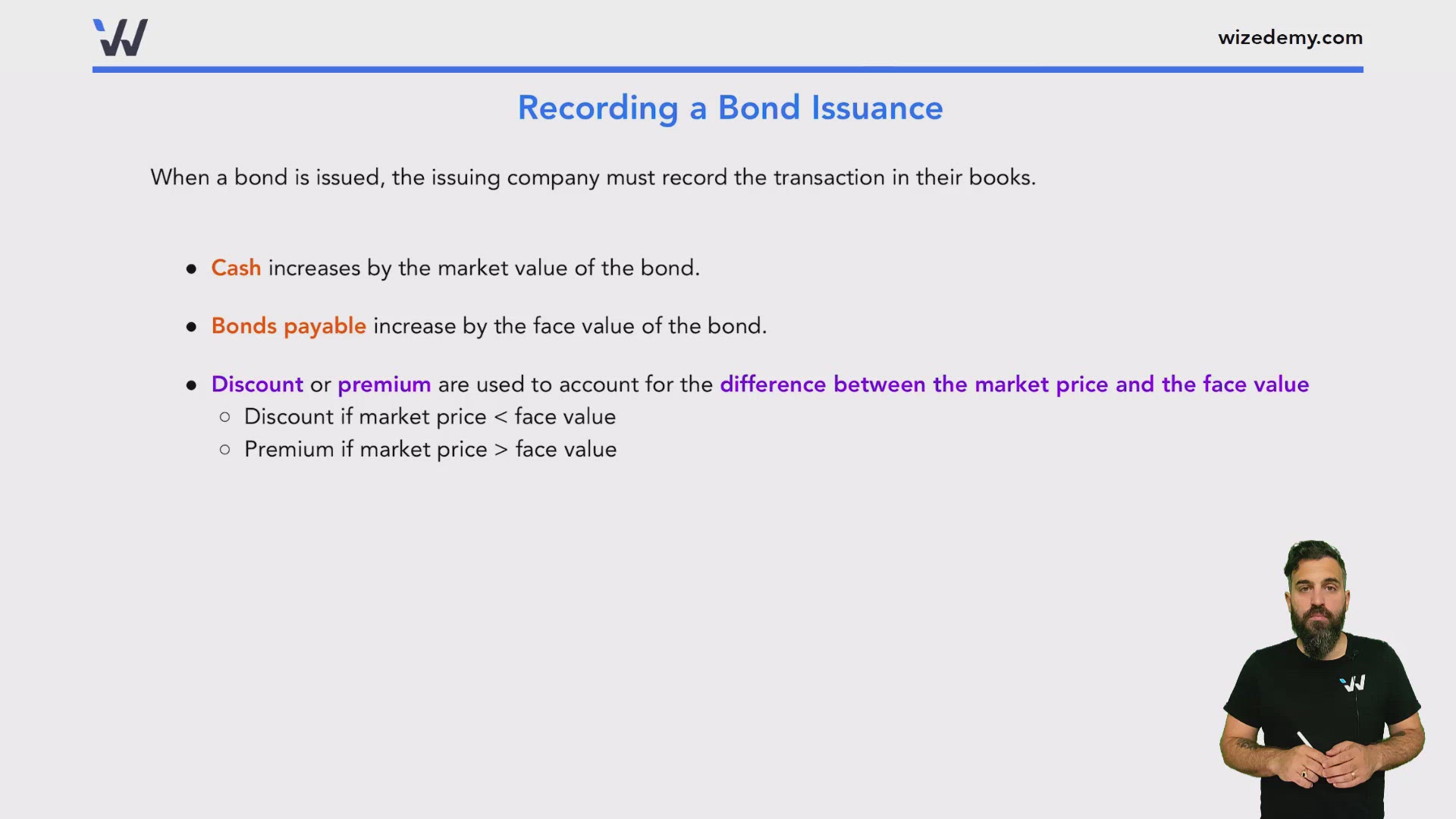
When a bond is issued, the issuing company must record the transaction in their books.
- Cash increases by the market value of the bond.
- Bonds payable increase by the face value of the bond.
- Discount or premium are used to account for the difference between the market price and the face value
- Discount if market price < face value
- Account name: Discount on bonds payable
- Contra-liability: Decreases the bond's carrying value
- Natural debit: Increases on the debit side and decreases on the credit side
- Premium if market price > face value
- Account name: Premium on bonds payable
- Liability: Increases the bond's carrying value
- Natural credit: Increases on the credit side and decreases on the debit side
Premium Bond

Discount Bond

Par Bond

Example: Bond Pricing
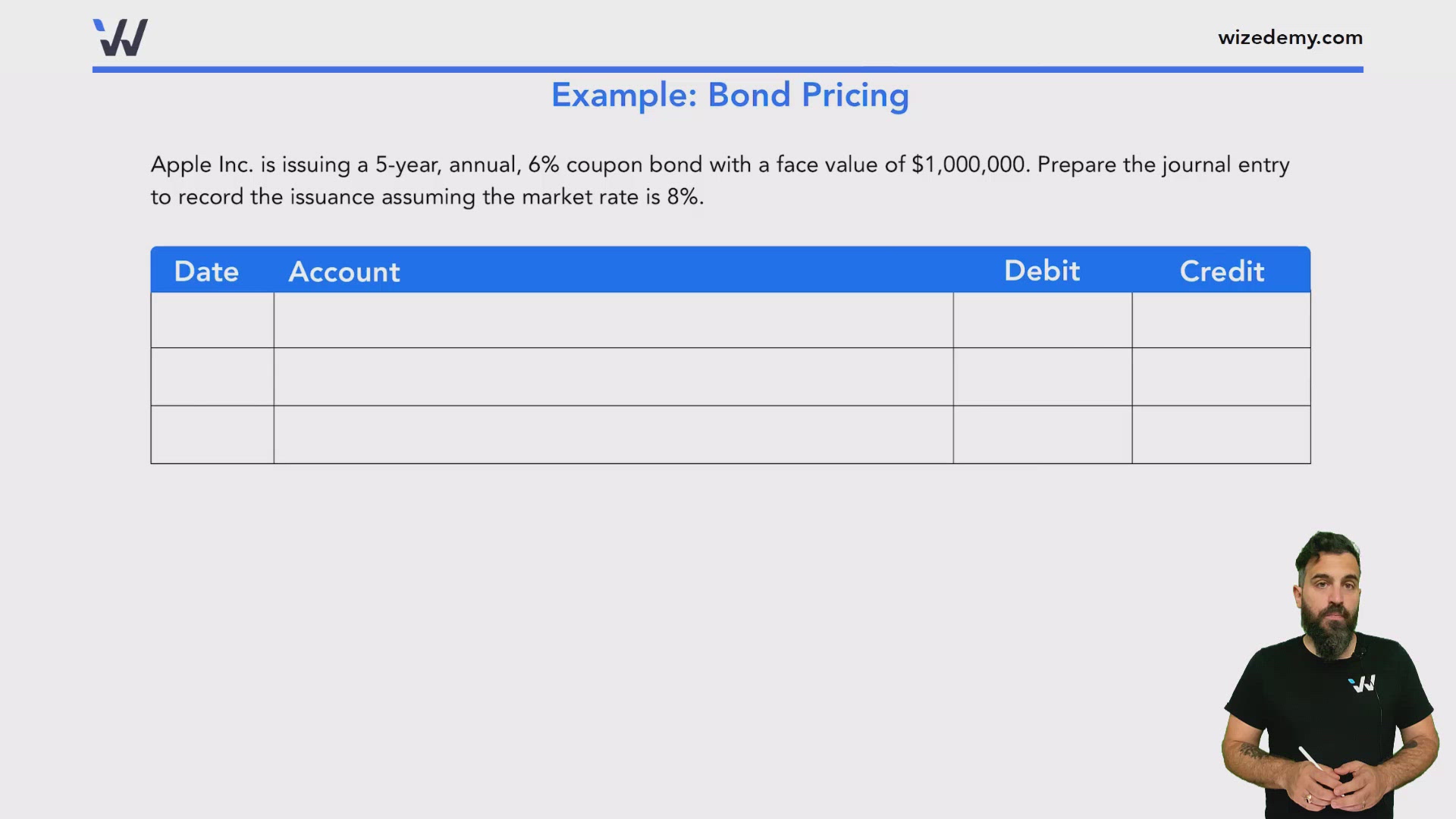
Apple Inc. is issuing a 5-year, annual, 6% coupon bond with a face value of $1,000,000. Prepare the journal entry to record the issuance assuming the market rate is 8%.
Round present value factors to 4 decimal places and round answers to the nearest dollar.

Example: Bond Pricing
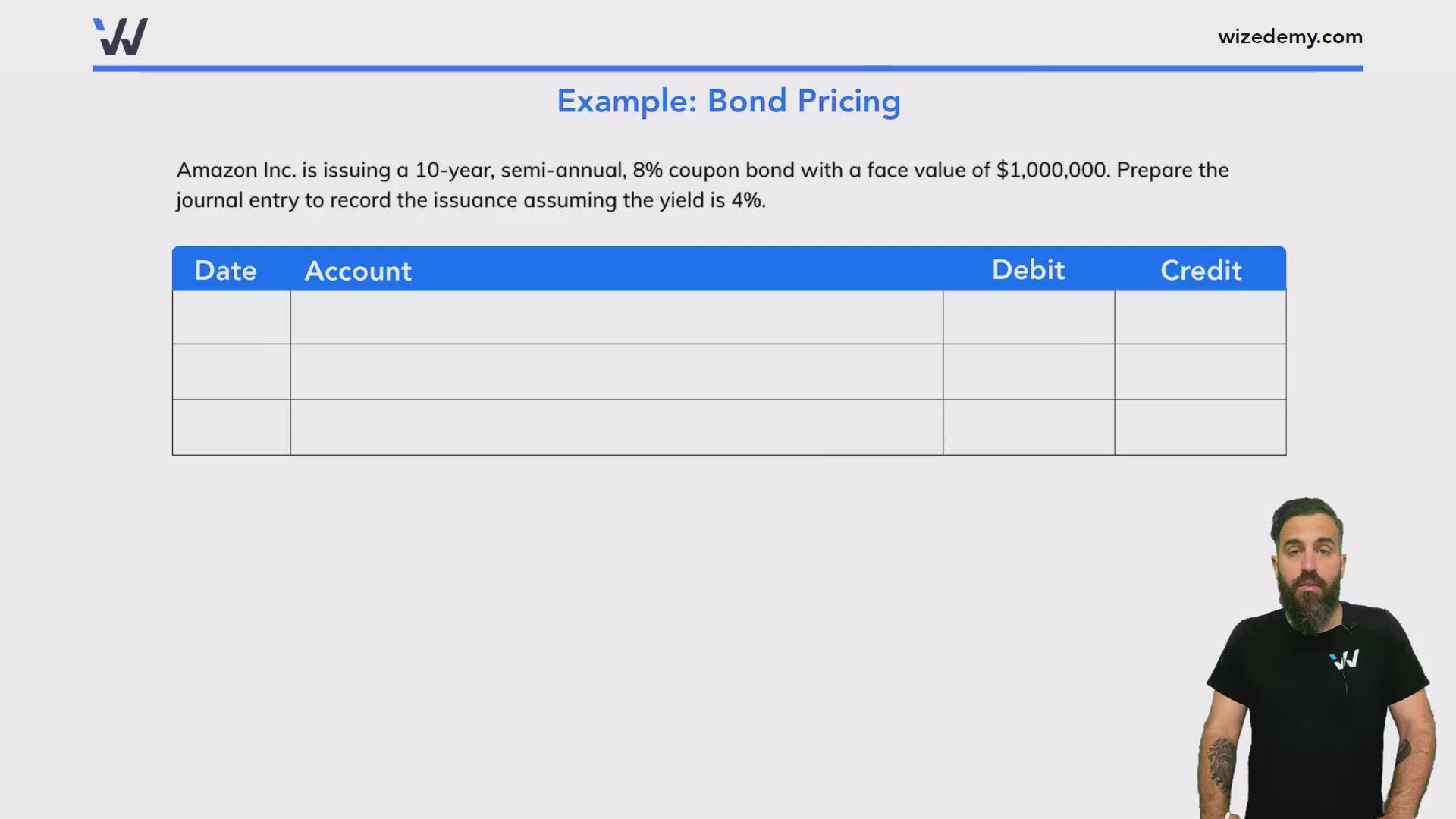
Amazon Inc. is issuing a 10-year, semi-annual, 8% coupon bond with a face value of $1,000,000. Prepare the journal entry to record the issuance assuming the yield is 4%.
Round present value factors to 4 decimal places and round answers to the nearest dollar.

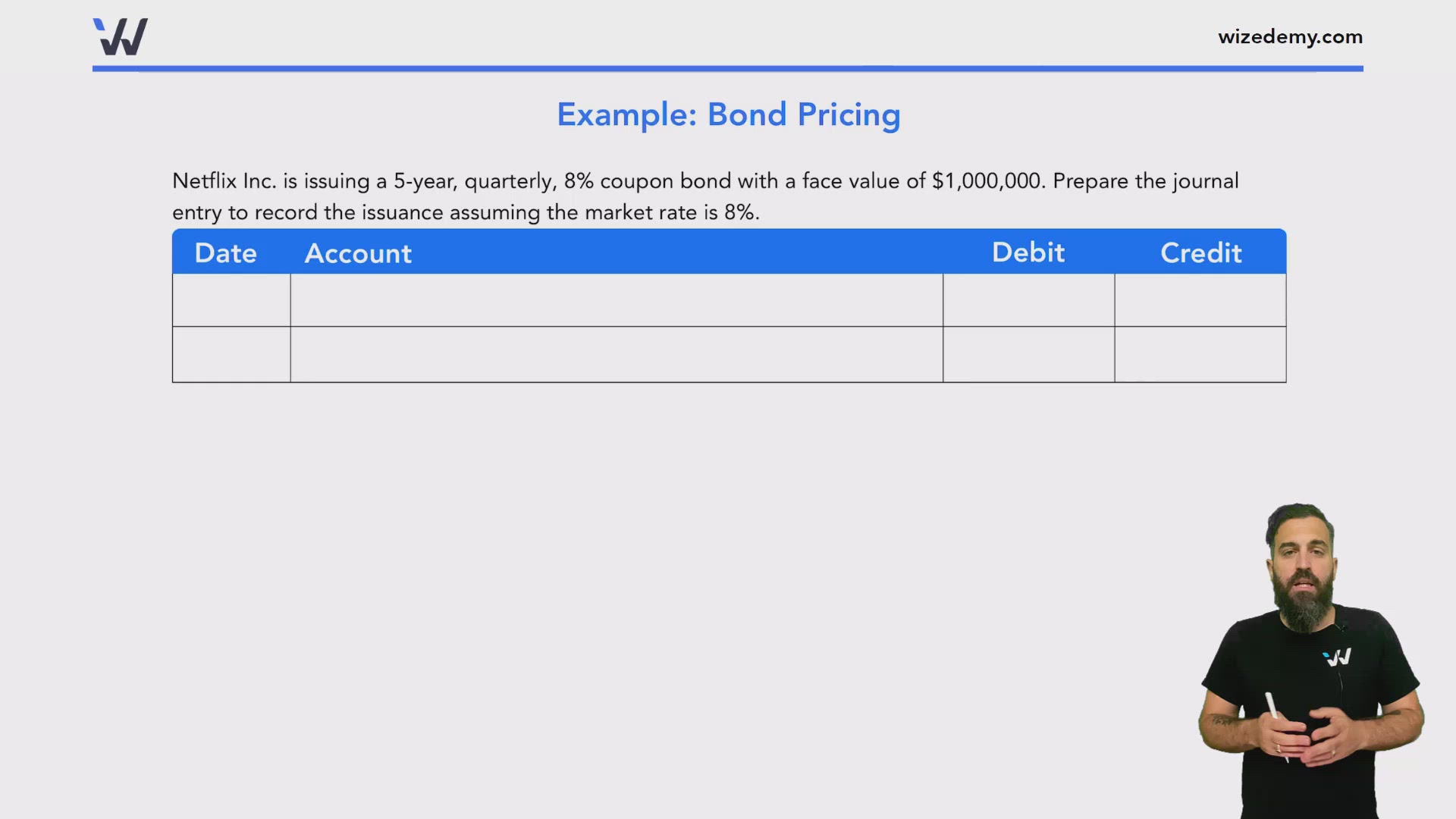
Example: Bond Pricing
Netflix Inc. is issuing a 5-year, quarterly, 8% coupon bond with a face value of $1,000,000. Prepare the journal entry to record the issuance assuming the market rate is 8%.
Round present value factors to 4 decimal places and round answers to the nearest dollar.

Present Value Factor Table
Table 1: Present Value of $1
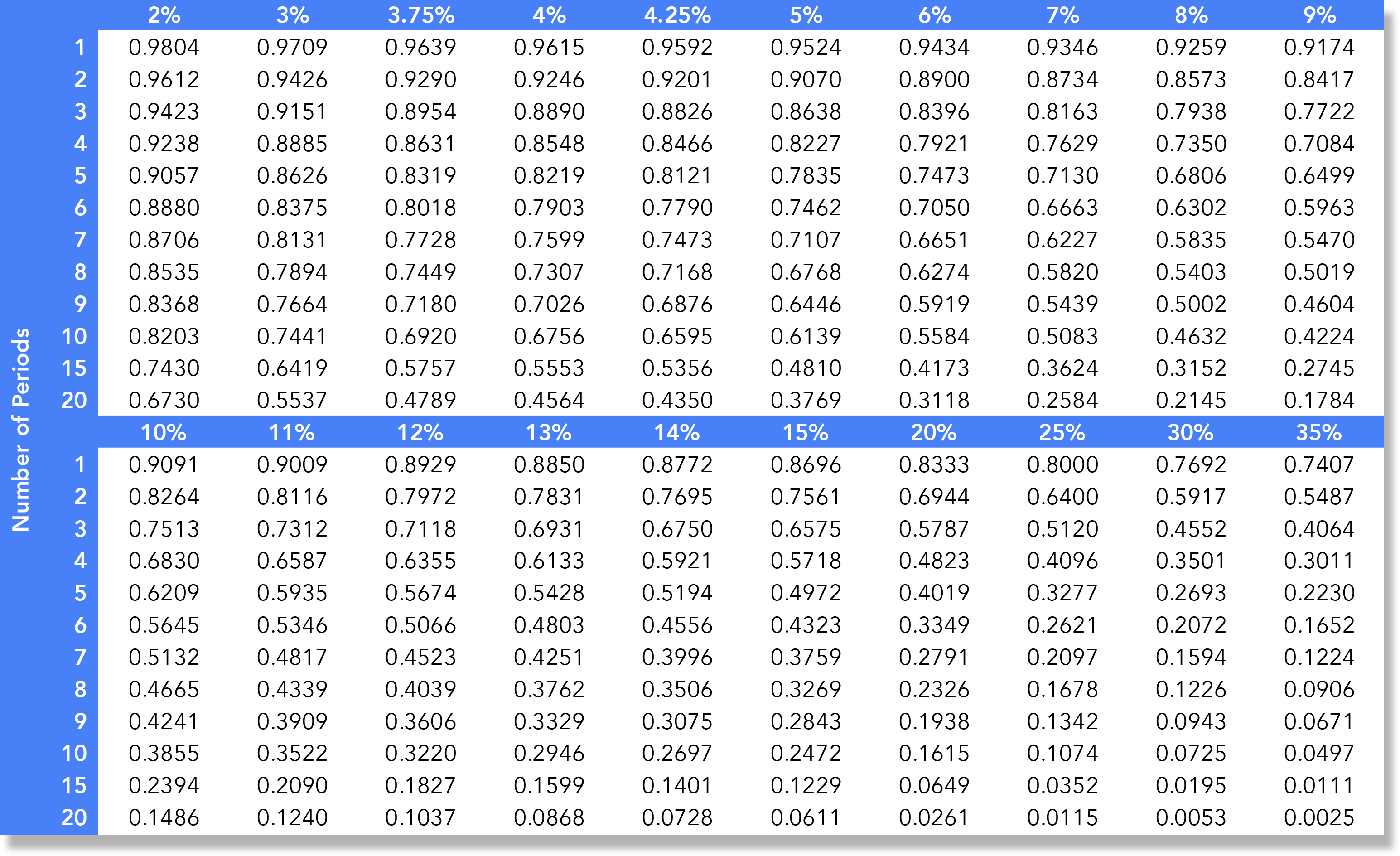
Table 2: Present Value of an Annuity of $1
