Create a free account to get started

Unlock full course notes by signing up

  • Video lessons taught by top educators
  • Practice questions with guided solutions
  • Written review notes for reference
  • Expert answers anytime from course tutors

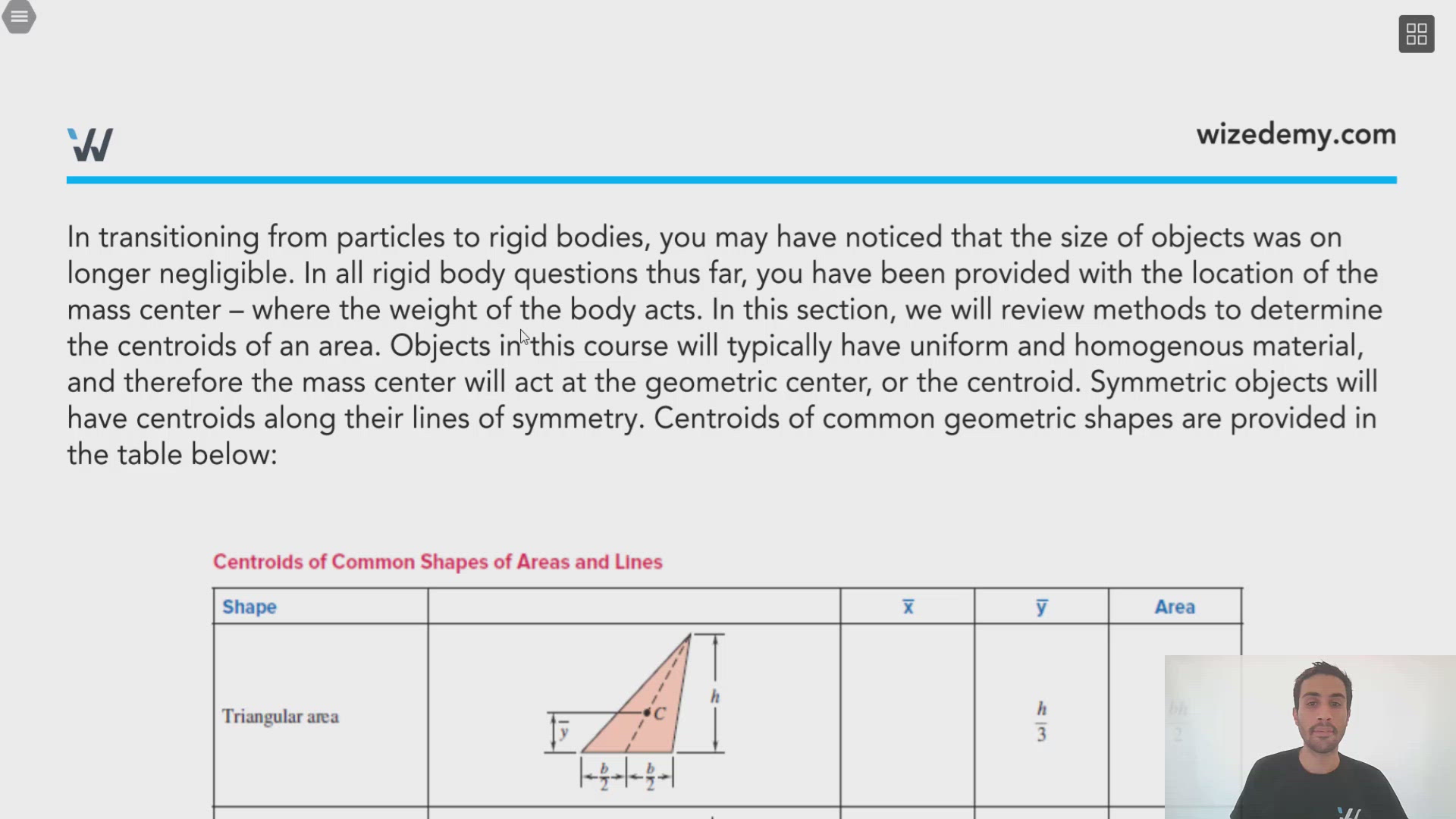
In transitioning from particles to rigid bodies, you may have noticed that the size of objects was on longer negligible. In all rigid body questions thus far, you have been provided with the location of the mass center – where the weight of the body acts. In this section, we will review methods to determine the centroids of an area. Objects in this course will typically have uniform and homogenous material, and therefore the mass center will act at the geometric center, or the centroid. Symmetric objects will have centroids along their lines of symmetry. Centroids of common geometric shapes are provided in the table below:


Image illustrating Centroids of Area


Given some geometric object, there are two ways to determine the location of its centroid:


1) Integration

Like any averaged property, integrating the first area moment and dividing by the area provides us with the location of the centroid. This can be computed as follows:


Image illustrating Centroids of Area

Hibbler: xˉ=∫Ax~dA∫AdA\bar{x}=\frac{\int_{A} \tilde{x} d A}{\int_{A} d A} yˉ=Σy~AΣA\bar{y}=\frac{\Sigma \widetilde{y} A}{\Sigma A}

Beer: x‾=∫xdAA\overline{x}=\frac{\int_{ }^{ }xdA}{A} yˉ=∫ydAA\bar{y}=\frac{\int y d A}{A}


2) Composite sections


A more common method to calculate centroids is based on composite shapes. We decompose the shape into multiple smaller sections, each with a centroid easy to determine (ie. square, triangle, circle, etc.), and average its properties to determine the centroid of the overall object. It is best to determine this to compute this is the format of a table. The integral formula simplifies to:
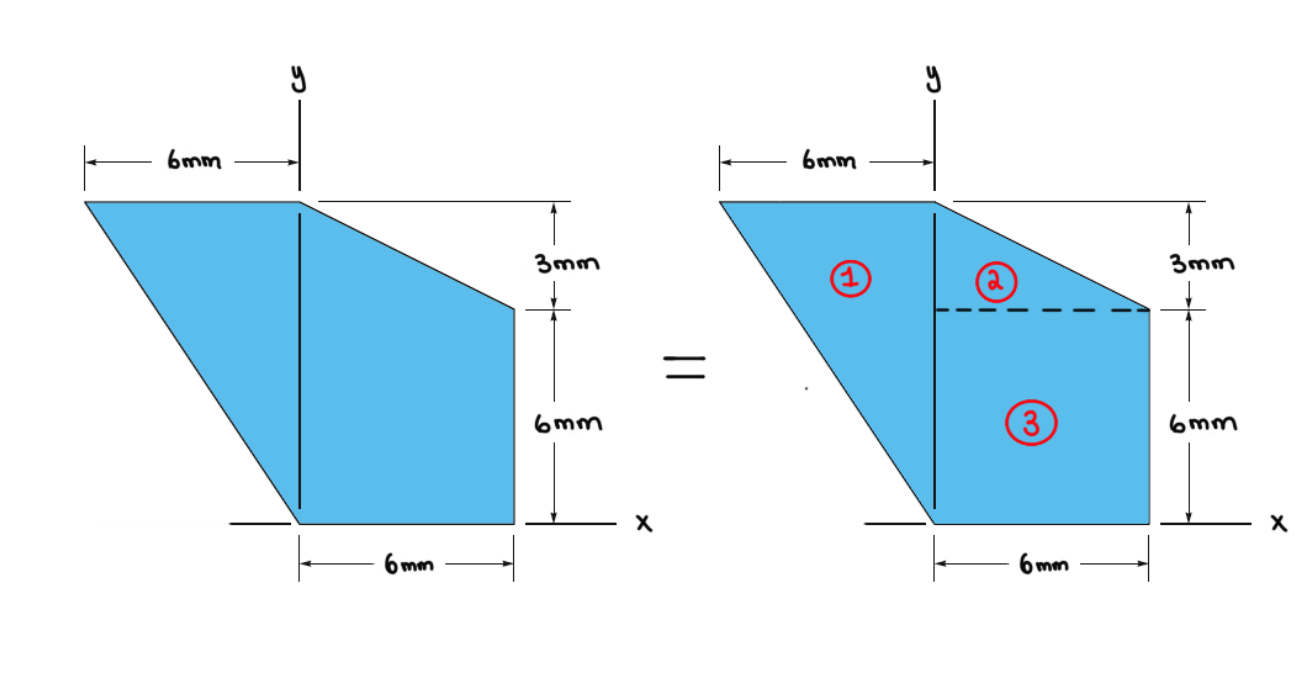
Image illustrating Centroids of Area

x‾=Σi=1nx~iAiΣi=1nAi\overline{x}=\frac{\Sigma^n_{i_=1}\tilde{x}_iA_i }{\Sigma^n_{i_=1}A_i }

y‾=yˉ=Σi=1ny~iAiyˉ=Σi=1nAi\overline{y}=\frac{\bar{y}=\Sigma^n_{i_=1}\tilde{y}_iA_i }{\bar{y}=\Sigma^n_{i_=1}A_i }


Note: bodies with cavities (holes) can be treated as negative area for purposes of this analysis.
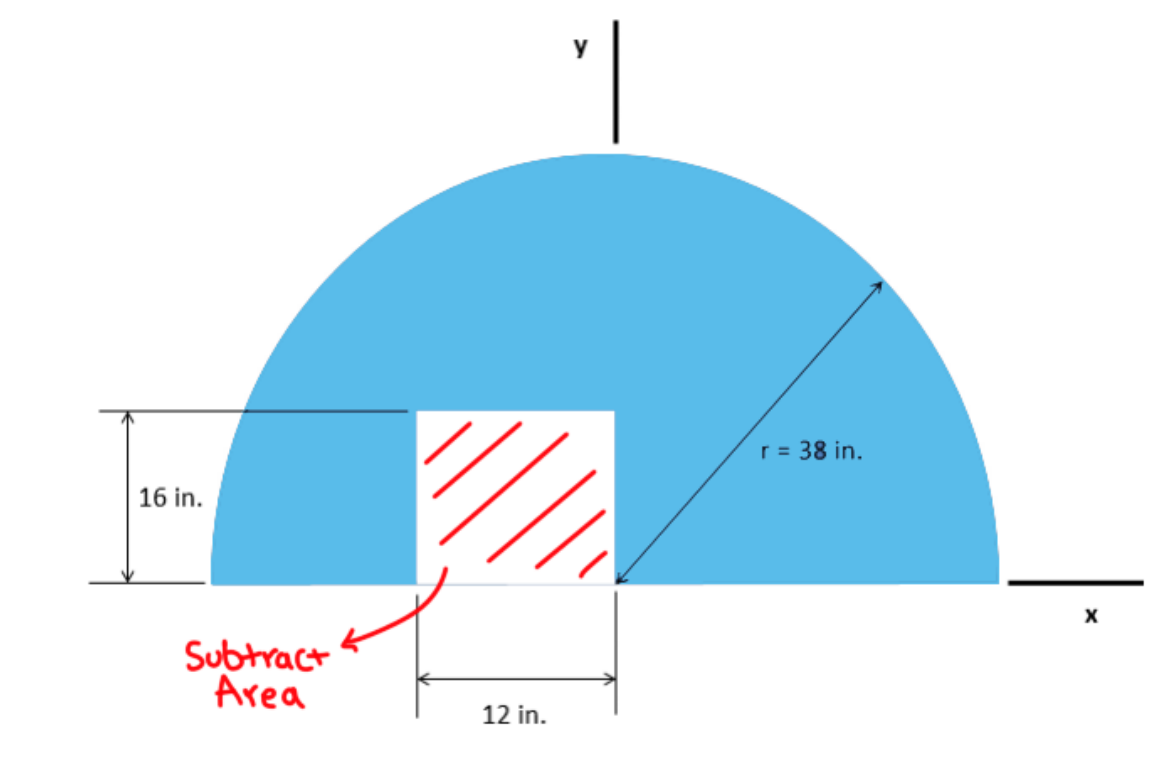

Image illustrating Centroids of Area


Create a free account to get started

Unlock full course notes by signing up

  • Video lessons taught by top educators
  • Practice questions with guided solutions
  • Written review notes for reference
  • Expert answers anytime from course tutors

In transitioning from particles to rigid bodies, you may have noticed that the size of objects was on longer negligible. In all rigid body questions thus far, you have been provided with the location of the mass center – where the weight of the body acts. In this section, we will review methods to determine centroids of an area. Objects in this course will typically have uniform and homogenous material, and therefore the mass center will act at the geometric center, or the centroid. Symmetric objects will have centroids along their lines of symmetry. Centroids of common geometric shapes are provided in the table below:


Image illustrating Centroids of Area


Given some geometric object, there are two ways to determine the location of its centroid:

  1. Integration

Like any averaged property, integrating the first area moment and dividing by the area provides us with the location of the centroid. This can be computed as follows:


xˉA=∫xdA\bar{x}A= \int{x}dA yˉA=∫ydA\bar{y}A= \int{y}dA


2) Composite sections

A more common method to calculate centroids is based on composite shapes. We decompose the shape into multiple smaller sections, each with a centroid easy to determine (ie. square, triangle, circle, etc.), and average its properties to determine the centroid of the overall object. It is best to determine this to compute this is the format of a table. The integral formula simplifies to:

x‾=Σi=1nx~iAiΣi=1nAi\overline{x}=\frac{\Sigma^n_{i_=1}\tilde{x}_iA_i }{\Sigma^n_{i_=1}A_i } y‾=yˉ=Σi=1ny~iAiyˉ=Σi=1nAi\overline{y}=\frac{\bar{y}=\Sigma^n_{i_=1}\tilde{y}_iA_i }{\bar{y}=\Sigma^n_{i_=1}A_i }


Note: bodies with cavities (holes) can be treated as negative area for purposes of this analysis.
Create a free account to get started

Unlock full course notes by signing up

  • Video lessons taught by top educators
  • Practice questions with guided solutions
  • Written review notes for reference
  • Expert answers anytime from course tutors

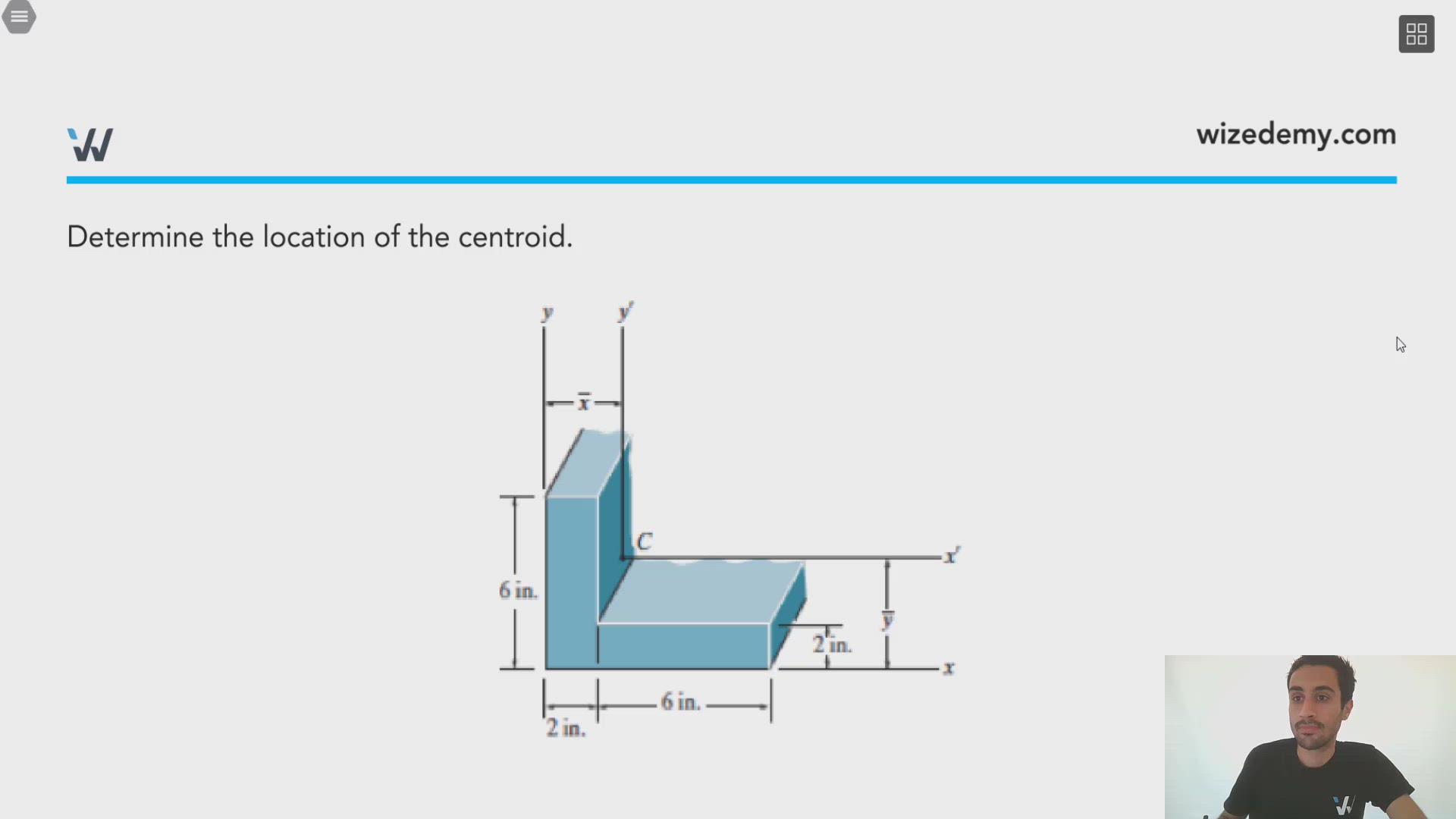
Determine the location of the centroid.
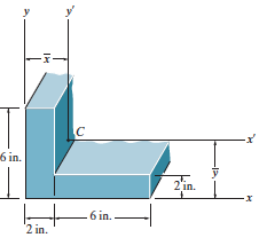


Image illustrating Example: Centroids of Area - Geometric (DO THIS!)


Image illustrating Example: Centroids of Area - Geometric (DO THIS!)


Image illustrating Example: Centroids of Area - Geometric (DO THIS!)


Create a free account to get started

Unlock full course notes by signing up

  • Video lessons taught by top educators
  • Practice questions with guided solutions
  • Written review notes for reference
  • Expert answers anytime from course tutors

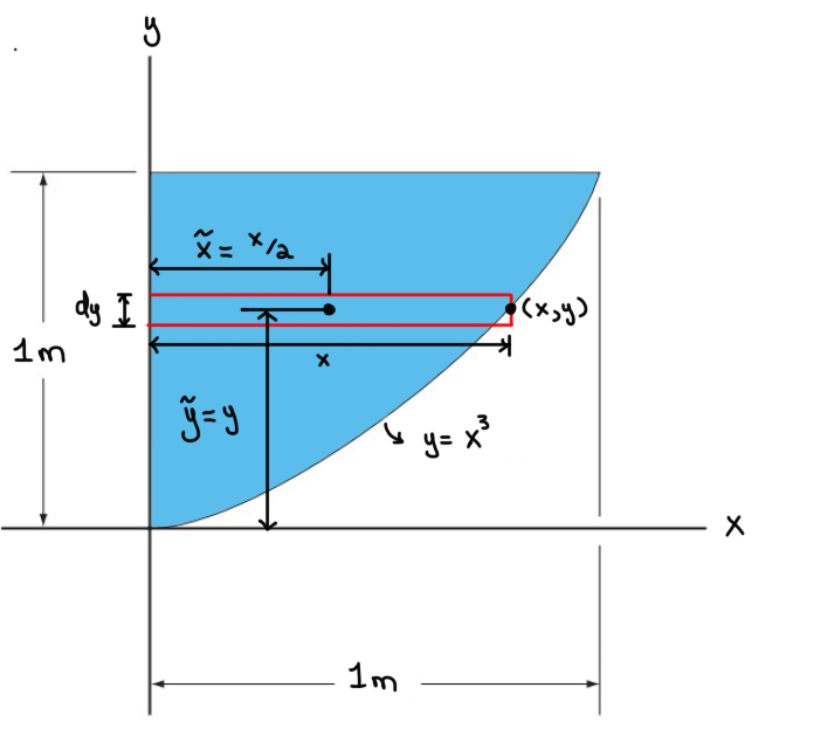
Determine the location of the centroid.
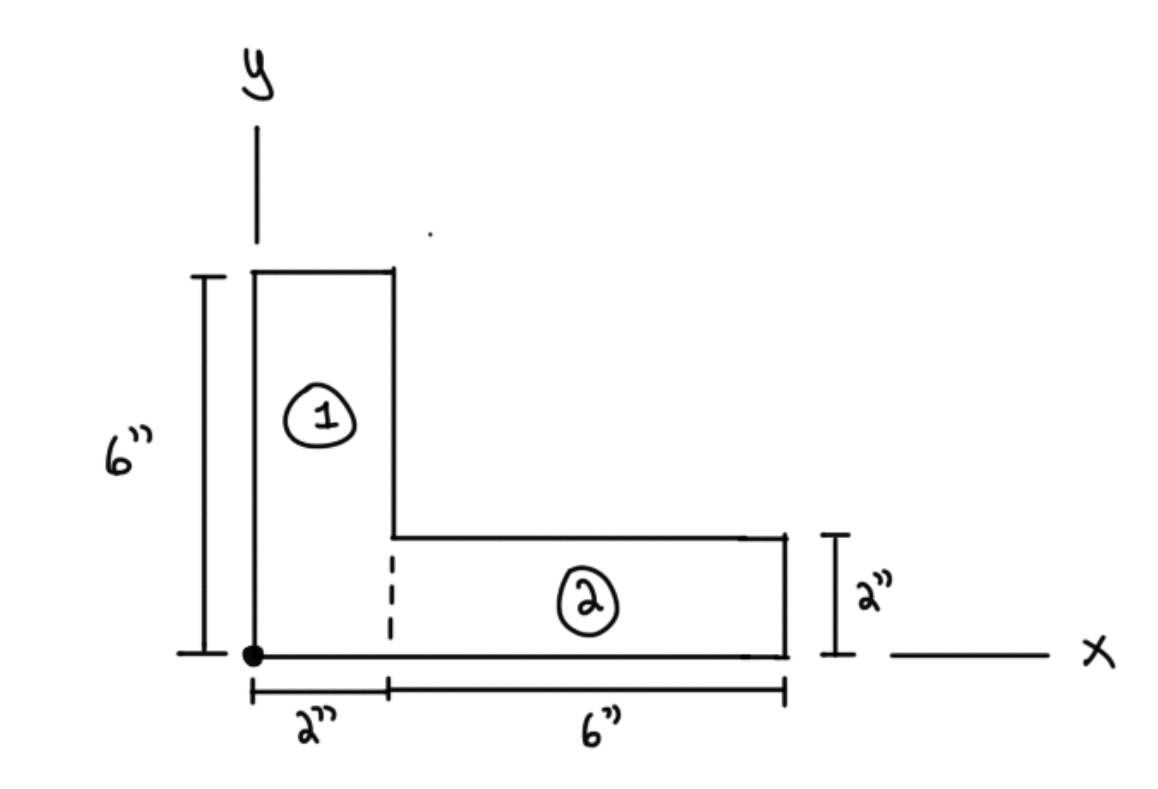

Image illustrating Example: Centroids of Area - Integration (OPTIONAL)


Cut out one Strip,


Image illustrating Example: Centroids of Area - Integration (OPTIONAL)


1) For X-Bar,


xˉ=∫Ax~dA∫AdA\bar{x}=\frac{\int_{A} \tilde{x} d A}{\int_{A} d A}


 Substitute x/2 for x~,y1/3dyfor dA, and y1/3 for x\text { Substitute } x / 2 \text { for } \tilde{x}, y^{1 / 3} d y^{\text {for }} d A, \text { and } y^{1 / 3} \text { for } x


xˉ=∫0112(y1/3)⋅(y1/3dy)∫01y1/3dy=12∫01y2/3dy∫01y1/3dy\begin{aligned} \bar{x} &=\frac{\int_{0}^{1} \frac{1}{2}\left(y^{1 / 3}\right) \cdot\left(y^{1 / 3} d y\right)}{\int_{0}^{1} y^{1 / 3} d y} \\ &=\frac{\frac{1}{2} \int_{0}^{1} y^{2 / 3} d y}{\int_{0}^{1} y^{1 / 3} d y} \end{aligned}


Apply Limits


xˉ=12∣y(23+1)/(23+1)∣01∣y(13+1)/(13+1)∣01\bar{x}=\frac{\frac{1}{2}\left|y^{\left(\frac{2}{3}+1\right)} /\left(\frac{2}{3}+1\right)\right|_{0}^{1}}{\left|y^{\left(\frac{1}{3}+1\right)} /\left(\frac{1}{3}+1\right)\right|_{0}^{1}}

=310∣y(5/3)∣0134∣y(4/3)∣01=310[(1)5/3−(0)5/3]34[(1)4/3−(0)4/3]\begin{aligned}=& \frac{\frac{3}{10}\left|y^{(5 / 3)}\right|_{0}^{1}}{\frac{3}{4}\left|y^{(4 / 3)}\right|_{0}^{1}} \\=& \frac{\frac{3}{10}\left[(1)^{5 / 3}-(0)^{5 / 3}\right]}{\frac{3}{4}\left[(1)^{4 / 3}-(0)^{4 / 3}\right]} \end{aligned}

=(310×43)m=\left(\frac{3}{10} \times \frac{4}{3}\right) \mathrm{m}

x‾=0.4 m\overline{x}=0.4\ m

2) For Y-bar use the same strip, dA does not change.


yˉ=∫Ay~dA∫AdA\bar{y}=\frac{\int_{A} \tilde{y} d A}{\int_{A} d A}


yˉ=∫01(y)⋅(y1/3dy)∫01y1/3dy\bar{y}=\frac{\int_{0}^{1}(y) \cdot\left(y^{1 / 3} d y\right)}{\int_{0}^{1} y^{1 / 3} d y}


yˉ=∫01y4/3dy∫01y1/3dy\bar{y}=\frac{\int_{0}^{1} y^{4 / 3} d y}{\int_{0}^{1} y^{1 / 3} d y}


yˉ=∣y(43+1)/(43+1)∣01∣y(13+1)/(13+1)∣01\bar{y}=\frac{\left|y^{\left(\frac{4}{3}+1\right)} /\left(\frac{4}{3}+1\right)\right|_{0}^{1}}{\left|y^{\left(\frac{1}{3}+1\right)} /\left(\frac{1}{3}+1\right)\right|_{0}^{1}}


=37∣y(7/3)∣0134∣y(4/3)∣01=\frac{\frac{3}{7}\left|y^{(7 / 3)}\right|_{0}^{1}}{\frac{3}{4}\left|y^{(4 / 3)}\right|_{0}^{1}}


=37[(1)7/3−(0)7/3]34[(1)4/3−(0)4/3]=\frac{\frac{3}{7}\left[(1)^{7 / 3}-(0)^{7 / 3}\right]}{\frac{3}{4}\left[(1)^{4 / 3}-(0)^{4 / 3}\right]}


=(37×43)myˉ=0.5714m\begin{aligned} &=\left(\frac{3}{7} \times \frac{4}{3}\right) \mathrm{m} \\ \bar{y} &=0.5714 \mathrm{m} \end{aligned}


Practice


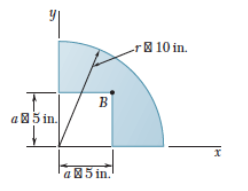
Find the centroid of the following shape.

Illustration for practice question: (MT) Centroids Practice - Geometric


Your answers

Create a free account to get started

Unlock full course notes by signing up

  • Video lessons taught by top educators
  • Practice questions with guided solutions
  • Written review notes for reference
  • Expert answers anytime from course tutors

Practice


Find the centroid y‾ \overline{y}\ of the following shape


Illustration for practice question: (MT/FINAL) Centroids Practice - Geometric


Your answers

Create a free account to get started

Unlock full course notes by signing up

  • Video lessons taught by top educators
  • Practice questions with guided solutions
  • Written review notes for reference
  • Expert answers anytime from course tutors

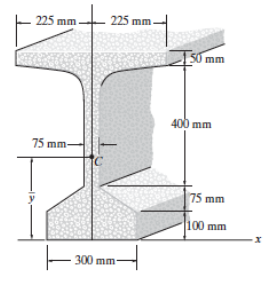
Determine the location yˉ\bar{y} of the centroid C of the beam having the cross-sectional area shown working from the top-down.

Illustration for practice question: Determine the location of the centroid C of the beam having the cross-sectional area shown working from the top-down.


Your answers

Create a free account to get started

Unlock full course notes by signing up

  • Video lessons taught by top educators
  • Practice questions with guided solutions
  • Written review notes for reference
  • Expert answers anytime from course tutors

Quiz: Centroids Practice - Geometric Quiz (New)

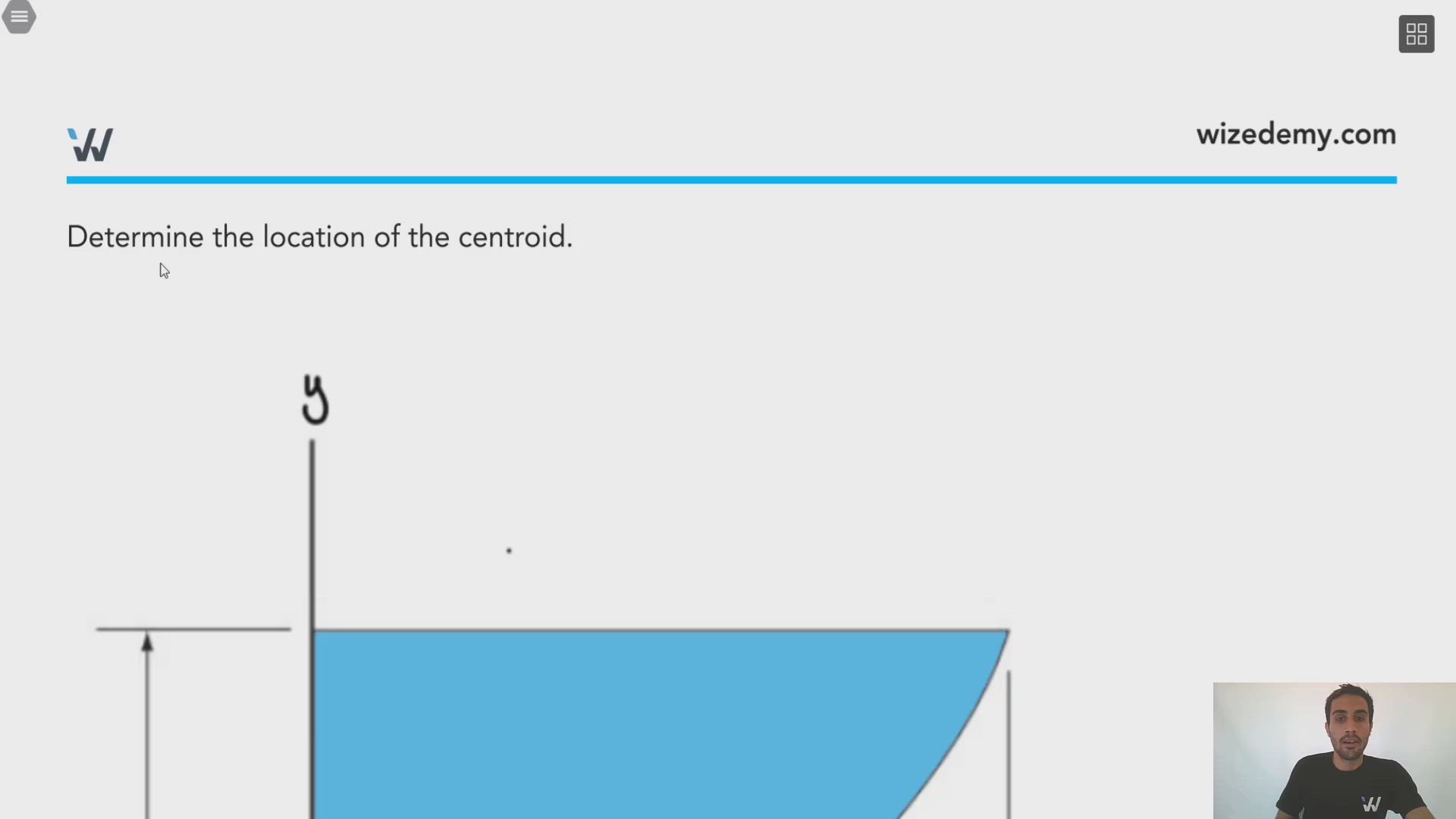
Determine the location of the centroid.
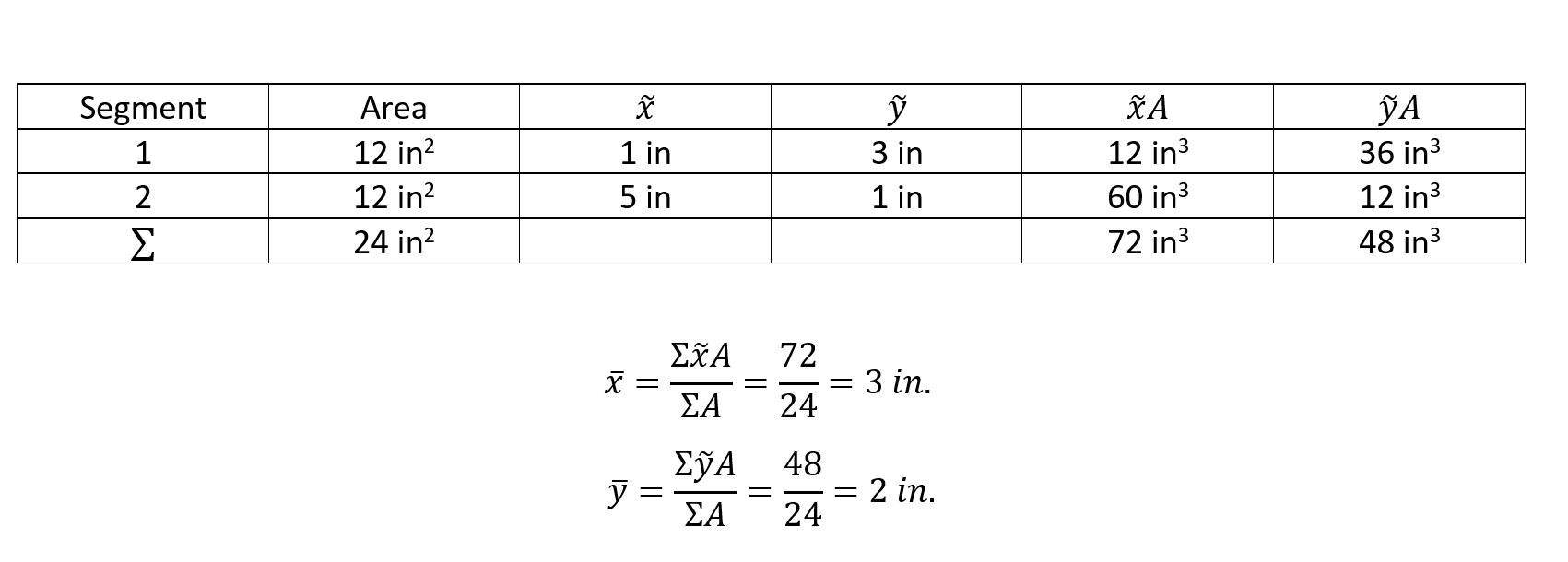

Illustration for practice question: Determine the location of the centroid.

Your answers

Determine the location of the centroid, as measured by yˉ\bar{y}


Illustration for practice question: Determine the location of the centroid, as measured by


Practice

Find the location of the centroid of the following body.


Illustration for practice question: (MT/FINAL) Centroids Practice - Geometric 3D


Your answers

Create a free account to get started

Unlock full course notes by signing up

  • Video lessons taught by top educators
  • Practice questions with guided solutions
  • Written review notes for reference
  • Expert answers anytime from course tutors

Practice


Find the centroid of the following shape


Illustration for practice question: Practice


Your answers

Create a free account to get started

Unlock full course notes by signing up

  • Video lessons taught by top educators
  • Practice questions with guided solutions
  • Written review notes for reference
  • Expert answers anytime from course tutors

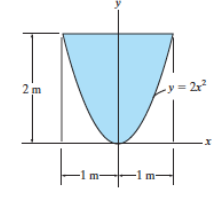
Find the centroid of the following shape:


Illustration for practice question: Centroids (2D) Integration


Your answers

Create a free account to get started

Unlock full course notes by signing up

  • Video lessons taught by top educators
  • Practice questions with guided solutions
  • Written review notes for reference
  • Expert answers anytime from course tutors

Quiz: Centroids Practice - Integration Quiz (New)

Determine the location of the centroid.
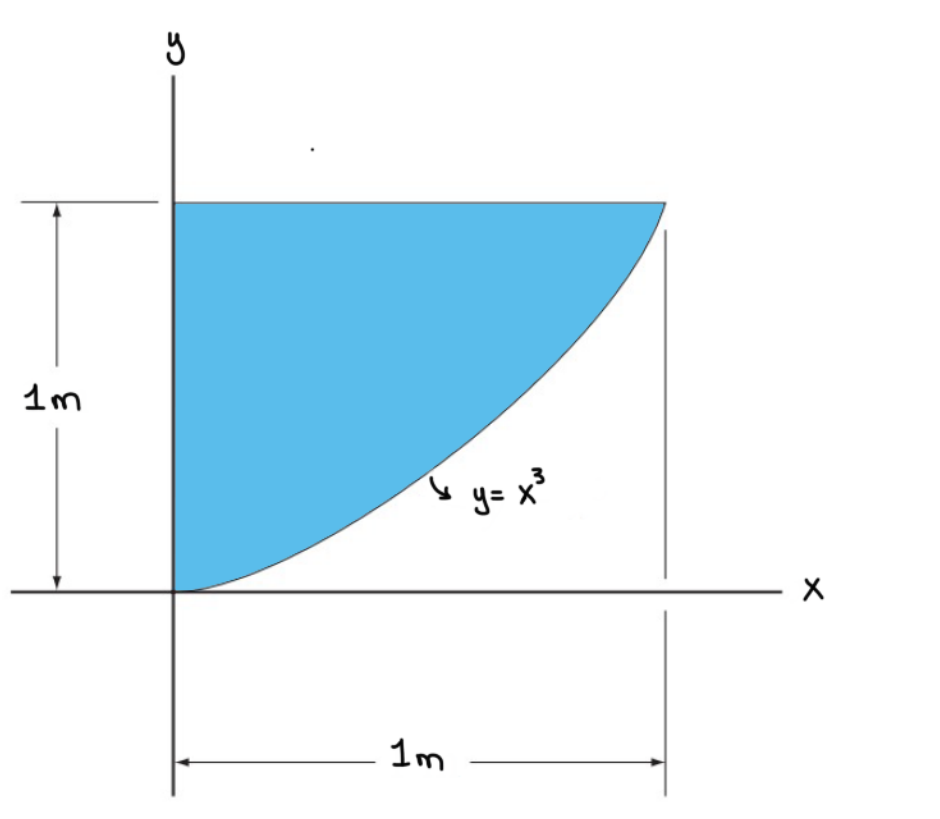

Illustration for practice question: Determine the location of the centroid.