Wize University Statics Textbook (Master) > Friction
Friction Around Pulleys
0:00 / 0:00
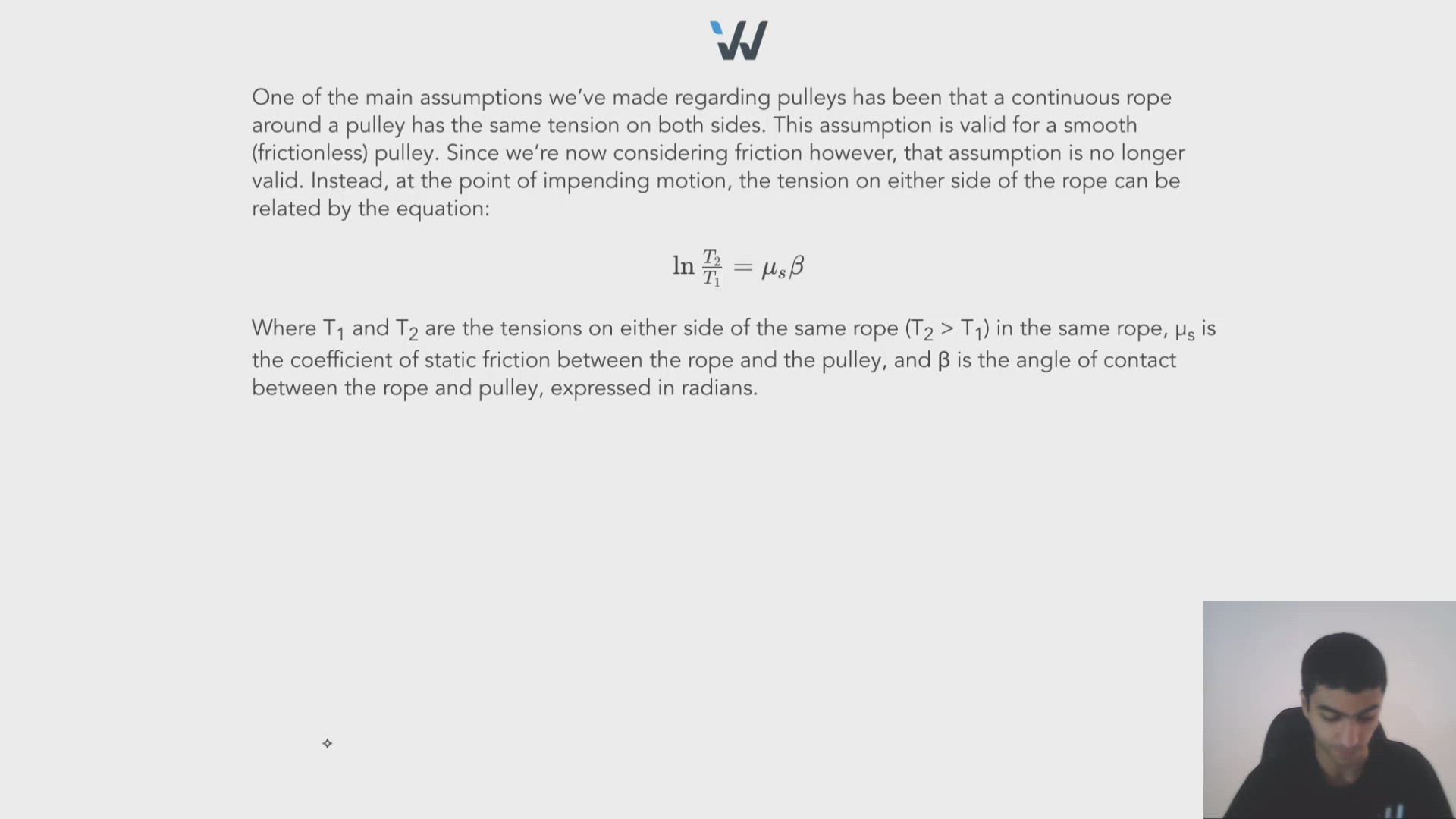
One of the main assumptions we’ve made regarding pulleys has been that a continuous rope around a pulley has the same tension on both sides. This assumption is valid for a smooth (frictionless) pulley. Since we’re now considering friction however, that assumption is no longer valid. Instead, at the point of impending motion, the tension on either side of the rope can be related by the equation:
Where T1 and T2 are the tensions on either side of the same rope (T2 > T1) in the same rope, µs is the coefficient of static friction between the rope and the pulley, and β is the angle of contact between the rope and pulley, expressed in radians.

0:00 / 0:00
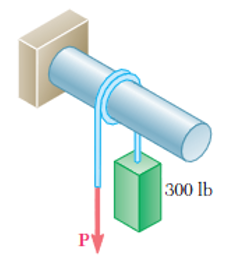
Determine the range of values of P for which equilibrium can be maintained if the coefficient of static friction is 0.15 between the cable and the bar.

Mark Yourself Question
- Grab a piece of paper and try this problem yourself.
- When you're done, check the "I have answered this question" box below.
- View the solution and report whether you got it right or wrong.
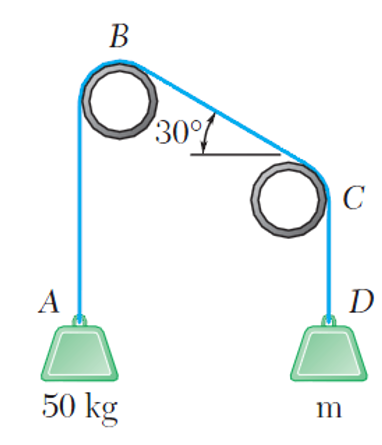
Determine the range of values of 'm' for which the system will remain in equilibrium if the coefficient of static friction is 0.40 between the cable and the pulleys.
Quiz: Friction Around Pulleys Practice Questions
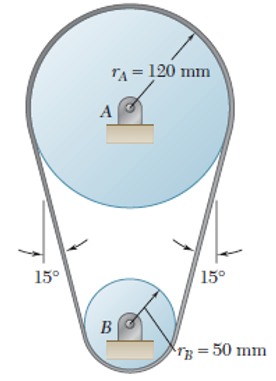
The belt shown is used to transmit a couple from drum B to drum A. Knowing that the coefficient of static friction is 0.50, and that the maximum allowable tension in the belt is 450 N, determine the tension on the other side of the belt.