
Catalysts
Catalysis General Information
- A catalyst is a species which is not consumed in the reaction but changes the RATE of the reaction
- A catalyst can increase the rate of a reaction by lowering the activation energy
- Activation Energy (Ea): Is the minimum amount of energy that the reacting species must possess to undergo the specified reaction.

- Since the catalyst lowers Ea for a reaction, does it speed up just the forward, backward, or forward and backward reaction?
- ________
- Speeds up the forward and reverse reaction for that step equally.
- Will the equilibrium constant change when we add a catalyst?
- ________
- Would the change in enthalpy be affected by a catalyst? If so, how? (Draw where we could see deltaH or deltaG on the above plot)
- ________
- **This is a reminder that catalysts have to do with kinetics/thermodynamics: ________ so they don't affect equilibrium constants, Gibb's Free Energy, reaction enthalpy, equilibrium concentrations, etc, which have to do with kinetics/thermodynamics: ________
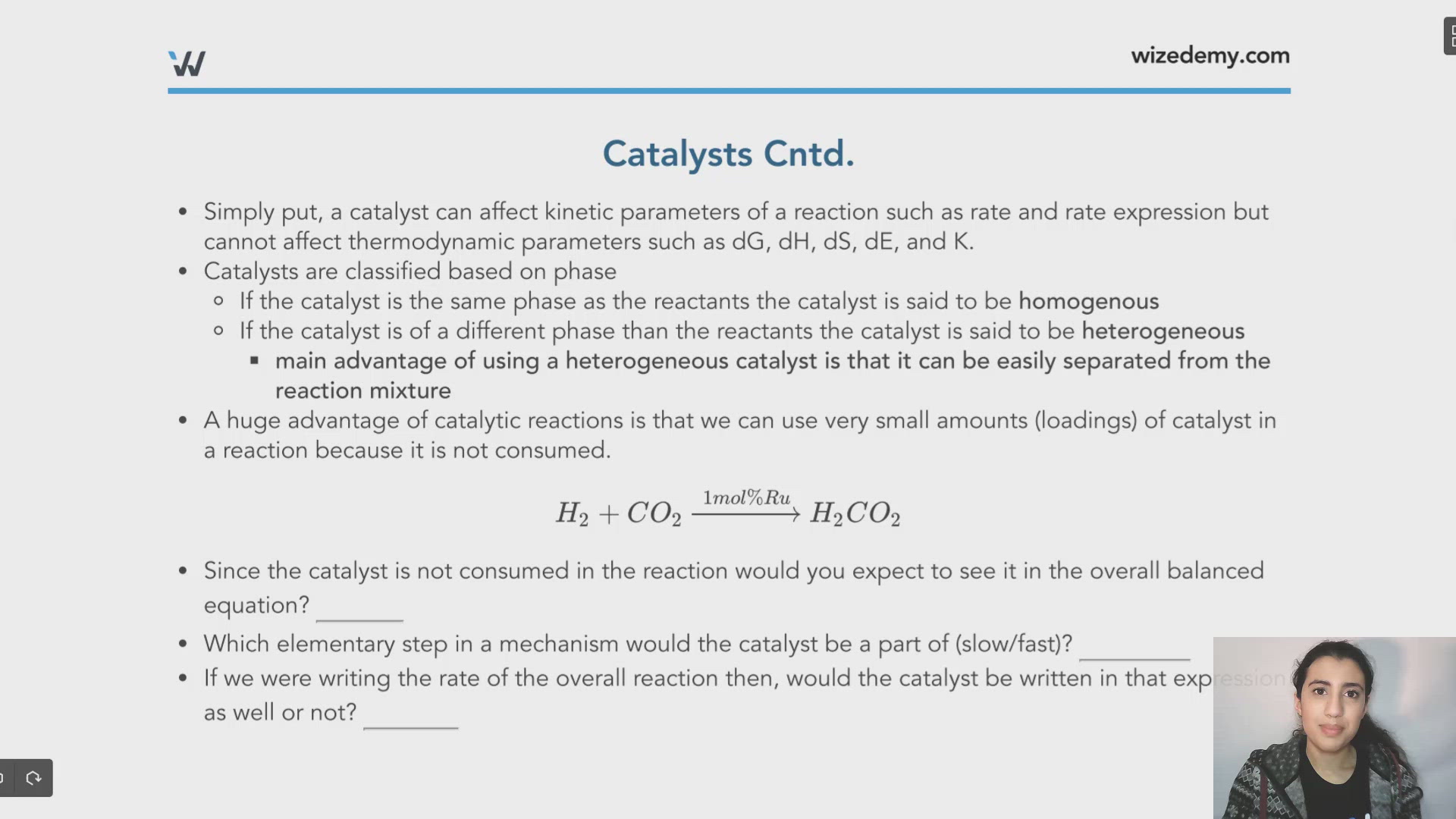
Catalysts Cntd.
- Simply put, a catalyst can affect kinetic parameters of a reaction such as rate and rate expression but cannot affect thermodynamic parameters such as ΔG, ΔH, ΔS, ΔE, and K.
- Catalysts are classified based on phase
- If the catalyst is the same phase as the reactants the catalyst is said to be homogenous
- If the catalyst is of a different phase than the reactants the catalyst is said to be heterogeneous
- main advantage of using a heterogeneous catalyst is that it can be easily separated from the reaction mixture
- A huge advantage of catalytic reactions is that we can use very small amounts (loadings) of catalyst in a reaction because it is not consumed.
- Since the catalyst is not consumed in the reaction would you expect to see it in the overall balanced equation? ________
- Which elementary step in a mechanism would the catalyst be a part of (slow/fast)? ________
- If we were writing the rate of the overall reaction then, would the catalyst be written in that expression as well or not? ________
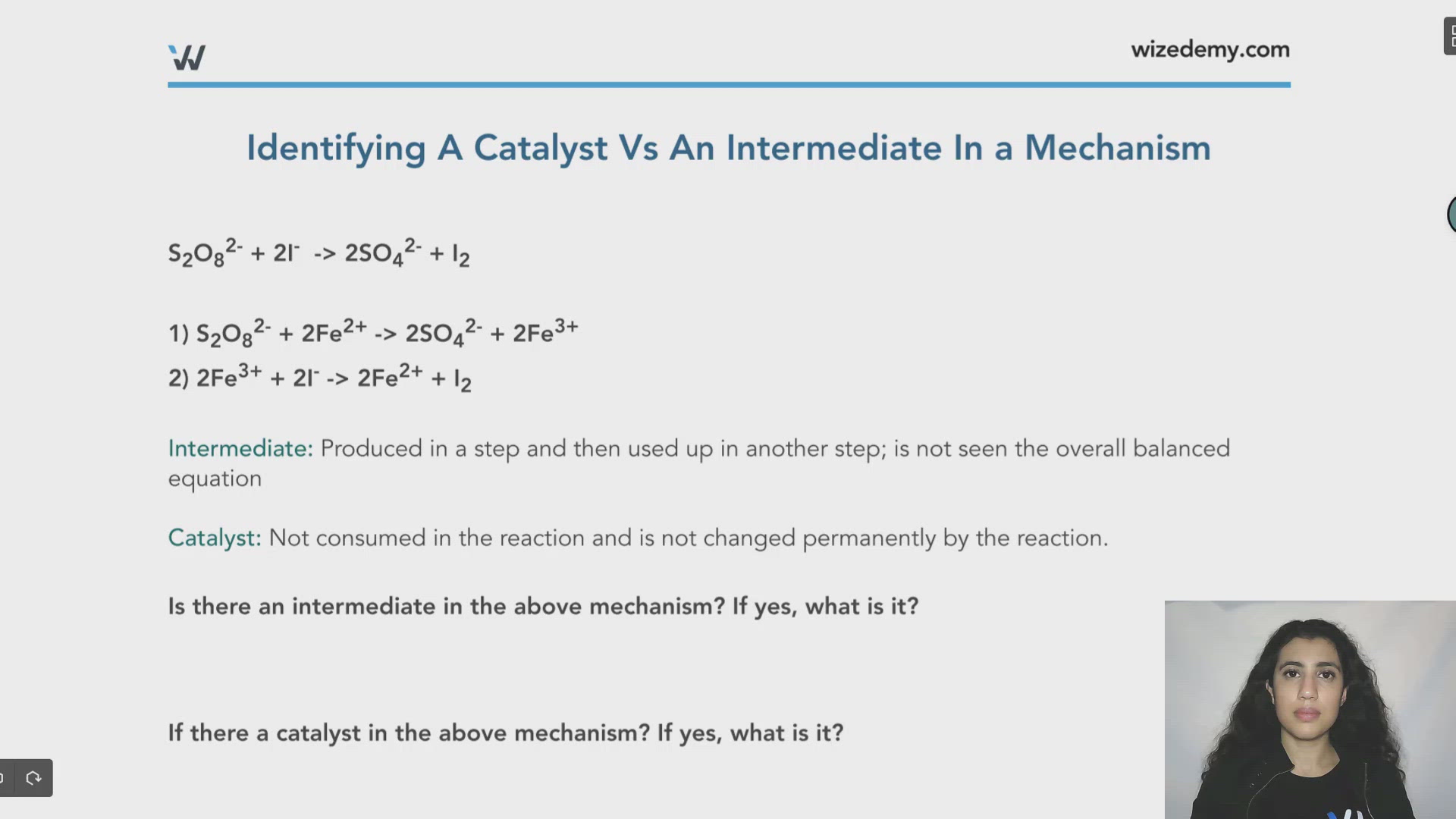
Identifying A Catalyst Vs An Intermediate In a Mechanism
S2O82- + 2I- -> 2SO42- + I2
1) S2O82- + 2Fe2+ -> 2SO42- + 2Fe3+
2) 2Fe3+ + 2I- -> 2Fe2+ + I2
Is there an intermediate in the above mechanism? If yes, what is it?
- Fe3+ is produced in the first step and is then used in the second step
If there a catalyst in the above mechanism? If yes, what is it?
- Fe2+ was present in the beginning of the 1st step and is seen at the end of the reaction in the 2nd step
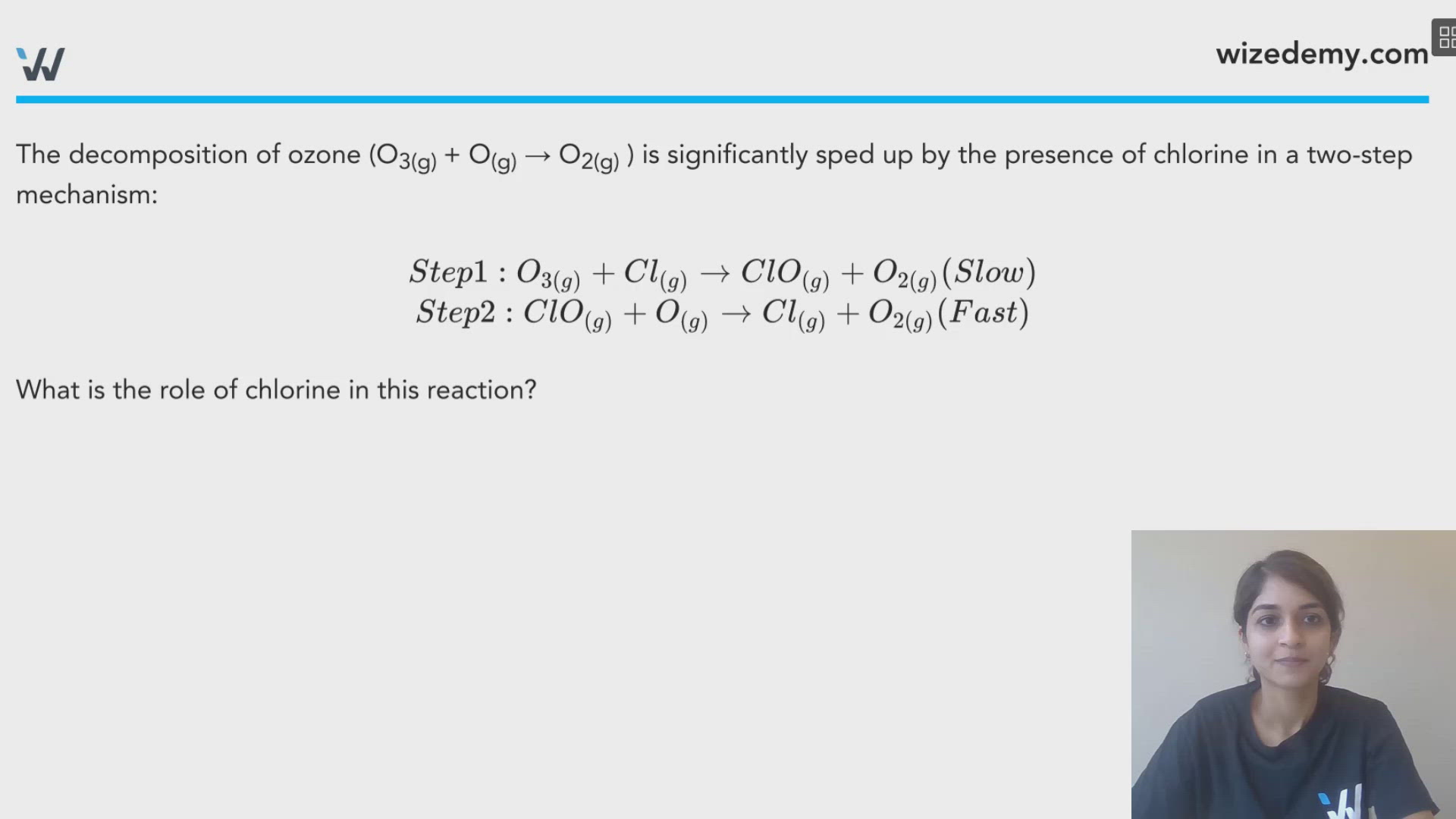
The decomposition of ozone (O3(g) + O(g) → O2(g) ) is significantly sped up by the presence of chlorine in a two-step mechanism:
What is the role of chlorine in this reaction?
Chlorine is not consumed in the reaction but speeds it up so it is a catalyst!