Wize University Chemistry Textbook > Kinetics
Reaction Mechanisms
Popular Courses
MCAT
General Course
Grade 12 Chemistry
Ontario High School
Grade 12 Chemistry
Canada High School
CHEM 1302A/B
Western University
General Chemistry
University Study Guides
AP Chemistry Exam Prep Course
AP Exam Prep
CHEM 112
Queen's University
CHEM 203
University of Calgary
High School Chemistry
US High School
Chemistry 30
Alberta High School
DAT
General Course
CHM 1311
University of Ottawa
Chemistry
General Course
CHEM 1AA3
McMaster University
General Chemistry
University Study Guides
ENGG 204
University of Calgary
Chemistry 12
British Columbia High School
CHM135H1
University of Toronto
CHEM 154
University of British Columbia
CHEM 102
University of Alberta

0:00 / 0:00
Reactions Mechanisms – Elementary Reactions
- All complex chemical reactions occur via a set of simpler reactions called elementary reactions.
- The summation of all these elementary reactions is referred to as the mechanism of the reaction.
- A mechanism tells us how a complex reaction occurs
- Elementary reactions can be classified based on the number of molecules which have to simultaneously collide. This is often referred to as molecularity.
The rate of an elementary reaction is quite simply expressed below.
What about if we had an elementary reaction like this:
2A +B-> C what is the molecularity?
termolecular
And what would the rate law look like for this elementary reaction?
v=k[A]2[B]
Note: ONLY for elementary reactions can we use stoichiometry for rate laws
Example: Write out a general rate law for the following elementary reactions.
0:00 / 0:00
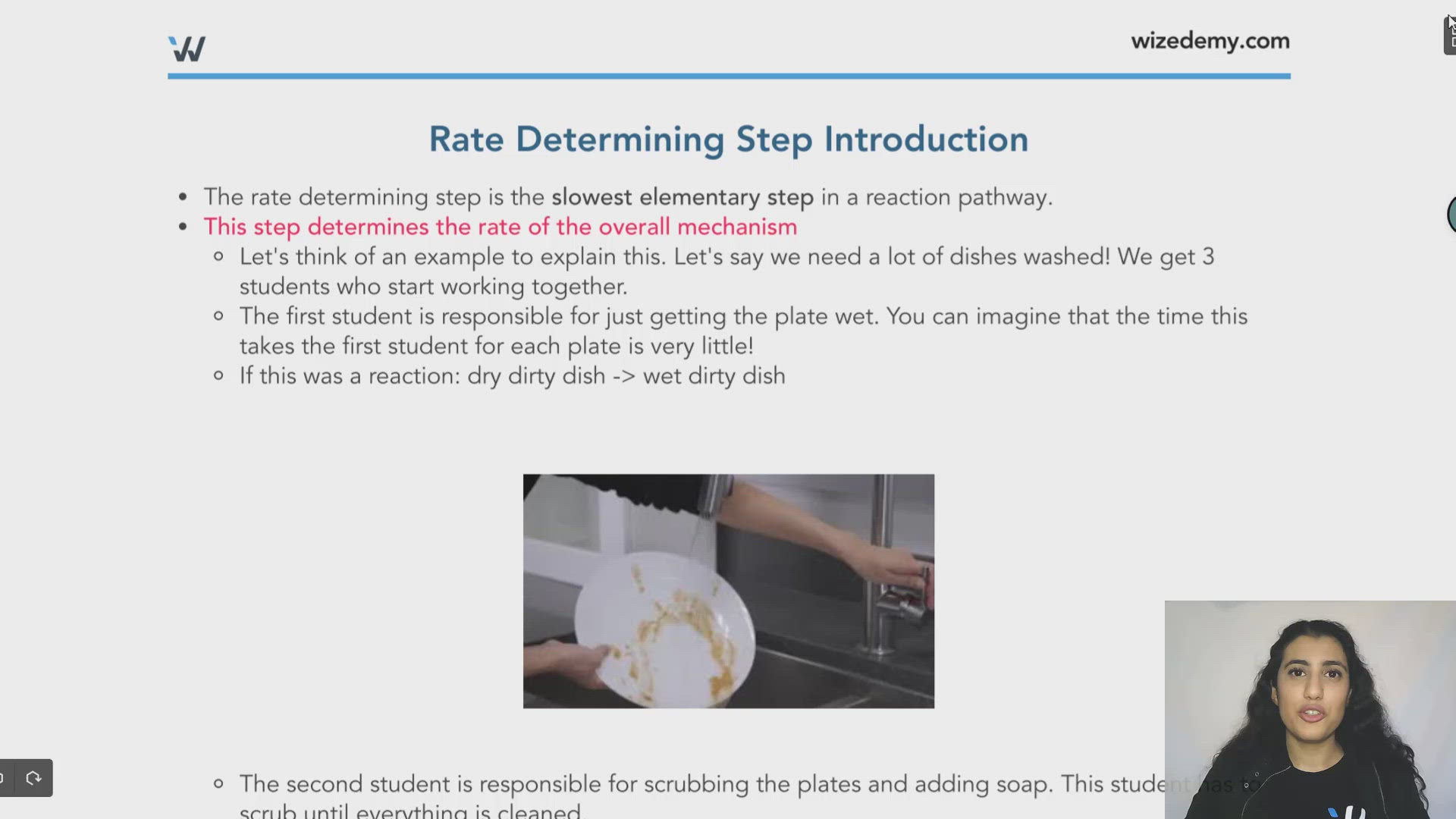
Rate Determining Step Introduction
- The rate determining step is the slowest elementary step in a reaction pathway.
- This step determines the rate of the overall mechanism
- Let's think of an example to explain this. Let's say we need a lot of dishes washed! We get 3 students who start working together.
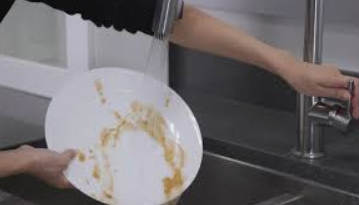
- The first student is responsible for just getting the plate wet. You can imagine that the time this takes the first student for each plate is very little!
- If this was a reaction: dry dirty dish -> wet dirty dish
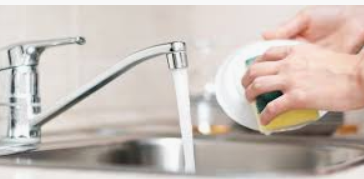
- The second student is responsible for scrubbing the plates and adding soap. This student has to scrub until everything is cleaned.
- If this was a reaction: wet dirty dish -> wet clean dish
- Finally, the third student just needs to pat the front and and back of the plate to dry it.
- If this was a reaction: wet clean dish -> dry clean dish

- Which student do you think would take the most amount of time per plate for their step?#2
- This means that the rate of the overall process going from dry dirty dish -> dry clean dish is determined by which step?#2
- If we increase the rate of step 1 do you think that would affect the rate of the overall process?No!
- The rate of the reaction is limited by the rate determining step.
- So if student 1 and 3 are both cleaning 1 plate/2 seconds but student 2 is cleaning 1 plate/30 seconds, the rate of the overall reaction would be 1 plate/30 seconds.
- Reducing the time it takes for student 1 and 3 to 1plate/1sec does nothing to the RDS and so the overall process will still take 30 seconds/plate.
- Then how could we increase the rate of the reaction?
Get student 2 a helper!
- In chemical reactions we use a catalyst! (*more on this later!)
0:00 / 0:00
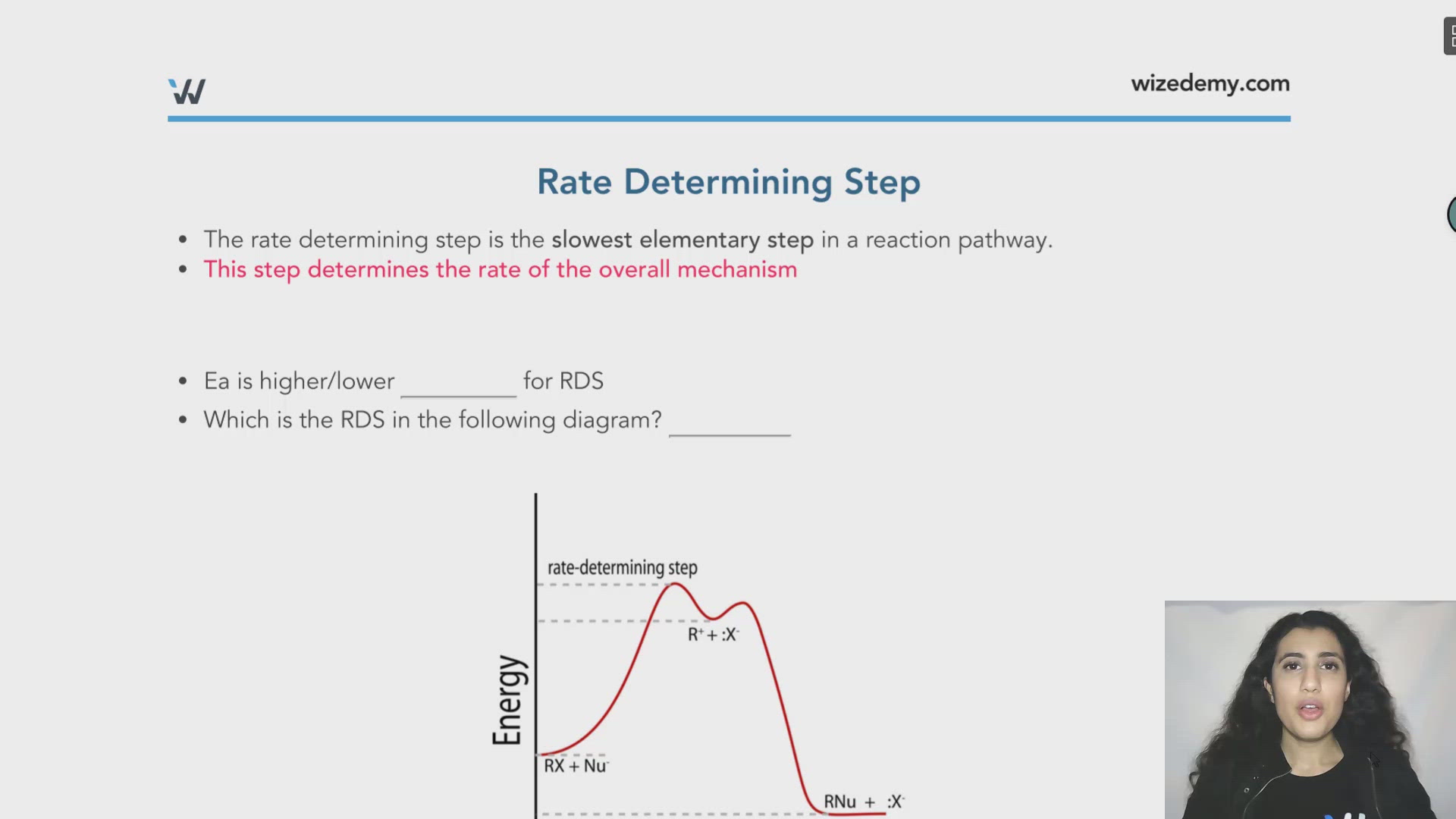
Rate Determining Step
- The rate determining step is the slowest elementary step in a reaction pathway.
- This step determines the rate of the overall mechanism
- Ea is higher/lowerhigherfor RDS
- Which is the RDS in the following diagram?Step 1

The reaction order can't be determined from the overall balanced equation
a) We could determine the reaction order from experimental data
OR
b) We could determine the reaction order from a reaction mechanism (that shows elementary steps)
For the following mechanism, what is the rate for the overall reaction?
NO2(g) + CO(g) -> NO(g) + CO2(g)
Mechanism:
Step 1: NO2 + NO2 -> NO + NO3 (slow)
Step 2: NO3 + CO -> NO2 + CO2 (fast)
Wize Tip
Since we will need the proper coefficients when figuring out the rate law, check to see if the equations are balanced!
1) What is the rate of each of the elementary steps?
Step 1: rate=k[NO2]2
Step 2: rate=k[NO3][CO]
Wize Tip
Here we can do this because it is clear that these are elementary steps (labelled Step 1 and 2). On your test don't assume you're looking at an elementary step unless it says so!
2) Which of these steps determines the rate of the overall reaction?
Step 1 (RDS)
3) What is the rate of the overall reaction?
Step 1 is the RDS so it determines the rate of the overall reaction.
rate=k[NO2]2
4) Are there any reaction intermediates? Where would we see these on the reaction coordinate diagram?
Intermediates are produced in one step and used up in another. They are not seen in the overall balanced equation.
Here NO3 is an intermediate.
Would see intermediates in the dips of energy before another peak (they get produced but are still high in energy so they want to react)
Do you think intermediates are easy/difficult to isolate?
difficult
5) What order is NO2?
To determine the order, we have to consider what exponent there is for NO2 in the overall rate law. There is an exponent of 2 so it is second order. NO2 is in the overall rate law because it is a reactant in the slow step!
6) What order is CO?
CO is not found in the overall rate law. Therefore, changing the [CO] would not change the rate of the reaction. This means CO is zero order.
7) Could I have found the rate law using this: NO2(g) + CO(g) -> NO(g) + CO2(g)
No. You can't find the rate law using an overall balanced equation.
When given a mechanism you can find the rate law of an elementary step.
If asked to find the rate of an overall reaction, given a mechanism, you need to look at the elementary steps, the rate law of the slowest step=rate of the overall reaction!
8) Which of these steps would the catalyst act on?
Step 1 because it is the RDS. Since the catalyst acts on the RDS (slowest step), it has an effect on the rate and increases the rate!
9) If we looked at the reaction in reverse could we use the same catalyst or would we need a different one? (see reaction energy diagram for help!)
Looking at the reaction diagram, we see that in the forward direction, step 1 has the highest Ea and step 2 has a small Ea. In the reverse, Step 2 has the highest Ea and Step 1 has a smaller Ea. So in the reverse, we would need a catalyst that acts on Step 2! In the forward direction we needed a catalyst that acted on Step 1. Therefore since the catalysts would need to act on different steps, we would need a different catalyst!
Wize Concept
Coefficients from a balanced elementary step can be used to determine the rate law for only that step, whereas coefficients from the balanced RDS are used to get the rate law for the overall reaction!
Wize Tip
One last tip about mechanisms. In the above example, we have a balanced equation and then 2 elemenraty steps. Just note that the steps in a particular mechanism can't be proven, they can only be supported or refuted. You might get a question that gives you different pieces of info and asks which statement supports the mechanism.
For example, if the question said that increasing [CO] led to an increase in rate, would that support or refute the provided mechanism?
[CO] is not in the overall reaction rate law, so it shouldn't have an impact on the rate. Therefore, that piece of information refutes (or goes against) the mechanism that is provided!
Assume the following reaction occurs by the given reaction mechanism.
Step 1 Slow
Step 2 Fast
Step 3 Fast
Overall
The rate law expression must be rate = ______________.
Use the following reaction coordinate diagram to answer the following three questions.

1) How many steps are there in this reaction?

Mark Yourself Question
- Grab a piece of paper and try this problem yourself.
- When you're done, check the "I have answered this question" box below.
- View the solution and report whether you got it right or wrong.
The proposed mechanism for a reaction is:
- What is the overall reaction?
- Identify the intermediates, if any.