Popular Courses
MCAT
General Course
CHEM 1302A/B
Western University
General Chemistry
University Study Guides
AP Chemistry Exam Prep Course
AP Exam Prep
CHEM 112
Queen's University
CHEM 203
University of Calgary
DAT
General Course
CHM 1311
University of Ottawa
Chemistry
General Course
CHEM 1AA3
McMaster University
General Chemistry
University Study Guides
ENGG 204
University of Calgary
CHM135H1
University of Toronto
CHEM 102
University of Alberta
CHEM 123
University of British Columbia
CHEM*1050
University of Guelph
CHY 102
Toronto Metropolitan University
CHEM 120
McGill University
SC/CHEM 1001 3.00
York University
APSC 132
Queen's University

0:00 / 0:00
Catalysts
Catalysis General Information
- A catalyst is a species which is not consumed in the reaction but changes the RATE of the reaction
- A catalyst can increase the rate of a reaction by lowering the activation energy
- Activation Energy (Ea): Is the minimum amount of energy that the reacting species must possess to undergo the specified reaction.

- Since the catalyst lowers Ea for a reaction, does it speed up just the forward, backward, or forward and backward reaction?
- Both!
- Speeds up the forward and reverse reaction for that step equally.
- Will the equilibrium constant change when we add a catalyst?
- No!
- Would the change in enthalpy be affected by a catalyst? If so, how? (Draw where we could see deltaH or deltaG on the above plot)
- No!
- **This is a reminder that catalysts have to do with kinetics/thermodynamics:kineticsso they don't affect equilibrium constants, Gibb's Free Energy, reaction enthalpy, equilibrium concentrations, etc, which have to do with kinetics/thermodynamics:thermodynamics
0:00 / 0:00
Catalysts Cntd.
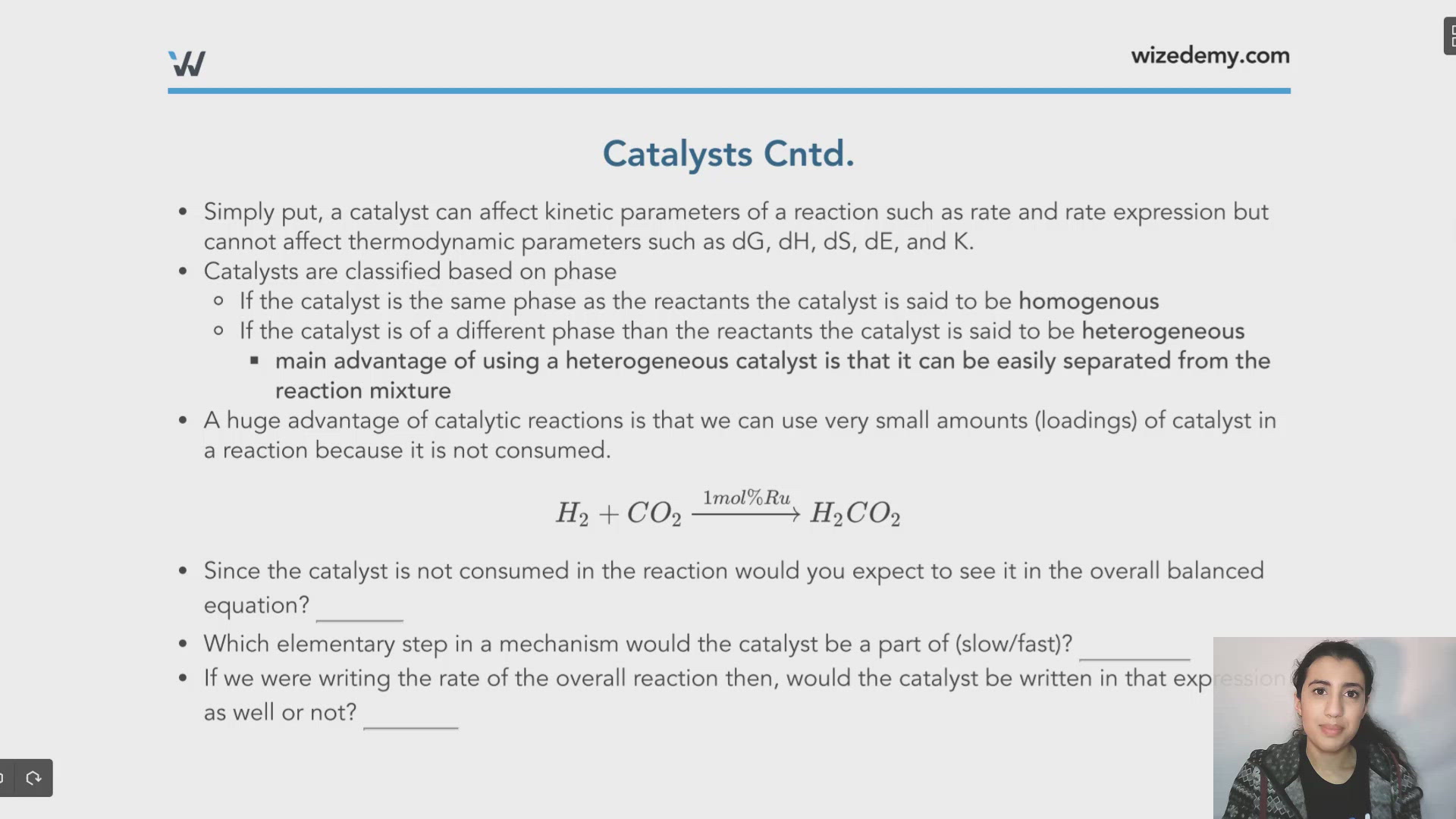
- Simply put, a catalyst can affect kinetic parameters of a reaction such as rate and rate expression but cannot affect thermodynamic parameters such as ΔG, ΔH, ΔS, ΔE, and K.
- Catalysts are classified based on phase
- If the catalyst is the same phase as the reactants the catalyst is said to be homogenous
- If the catalyst is of a different phase than the reactants the catalyst is said to be heterogeneous
- main advantage of using a heterogeneous catalyst is that it can be easily separated from the reaction mixture
- A huge advantage of catalytic reactions is that we can use very small amounts (loadings) of catalyst in a reaction because it is not consumed.
- Since the catalyst is not consumed in the reaction would you expect to see it in the overall balanced equation?No!
- Which elementary step in a mechanism would the catalyst be a part of (slow/fast)?Slow!
- If we were writing the rate of the overall reaction then, would the catalyst be written in that expression as well or not?Yes!
0:00 / 0:00
Identifying A Catalyst Vs An Intermediate In a Mechanism
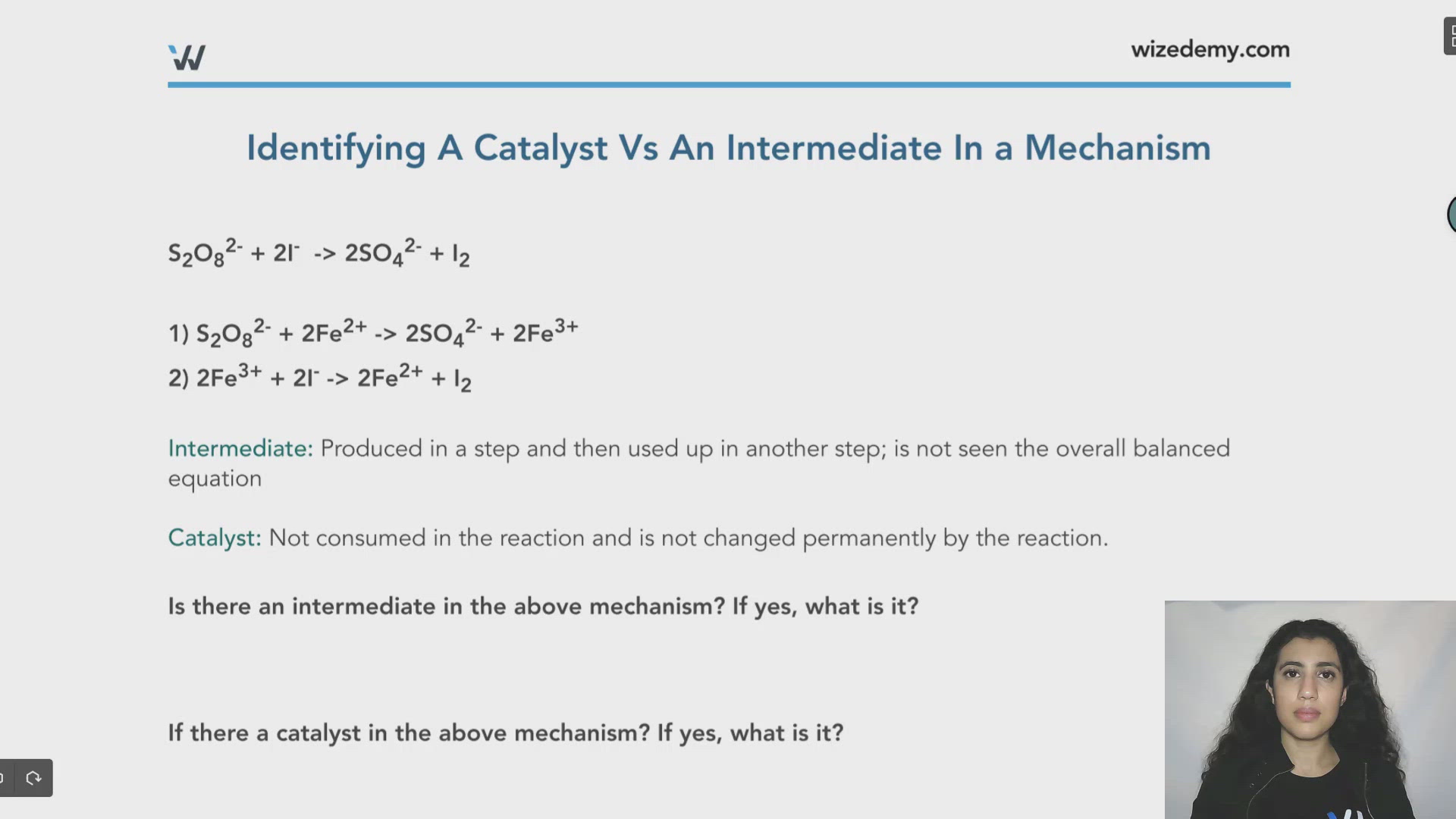
S2O82- + 2I- -> 2SO42- + I2
1) S2O82- + 2Fe2+ -> 2SO42- + 2Fe3+
2) 2Fe3+ + 2I- -> 2Fe2+ + I2
Wize Concept
Intermediate: Produced in a step and then used up in another step; is not seen the overall balanced equation
Catalyst: Not consumed in the reaction and is not changed permanently by the reaction.
Is there an intermediate in the above mechanism? If yes, what is it?
- Fe3+ is produced in the first step and is then used in the second step
If there a catalyst in the above mechanism? If yes, what is it?
- Fe2+ was present in the beginning of the 1st step and is seen at the end of the reaction in the 2nd step
0:00 / 0:00
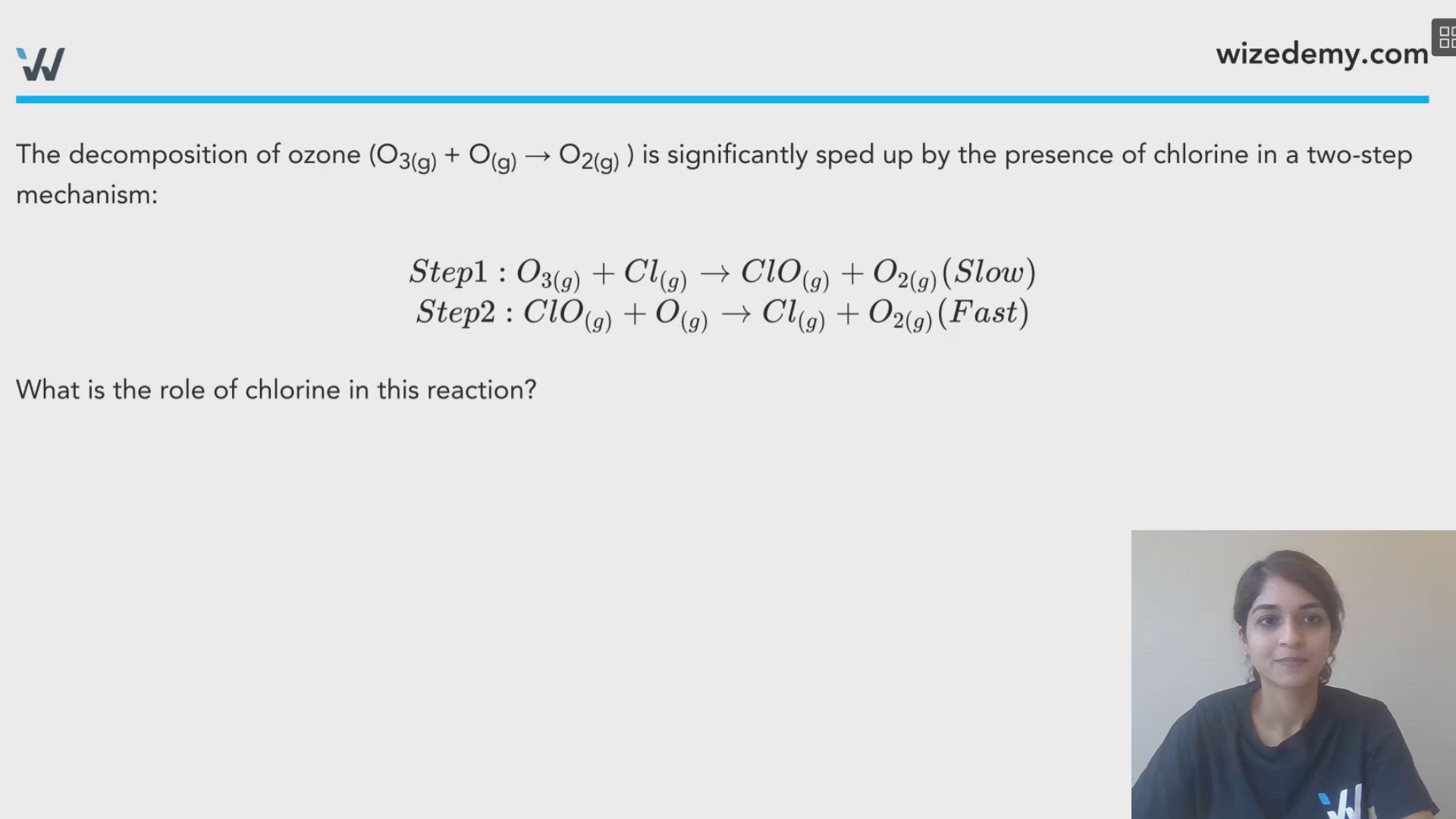
The decomposition of ozone (O3(g) + O(g) → O2(g) ) is significantly sped up by the presence of chlorine in a two-step mechanism:
What is the role of chlorine in this reaction?
Chlorine is not consumed in the reaction but speeds it up so it is a catalyst!