Create a free account to get started

Unlock full course notes by signing up

  • Video lessons taught by top educators
  • Practice questions with guided solutions
  • Written review notes for reference
  • Expert answers anytime from course tutors

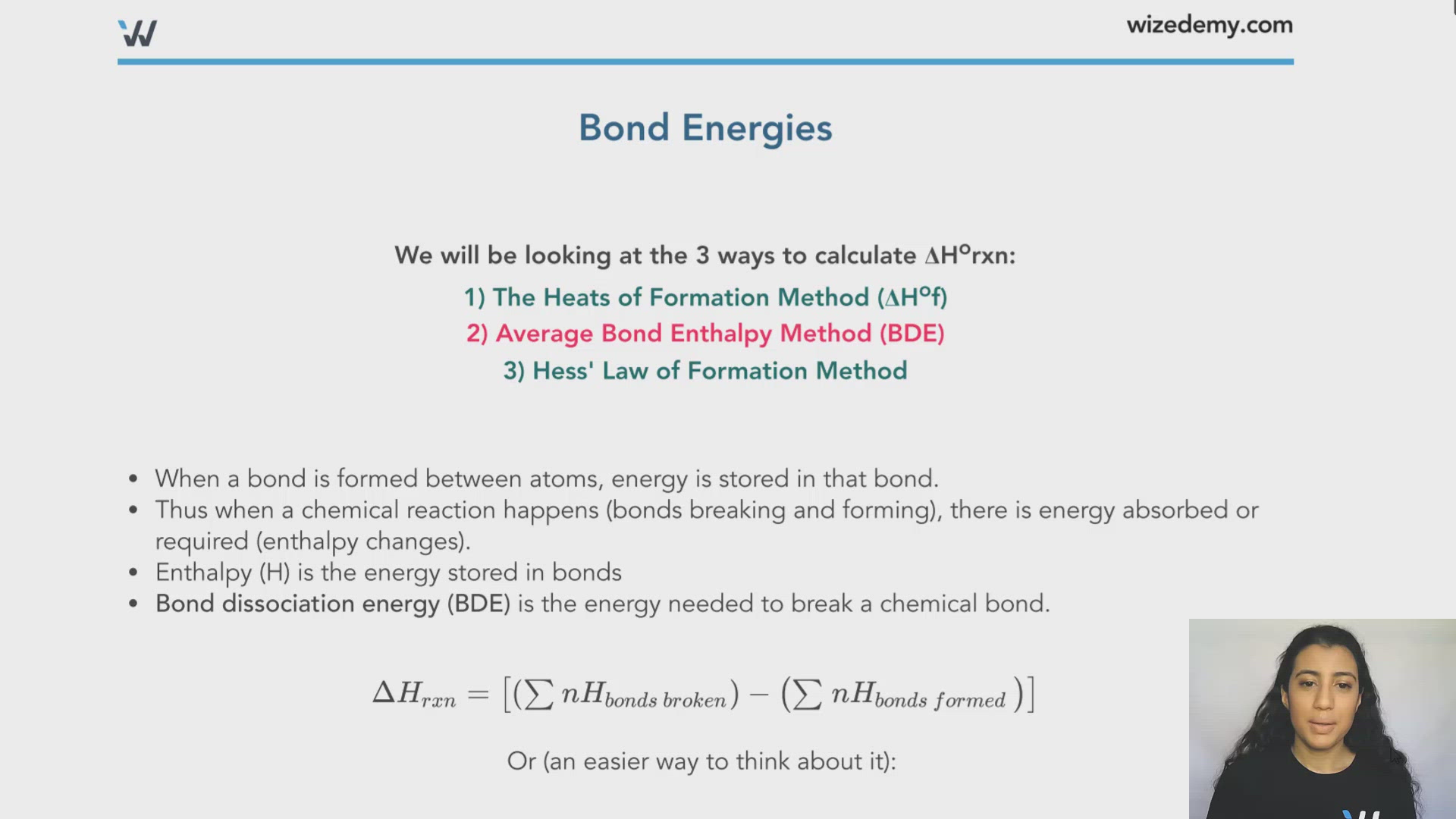
Bond Energies

Enthalpy (H) is the energy stored in bonds.


Bond dissociation energy (BDE) is the energy needed to break a chemical bond.


ΔHrxn=[(∑nHbonds broken)−(∑nHbonds formed )]\Delta H_{rxn}=\left[\left(\sum_{ }^{ }nH_{bonds\ broken}\right)-\left(\sum_{_{ }}^{ }nH_{bonds\ formed\ }\right)\right]


Or (an easier way to think about it):


ΔHrxn=[(∑nBDEreactants)−[(∑nBDEproducts)]\boxed{\Delta Hrxn=[(\sum n BDE_{reactants})-[({\sum nBDE_{products})]}}


ΔHrxn=\Delta H_{rxn}= enthalpy change for the reaction (kJ/mol)

BDE = bond energy per mole of bonds (kJ/mol), always positive


ΔHrxn=[(∑nBDEreactants)−[(∑nBDEproducts)]\boxed{\Delta Hrxn=[(\sum n BDE_{reactants})-[({\sum nBDE_{products})]}}


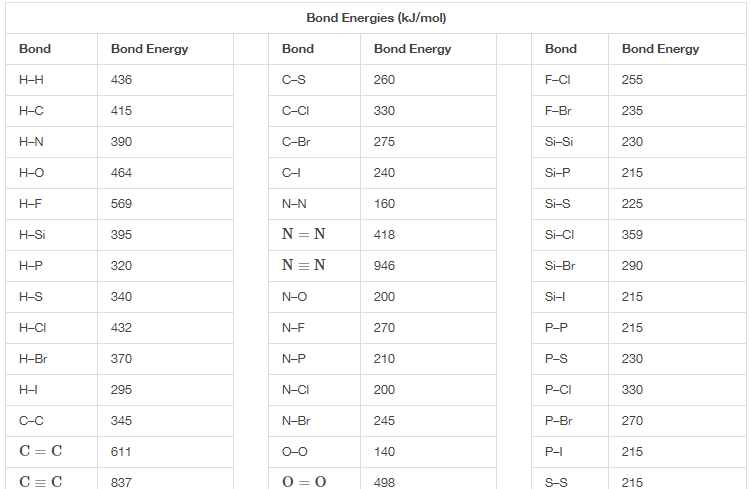
Image illustrating Bond Energies


Photo by Rice University / CC BY


Example: Using Bond Dissociation Energies to Calculate Enthalpy of a Reaction

What is ΔHrxn for the following reaction?

2H2(g)+O2(g)→2H2O(g)2H_2(g) +O_2(g) \rightarrow 2H_2O(g)


Bond Bond Energy (kJ/mol)

H-H 436

O=O 499

O-H 463


ΔHrxn=[(∑nBDEreactants)−(∑nBDEproducts)]{\Delta Hrxn=[(\sum n BDE_{reactants})-{(\sum nBDE_{products})}}]


ΔHrxn=[(2x436 + 499) - (4x463)]

=1371 - 1852

=-481kJ


Practice: Calculating Enthalpy of a Reaction Using Bond Energies

Use the table of average bond energies to calculate the ΔH{\small \Delta \text{H}} for the following reaction:


H−C≡C−H→H2C=CH2\text{H}-\text{C}\equiv\text{C}-\text{H}\rightarrow\text{H}_2\text{C}=\text{CH}_2


Bond‾Bond Energy (kJ/mol)‾H−H432H−C413H−I295I−I149C−I240C−C347C=C614C≡C839\begin{array}{cc} {\small \underline{\text{Bond}}}&{\small \underline{\text{Bond Energy (kJ/mol)}}}\\ \text{H}-\text{H} & 432 \\ \text{H}-\text{C} & 413\\ \text{H}-\text{I} & 295\\ \text{I}-\text{I} & 149\\ \text{C}-\text{I} & 240\\ \text{C}-\text{C} & 347\\ \text{C}=\text{C} & 614\\ \text{C}\equiv\text{C} & 839 \end{array}


Choose an answer

Create a free account to get started

Unlock full course notes by signing up

  • Video lessons taught by top educators
  • Practice questions with guided solutions
  • Written review notes for reference
  • Expert answers anytime from course tutors