Popular Courses
MCAT
General Course
CHEM 1302A/B
Western University
General Chemistry
University Study Guides
CHEM 1A03
McMaster University
CHEM 112
Queen's University
CHEM 203
University of Calgary
Chemistry
General Course
DAT
General Course
General Chemistry
University Study Guides
CHEM 1E03
McMaster University
CHM135H1
University of Toronto
CHEM 154
University of British Columbia
CHEM 102
University of Alberta
CHEM 123
University of British Columbia
CHEM*1050
University of Guelph
CHEM 121
Simon Fraser University
CHEM 120
McGill University
APSC 132
Queen's University
APSC 131
Queen's University
CHEM 205
University of British Columbia
0:00 / 0:00
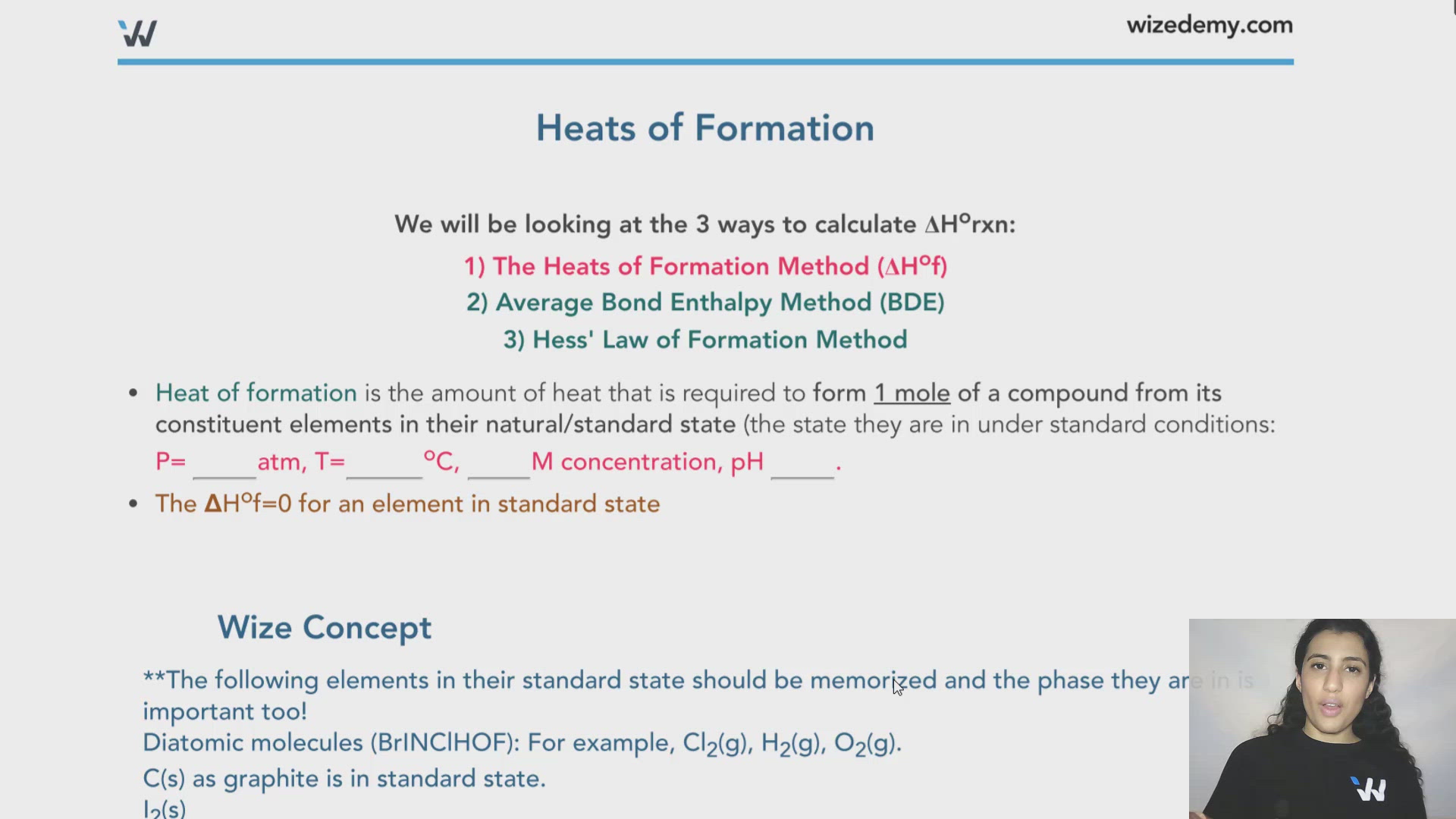
Heats of Formation
Heat of formation is the amount of heat that is required to form 1 mole of a compound from its constituent elements in their natural/standard state (the state they are in under standard conditions: P=
1
atm, T=25
oC, 1
M concentration, pH 7
. Wize Concept
The ΔHof=0 for an element in standard state.
Wize Tip
**The following elements in their standard state should be memorized and the phase they are in is important too!
C(s) as graphite is in standard state.
I2(s)
Br2(l)
Hg(l)
Diatomic molecules (BrINClHOF)
Examples:
Cl2(g), H2(g), O2(g)
Watch Out!
If you are shown O(g) on your exam, this is NOT oxygen in its standard state. Remember oxygen in its standard state has to be gaseous AND diatomic! O2(g) would be in standard state.
Example: The formation reaction for C4H10O(l) would be:
The enthalpy of formation for this compound is -327kJ/mol.
Calculating the Enthalpy of Reaction Using Heats of Formations
If you know the enthalpies of formation for each reactant and product in any chemical equation, you can find the enthalpy change for that reaction:
In other words, Δ= Final - Initial
Example: Calculating the Enthalpy of a Reaction
Calculate ΔHorxn for the following reaction:
ΔHof(NO(g))=90.75kJ/mol
ΔHof(NO2(g))=33.18kJ/mol
ΔHof(O2(g))=
0
ΔHorxn=[(2molx33.18kJ/mol)-(2molx90.75kJ/mol + 0)]
ΔHorxn=[(66.36kJ-181.5kJ)]
=-115.14 kJ

Mark Yourself Question
- Grab a piece of paper and try this problem yourself.
- When you're done, check the "I have answered this question" box below.
- View the solution and report whether you got it right or wrong.
Practice: Formation Reaction
Write a reaction for the heat of formation for dimethylaminopyridine, (CH3)2NC5H4N.
Practice: Calculate the Enthalpy of the Reaction
Find ΔHorxn for the following reaction at 25°C:
Given the following data:
