Wize University Chemistry Textbook > Thermodynamics: Part 1: (0th law, 1st law, Calorimetry, Enthalpy)
Introduction to Enthalpy Calculations
Popular Courses
MCAT
General Course
CHEM 1302A/B
Western University
General Chemistry
University Study Guides
CHEM 1A03
McMaster University
CHEM 112
Queen's University
CHEM 203
University of Calgary
Chemistry
General Course
DAT
General Course
General Chemistry
University Study Guides
CHEM 1E03
McMaster University
CHM135H1
University of Toronto
CHEM 154
University of British Columbia
CHEM 102
University of Alberta
CHEM 123
University of British Columbia
CHY 102
Toronto Metropolitan University
CHEM 121
Simon Fraser University
CHEM 120
McGill University
SC/CHEM 1000 3.00
York University
APSC 132
Queen's University
APSC 131
Queen's University

0:00 / 0:00
Enthalpy of Reaction (ΔHorxn)
Enthalpy (H): is a measure of the energy associated with breaking or forming bonds
- Breaking bonds (requires/releases)requiresenergy
- Therefore, this is (endothermic/exothermic)endothermic
- *Think: you need to be strong to break bonds!
- Forming bonds (requires/releases)releasesenergy
- Therefore, this is (endothermic/exothermic)exothermic
- *Think: bonds want to form if they are stable and lower in energy!
Wize Concept
In summary: breaking bonds requires energy & forming bonds releases energy!
We will soon look at the different ways to calculate ΔHorxn:
The Heats of Formation Method (ΔHof)
Average Bond Enthalpy Method (BDE)
Hess' Law of Formation Method
0:00 / 0:00
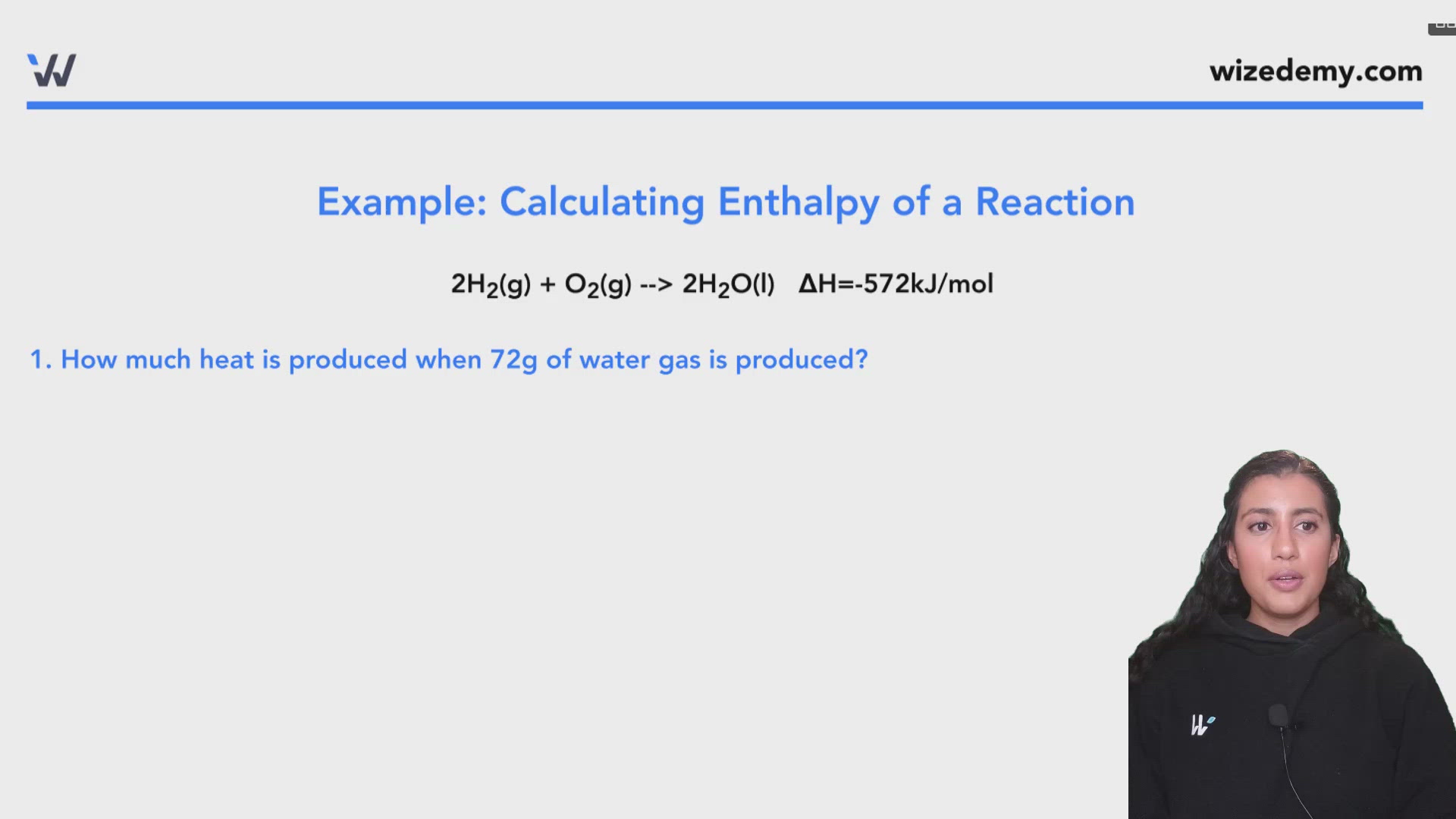
Example: Calculating Enthalpy of a Reaction
2H2(g) + O2(g) → 2H2O(l) ΔH=-572kJ/mol
1. How much heat is produced when 72g of water gas is produced?
Currently we see that when 2 mol of H2O(l) are produced we have 572 kJ/mol produced.
We need to find out how many moles of water we have when we have 72g of water:
n=? m=72g, M=18g/mol
n=72/18
n=36/9
n=4 moles
Now that we have 4 moles of H2O(l) produced (double the amount shown in the equation), that means that the heat produced would also be doubled.)
Therefore, 1144kJ of heat would be released (-1144kJ) when 4 moles of water is produced.
2. Is the reaction endothermic or exothermic?
Since ΔH is negative, it means heat is being released and the reaction is therefore exothermic (heat is EXiting!)
2H2(g) + O2(g) → 2H2O(l) ΔH=-572kJ/mol
3. We are told that O2(g) is the limiting reagent of this reaction. How many moles of O2(g) are used if the reaction releases 286kJ of heat?
- 286/572=1/2
- Since we now have half the amount of heat released, it means that we would start with half the amount of moles of O2 that we have in the reaction
- The reaction has 1 mol of O2 leading to 572kJ of heat being released
- So 1/2 a mole of O2 would lead to 286kJ of heat being released