Popular Courses
MCAT
General Course
CHEM 1302A/B
Western University
General Chemistry
University Study Guides
CHEM 1A03
McMaster University
CHEM 112
Queen's University
CHEM 203
University of Calgary
DAT
General Course
Chemistry
General Course
General Chemistry
University Study Guides
CHEM 1E03
McMaster University
CHM135H1
University of Toronto
CHEM 154
University of British Columbia
CHEM 102
University of Alberta
CHEM 123
University of British Columbia
CHEM*1050
University of Guelph
CHY 102
Toronto Metropolitan University
CHEM 121
Simon Fraser University
CHEM 120
McGill University
SC/CHEM 1000 3.00
York University
APSC 132
Queen's University

0:00 / 0:00
Heat Capacity and Calorimetry
- Heat capacity (C): has units of J/oK or J/oC and describes the amount of heat needed to heat up the substance or object by one degree
- Specific heat capacity (c): has units of J/goK or J/goC and described the amount of heat required to heat up 1g of a substance by one degree.
- We also have a molar heat capacity (units J/Kmol, or J/Cmol), which is the amount of heat required to heat up 1 mol of a substance by one degree).
q is heat (in J)
C is the heat capacity (J/oK or J/oC)
c is the specific heat capacity (J/goK or J/goC)
m=mass (in g)
ΔT=change in temperature (T2-T1) in oK or oC
n=moles
Note: mc=C
General Introduction to Calorimeters
Calorimeters come in two general varieties:
- Simple "coffee cup" calorimeters
- And bomb calorimeters

Left Photo by Community College Consortium for Bioscience Credentials / CC BY, right photo by Lisdavid89 / CC BY
What is a calorimeter?
- A calorimeter is just a container that is insulated. It holds a liquid that is usually water inside of it and you can have reactions happening inside of it as well.
- For a calorimeter, the water is the surroundings and the reaction is the system.
- A thermometer will be able to read the temperature changes of the water.
- If the thermometer measures an increase in temperature, that means the water went up in temperature.
- If the water went up in temperature then that means it gained all of the heat from the system (or the reaction taking place inside the calorimeter). It didn't gain the heat from anywhere else because the calorimeter is insulated!
- This means the system/reaction lost heat and is endothermic/exothermic:exothermic.
Wize Concept
In general:
qwater=-qrxn where q=mcΔT
Coffee Cup Calorimeters
Essentially it's an open styrofoam cup with a thermometer.

These are most frequently used to measure the temperature change of an aqueous reaction under constant
pressure
conditions.ΔH= ΔE + PΔV
ΔH= q + w -w
ΔH=qp (under constant pressure conditions)
Wize Concept
In general:
qsystem(sample) = -qsurroundings(H2O)
using q=mcΔT:
(mass of sample)(c of sample)(ΔT of sample) = -(mass of H2O)(c of H2O)(ΔT of water)
Bomb Calorimeters
Typically these consist of a sealed reaction vessel loaded with a combustible material and filled with oxygen placed in a surrounding water bath.
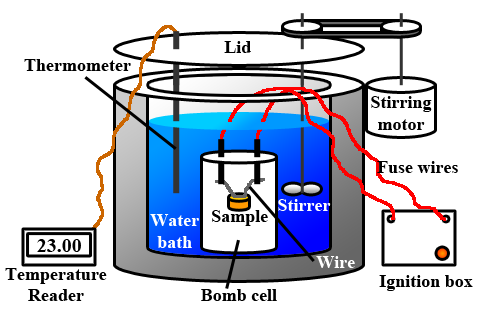
A combustion reaction is performed under constant
volume
conditions and the resulting change in temperature of the water bath is measured.ΔE= qv + w
ΔE=qv -PΔV
(ΔV=0) so w=0
ΔE=qv
For bomb calorimeters, we will see two types of problems:
1) Sometimes we evaluate the heat capacity for the entire calorimeter (the q of the calorimeter represents bomb and the water bath)
2) Sometimes we evaluate the heat capacity of the bomb and water separately (qtotal=qbomb + qwater bath)
Wize Tip
Read the question carefully to figure out which one of these types of problems we are looking at!
Wize Concept
In general:
qrxn = -qcalorimeter
Can usually use q=CΔT for the bomb calorimeter
0:00 / 0:00
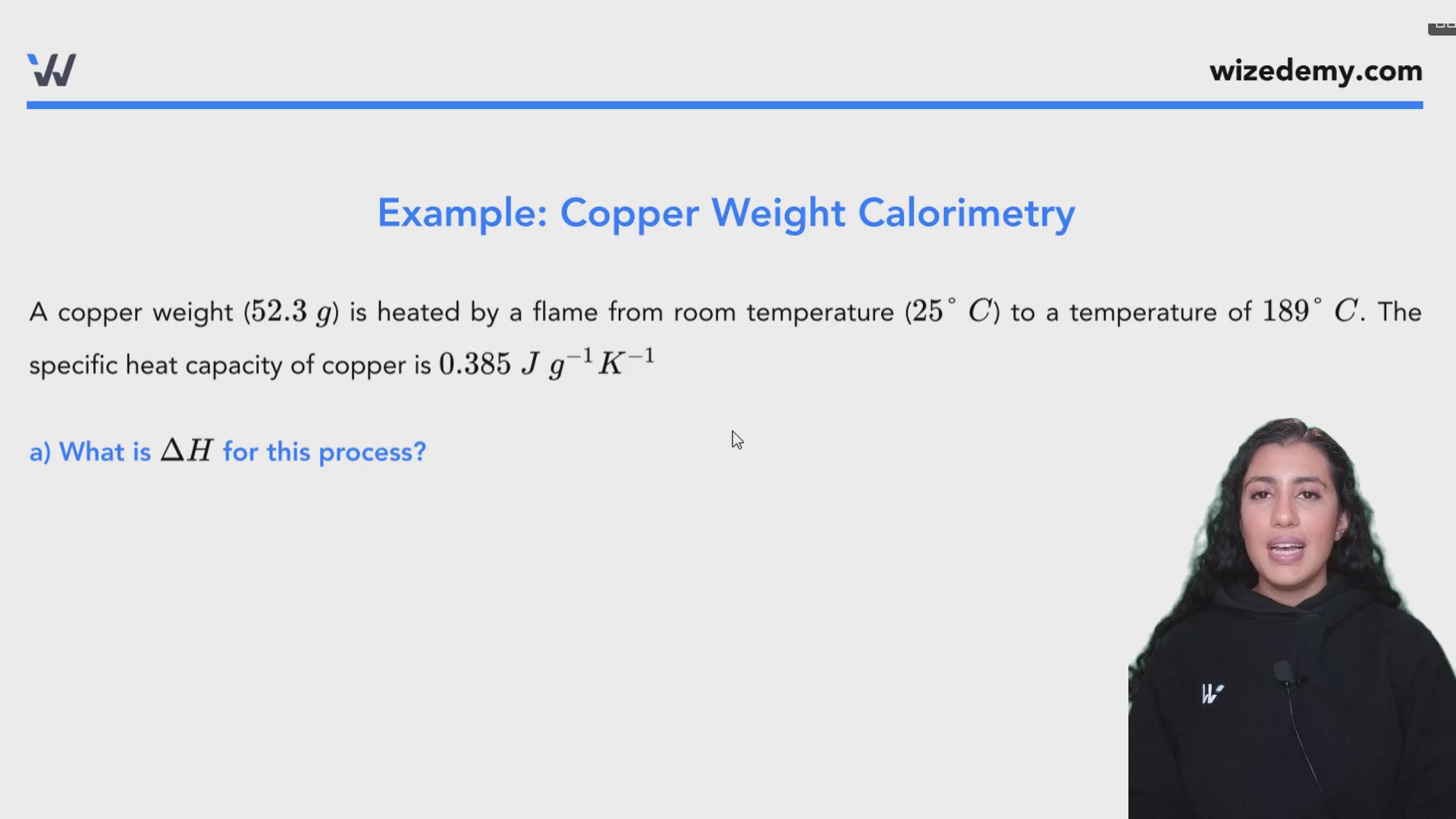
Example: Copper Weight Calorimetry
A copper weight () is heated by a flame from room temperature () to a temperature of . The specific heat capacity of copper is
a) What is for this process?
b) The block is then allowed to cool in some water until the temperature of the block is , what is for this process?
c) What is the from part b) with respect to the water ?
The heat was transferred from the copper to the water so
Remember that the amount of heat the system (our copper-the thing that is reacting) gains or loses will be the opposite for the surroundings.
In b) we found the system (copper) lose 2295J.
This means the surroundings must gain 2295J.
Since a calorimeter is insulated, whatever is lost by the system is gained by the surroundings and when the surroundings loses energy, it loses that energy to the system!

0:00 / 0:00
Example: Calorimetry
A block of lead cube () is heated to . The cube is then submerged into a Styrofoam cup containing of water at room temperature (). After the water and the lead cube come to thermal equilibrium, what is the final temperature of the water?
Wow! Water is a pretty good insulator
The temperature of a 12.58 g sample of calcium carbonate (CaCO3(s)) increases from 23.6°C to 38.2°C. If the specific heat capacity of calcium carbonate is 0.82 J/g K, how many joules of heat are absorbed?
The ΔHsoln for the process when solid sodium hydroxide (NaOH) dissolves in water is 44 kJ/mol. When a 10.0 g sample of NaOH dissolves in 250.0 g of water in a coffee-cup calorimeter, the temperature increases from 23.0oC to _______oC. Assume that the solution has the same specific heat as liquid water ie, 4.18 J/gK.
0:00 / 0:00
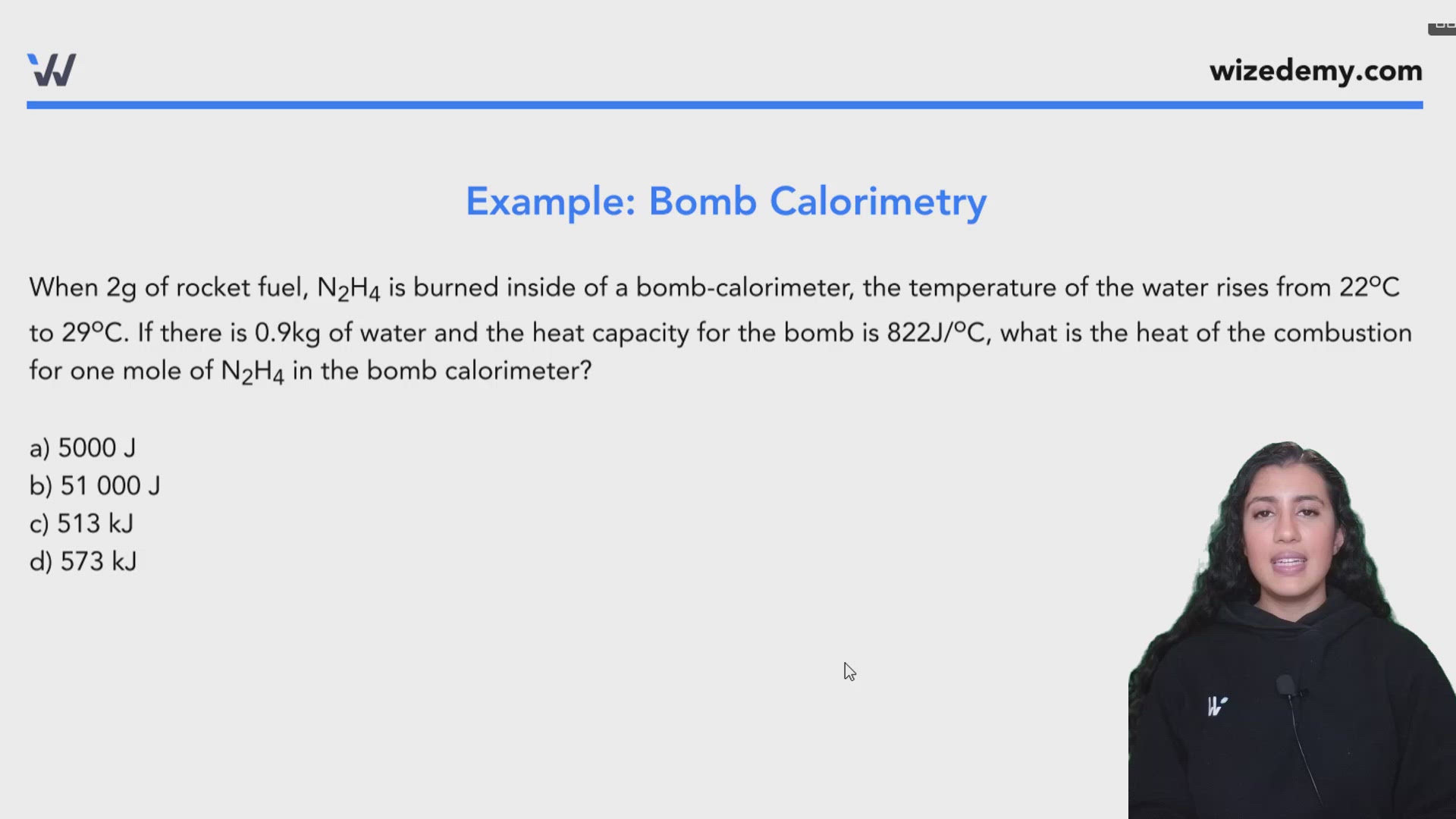
Example: Bomb Calorimetry
When 2g of rocket fuel, N2H4 is burned inside of a bomb-calorimeter, the temperature of the water rises from 22oC to 29oC. If there is 0.9kg of water and the heat capacity for the bomb is 822J/oC, what is the heat of the combustion for one mole of N2H4 in the bomb calorimeter?
a) 5000 J
b) -51 000 J
c) -513 kJ
d) -573 kJ
Let's first write out all the information we have:
Rocket fuel (N2H4):
m=2g
Bomb Calorimeter:
T1=22oC of water bath
T2=29oC of water bath
ΔT=29-22=7oC
0.9 kg water =900g water in water bath
C(bomb)=822J/oC
This question is asking us to find how much heat (q) is involved when we combust 1 mole of the rocket fuel (N2H4).
We currently are given the situation with 2g of rocket fuel.
We can find how much heat is involved when we have 2g of rocket fuel first. Then we can figure out how much heat would be involved for a mole of the rocket fuel!
For the bomb calorimeter, notice we are only given C(bomb) not C(calorimeter), which would include the bomb and the water bath.
Therefore, the qtotal for the calorimeter = qbomb + qwater bath in this case
qbomb=C(bomb)ΔT
qbomb=822J/oC(7oC)
qbomb= 5754 J
qwater bath=mcΔT
qwater bath=900g(4.18J/goC)(7oC)
qwater bath=26334 J
qtotal for the calorimeter = qbomb + qwater bath
qtotal for the calorimeter = 5754 J + 26334 J
qtotal for the calorimeter = 32 088 J
Let's double check the sign (+ or -) of our q calorimeter. We are told that the water bath temperature increases. This means the water bath (and calorimeter in general) gained heat and so the q value should be +!
qcalorimeter = +32 088J
So in this reaction, the qcombustion reaction= -32 088J
Recall: the reaction is the system and the calorimeter is the surroundings. qsys = -qsurr
Now we know that 32 088J was released when we did this reaction with 2g of our rocket fuel (N2H4).
We need to figure out how many J would be released when we instead use 1 mol of rocket fuel:
1) Figure out how many moles we have when we used 2g
n=m/M M=N2H4= 32g/mol
n=2g/32g/mol
n=0.0625 moles
2) When we had 0.0625 moles of rocket fuel 32 088 J of heat was released
When we have 1 mole of rocket fuel _________ J of heat would be released
1/0.0625 is 16. To double check, check that 0.0625 x16 =1.. it does!
This means we can do 32 088J x16 to get our answer: 513408J would be released if we had 1 mol of rocket fuel!
=513kJ
Practice: Bomb Calorimetry
A fuel compound was burned in oxygen in a bomb calorimeter with a combined heat capacity of 56.5 kJ/K (bomb assembly and water). The temperature of the surrounding water bath increased from 23.5 to 34.6°C as a result. What was the value of qsys for this process?