Wize University Chemistry Textbook > Thermodynamics: Part 1: (0th law, 1st law, Calorimetry, Enthalpy)
Relating Calorimetry to the 1st Law
Popular Courses
MCAT
General Course
CHEM 1302A/B
Western University
General Chemistry
University Study Guides
DAT
General Course
Chemistry
General Course
General Chemistry
University Study Guides
CHEM 102
University of Alberta
CHEM 123
University of British Columbia
CHEM 121
Simon Fraser University
CHEM 120
McGill University
APSC 132
Queen's University
CHEM 205
University of British Columbia
CHEM 102
University of Victoria
CHEM 123
University of Waterloo
CHEM 130
University of British Columbia
CHEM 1100
University of Manitoba
CHEM 1481
Texas A & M University
CHEM 122
Simon Fraser University
CEM 141
Michigan State University
CHY 113
Toronto Metropolitan University

0:00 / 0:00
Calorimetry
- We use calorimetry to measure the heat flow of a system. The following equation can be used to calculate heat flow using given that is the heat capacity of the calorimeter
- Heat capacity, , is dependent on the substance and is different depending on whether the calorimetry is performed at constant volume,or constant pressure,
- Specific heat capacity is expressed as a function of mass ( )
- Molar heat capacity is expressed as a function of the number of moles ( ).
Case 1: Constant Volume Process,
Note that we can use the exact same equations if we are told there is free expansion into a vacuum:
- When expanding freely into a vacuum there is no external pressure
- Since w=-PΔV and P=0, then w=0
Case 2: Constant Pressure Calorimetry,
We need to define a new state function to keep track of heat exchange at constant
It can be shown that
Case 3: Isothermal Conditions
Under isothermal conditions (constant temperature), ∆T=0
Wize Tip
∆U in the equation: ∆U= q + w, depends only on temperature!
So when there is no temperature change under isothermal conditions, there is no change in U ( ∆U=0)
Note: because it’s isothermal, ∆U=0
0:00 / 0:00
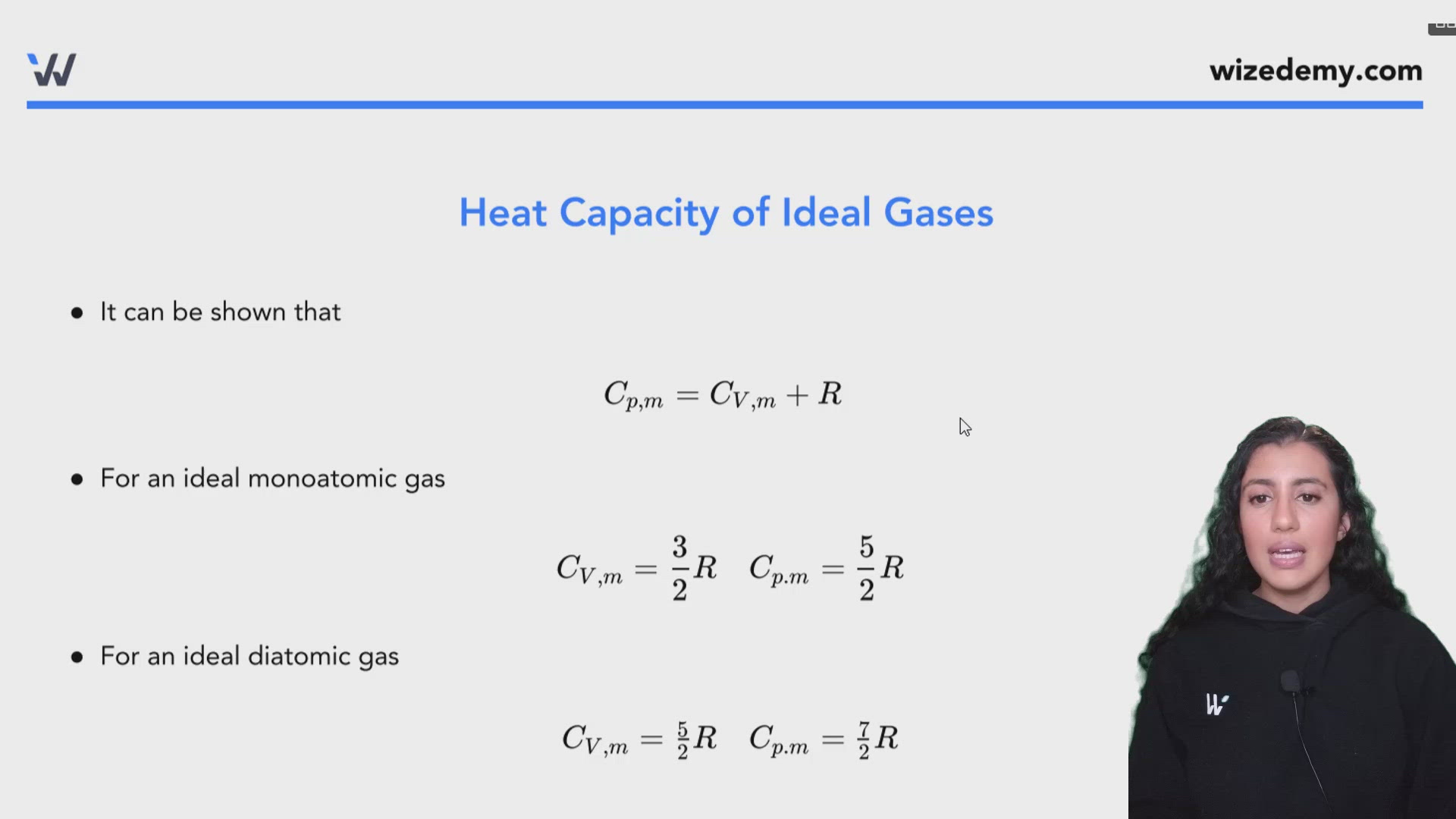
Heat Capacity of Ideal Gases
- It can be shown that
- For an ideal monoatomic gas
- For an ideal diatomic gas
The following is low yield info that can help you memorize these equations (but they will most likely be provided to you on a formula sheet).
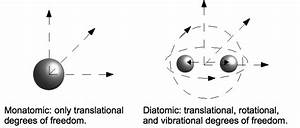
- Monoatomic gases have 3 degrees of freedom (they are able to move in 3 directions)
- While diatomic gases have 5 degrees of freedom (they are able to move in 5 directions)
- The degrees of freedom matches the numerator of the Cv equation for each!
The enthalpy of combustion for ethanol C2H5OH is -1370.7 kJ/mol. Calculate q and ΔH when 45 g of ethanol are burned at 1 atm and 298 K.
- q (kJ)
- deltaH (kJ)
(Don't include units in your answer and round to the nearest whole number)

Mark Yourself Question
- Grab a piece of paper and try this problem yourself.
- When you're done, check the "I have answered this question" box below.
- View the solution and report whether you got it right or wrong.
Practice: Isothermal Expansion
4 moles of neon was confined to a 8L flask initially at room temperature underwent an isothermal expansion into a vacuum at 348K. Calculate ∆𝑈, ∆𝐻, 𝑎𝑛𝑑 𝑞 for this process.