Wize University Chemistry Textbook > Thermodynamics: Part 1: (0th law, 1st law, Calorimetry, Enthalpy)
Relating Work and the Ideal Gas Law
Popular Courses
MCAT
General Course
General Chemistry
University Study Guides
DAT
General Course
Chemistry
General Course
General Chemistry
University Study Guides
CHEM 102
University of Alberta
CHEM 123
University of British Columbia
CHY 102
Toronto Metropolitan University
CHEM 121
Simon Fraser University
CHEM 120
McGill University
SC/CHEM 1000 3.00
York University
APSC 132
Queen's University
CHEM 205
University of British Columbia
CHEM-1100
University of Windsor
CHEM 102
University of Victoria
CHEM 123
University of Waterloo
CHEM 130
University of British Columbia
CHEM 1100
University of Manitoba
CHEM 1481
Texas A & M University
CHEM 122
Simon Fraser University

0:00 / 0:00
Expansion Due to Chemical Reaction
When a chemical reaction takes place where the number of moles of gas changes, expansion can occur. Typically this would happen with a reaction in a balloon, but this also happens for a reaction happening in an open vessel.
Example:
Calcium carbonate decomposes into calcium oxide and carbon dioxide as shown below. If 12g of calcium carbonate are placed into a vessel open to the atmosphere at room temperature and the reaction takes place, how much work is done on/by the system?
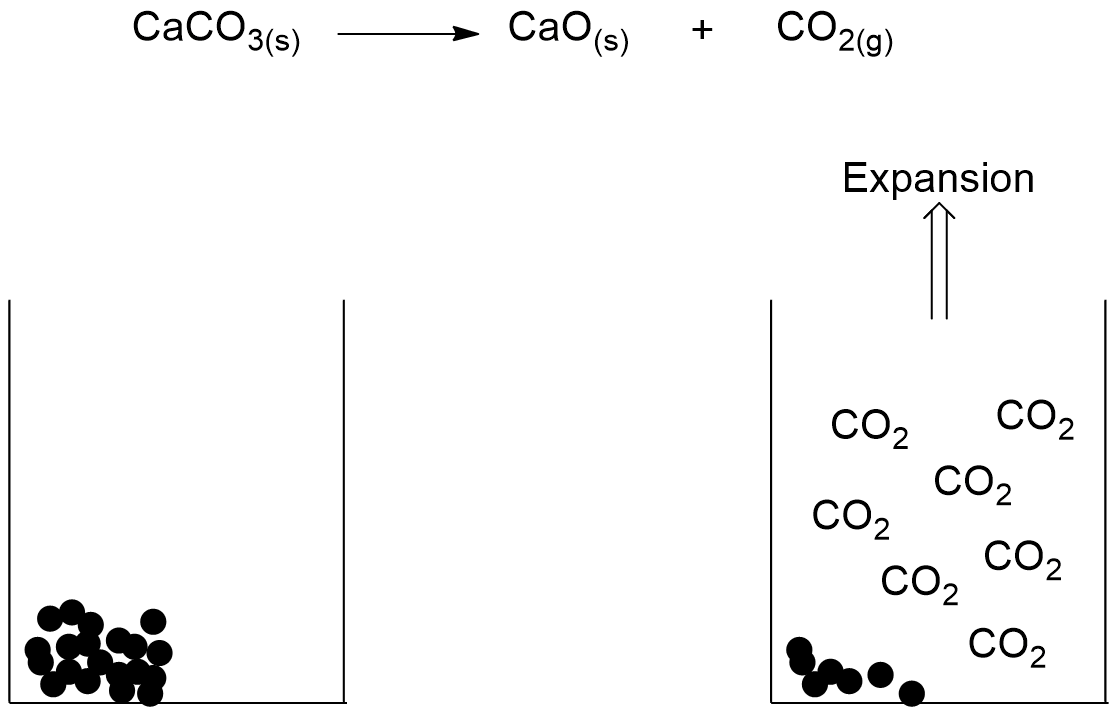
The flask is open to the atmosphere so the expansion is taking place against a constant external pressure of 1 atm, however we don't know the change in volume.
Using the Ideal gas law,
substituting we get,
We can find the number of moles of gas produced by the reaction, , by examining the stoichiometry in the question.
Example:
Calcium carbonate decomposes into calcium oxide and carbon dioxide as shown below. If 12g of calcium carbonate are placed into a vessel open to the atmosphere at room temperature and the reaction takes place, how much work is done on/by the system?

We can now solve for the work done by this chemical reaction,
0:00 / 0:00
Example: Relating Work and the Ideal Gas Law
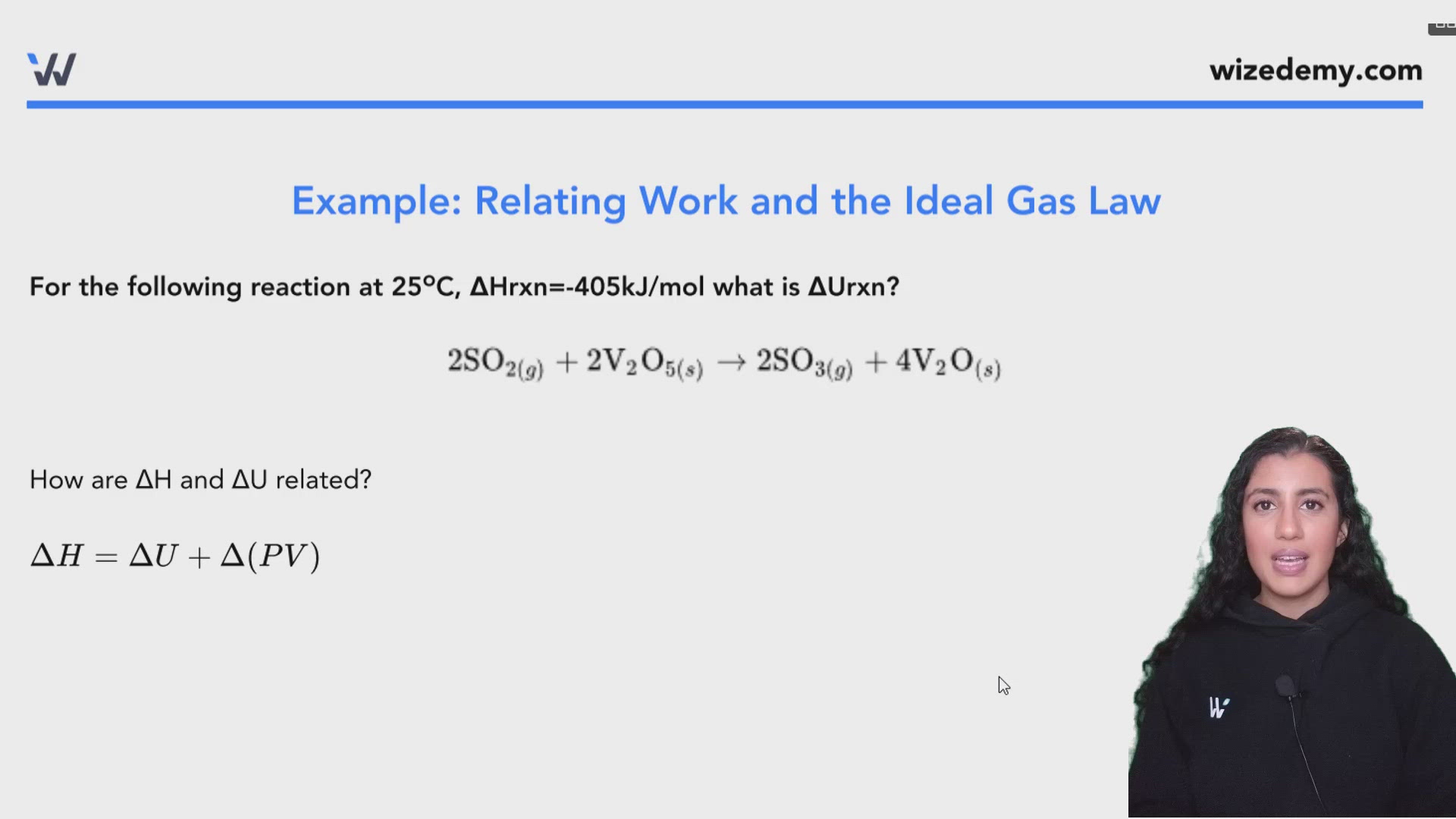
For the following reaction at 25oC, ΔHrxn=-405kJ/mol what is ΔUrxn?
How are ΔH and ΔU related?
Here we do not have P or V so what should we do?
Think of ideal gas law and use the following equation instead:
Rearrange to solve for ΔU:
ΔU=ΔH - Δ(n)RT
ΔU=-405000J/mol -(1-1 moles)(8.314J/Kmol)(298K)
ΔU=-405000J/mol

Mark Yourself Question
- Grab a piece of paper and try this problem yourself.
- When you're done, check the "I have answered this question" box below.
- View the solution and report whether you got it right or wrong.
A 10.0 g piece of Mg(s) is deposited in a container with a vast excess of HCl(aq). A reaction takes place forming hydrogen gas and Magnesium Chloride.
a) Write a balanced chemical reaction for the transformation
b) Calculate the work done by the system as a consequence of the reaction, if Pex = 1.1 atm and T = 298.15 K. You may assume ideal behaviour.