Wize University Chemistry Textbook > Thermodynamics: Part 1: (0th law, 1st law, Calorimetry, Enthalpy)
The 1st Law of Thermodynamics and Work
Popular Courses
MCAT
General Course
CHEM 1302A/B
Western University
General Chemistry
University Study Guides
CHEM 1A03
McMaster University
CHEM 112
Queen's University
CHEM 203
University of Calgary
DAT
General Course
Chemistry
General Course
General Chemistry
University Study Guides
CHEM 1E03
McMaster University
CHM135H1
University of Toronto
CHEM 154
University of British Columbia
CHEM 102
University of Alberta
CHEM 123
University of British Columbia
CHEM*1050
University of Guelph
CHY 102
Toronto Metropolitan University
CHEM 121
Simon Fraser University
CHEM 120
McGill University
SC/CHEM 1000 3.00
York University
APSC 132
Queen's University

0:00 / 0:00
1st Law of Thermodynamics
- 1st Law of Thermodynamics: The energy of an isolated system is constant, .
- Sometimes this is re-worded as "energy cannot be created or destroyed".
- is very difficult to measure so instead we measure changes in indirectly
- The change in energy can be considered as a sum of heat and work done on and by the system. is a state function, and are not.
ΔE is the change in Energy
q is heat (in J)
w is work (in J)
Wize Tip
Some profs write ΔE and others write ΔU. They mean the same thing! Both are referring to the internal energy of the system!
From the 1st law of thermodynamics we can see that change in energy for system and surroundings must be equal in magnitude because the change in internal energy of the universe must be equal to zero.

Examples:
- If the system gains 5 J of energy, the surroundings (gains/loses)loses5 J of energy.
- If the system loses 10 J of energy, the surroundings (gains/loses)gains10 J of energy.
Internal Energy of Ideal Gases
The internal energy of an ideal gas is only dependent on temperature:
So for any Isothermal process involving an ideal gas,

0:00 / 0:00
Signs of Heat and Work & Calculating Work
Recall the equation for the first law of thermodynamics:
ΔE is the change in Energy
q is heat (in J)
w is work (in J)
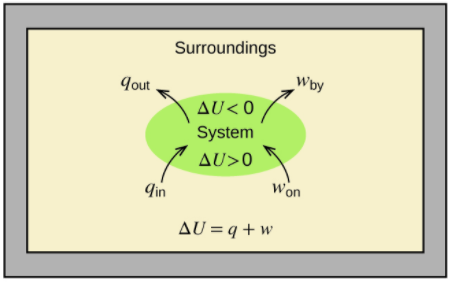
In chemistry everything is with respect to the system so the following conventions exist:
Wize Concept
w > 0 if the surroundings do work on the system
w < 0 if the system does work on the surroundings
q > 0 if heat moves from the surroundings to the system
q < 0 if heat moves from the system to the surroundings
When the external pressure is constant we can calculate work using the following equation:
w=work (J)
Pext=constant external pressure (in kPa)
ΔV=Vf-Vi (in L)
0:00 / 0:00
Example: Work Heat and Internal Energy of an Ideal Gas
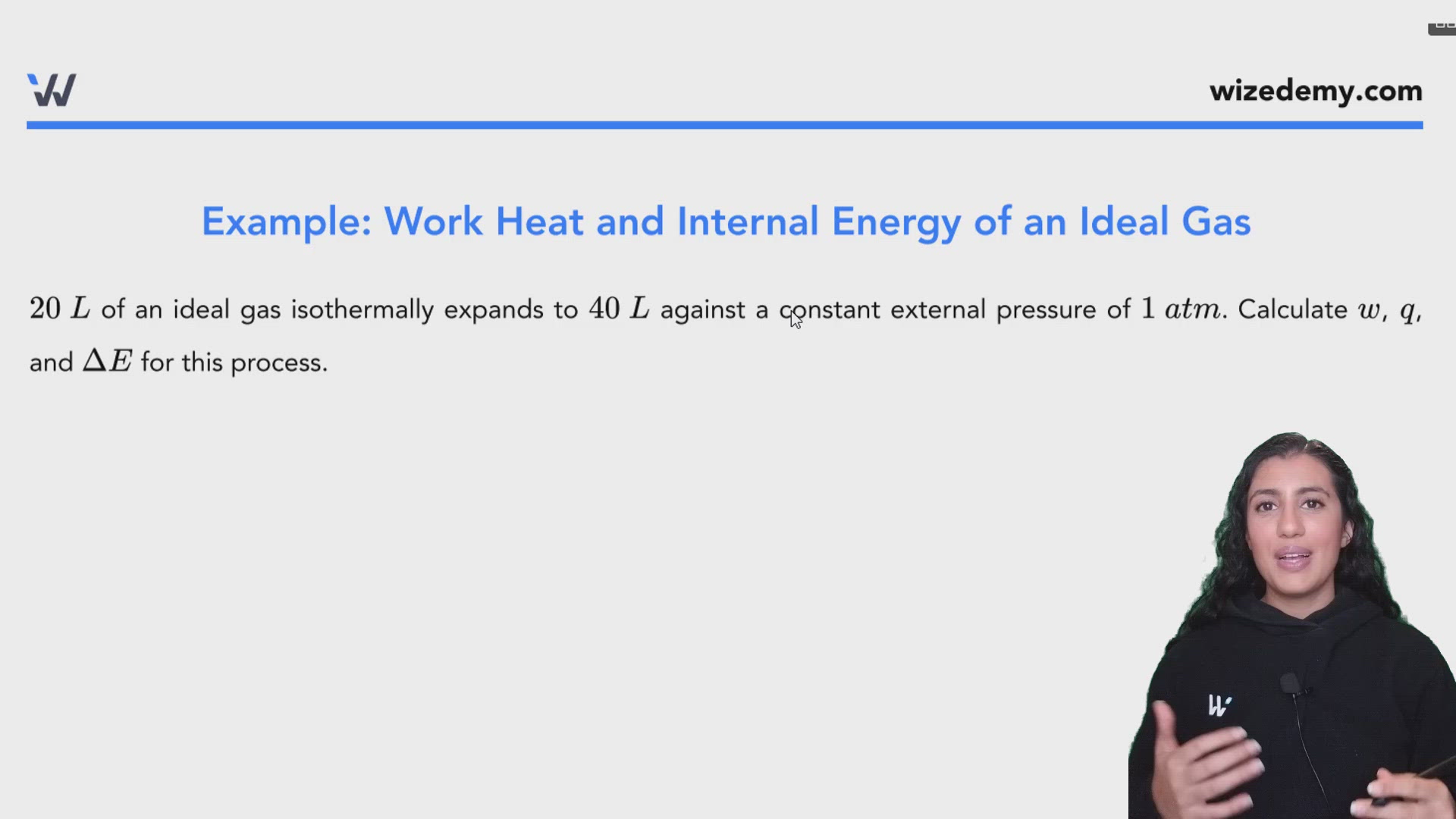
of an ideal gas isothermally expands to against a constant external pressure of . Calculate , , and for this process.
We can use the following equation to calculate work first:
Before plugging in values into this equation, check if the values we were provided have the correct units.
We need to convert the pressure from atm to kPa:
Now we can plug in values into our equation to solve for work:
The process is Isothermal expansion of an ideal gas so
A system composed of 4.50 L of N2 in a cylinder expands against an external pressure of 300 kPa until its volume is 6.30 L.
- What is the value of w for this process?
- What would the value of w be if the external pressure was 0 kPa?
Fill in the following blanks.
How to fill in this table:
For the first column we have ∆U. Your options are temperature is constant, temperature increases, or temperature decreases
For the second column we have q. Your options are no heat is exchanged, heat enters the gas, or heat exits the gas
For the third column we have w. Your options are the volume is constant, the gas is compressed, or the gas expands.
| ∆U (Change in Internal Energy): | q (heat): | w (work): | |
| Is positive when... | |||
| Is negative when... | |||
| Is 0 when... |