Wize University Chemistry Textbook > Thermodynamics: Part 1: (0th law, 1st law, Calorimetry, Enthalpy)
Average Bond Enthalpy Method
Popular Courses
MCAT
General Course
CHEM 1302A/B
Western University
General Chemistry
University Study Guides
AP Chemistry Exam Prep Course
AP Exam Prep
CHEM 1A03
McMaster University
CHEM 203
University of Calgary
DAT
General Course
Chemistry
General Course
General Chemistry
University Study Guides
CHEM 1E03
McMaster University
CHM135H1
University of Toronto
CHEM 154
University of British Columbia
CHEM 102
University of Alberta
CHEM 123
University of British Columbia
CHEM*1050
University of Guelph
CHEM 121
Simon Fraser University
CHEM 102
University of Victoria
CHEM 123
University of Waterloo
CHEM 130
University of British Columbia
CHEM 1100
University of Manitoba
0:00 / 0:00
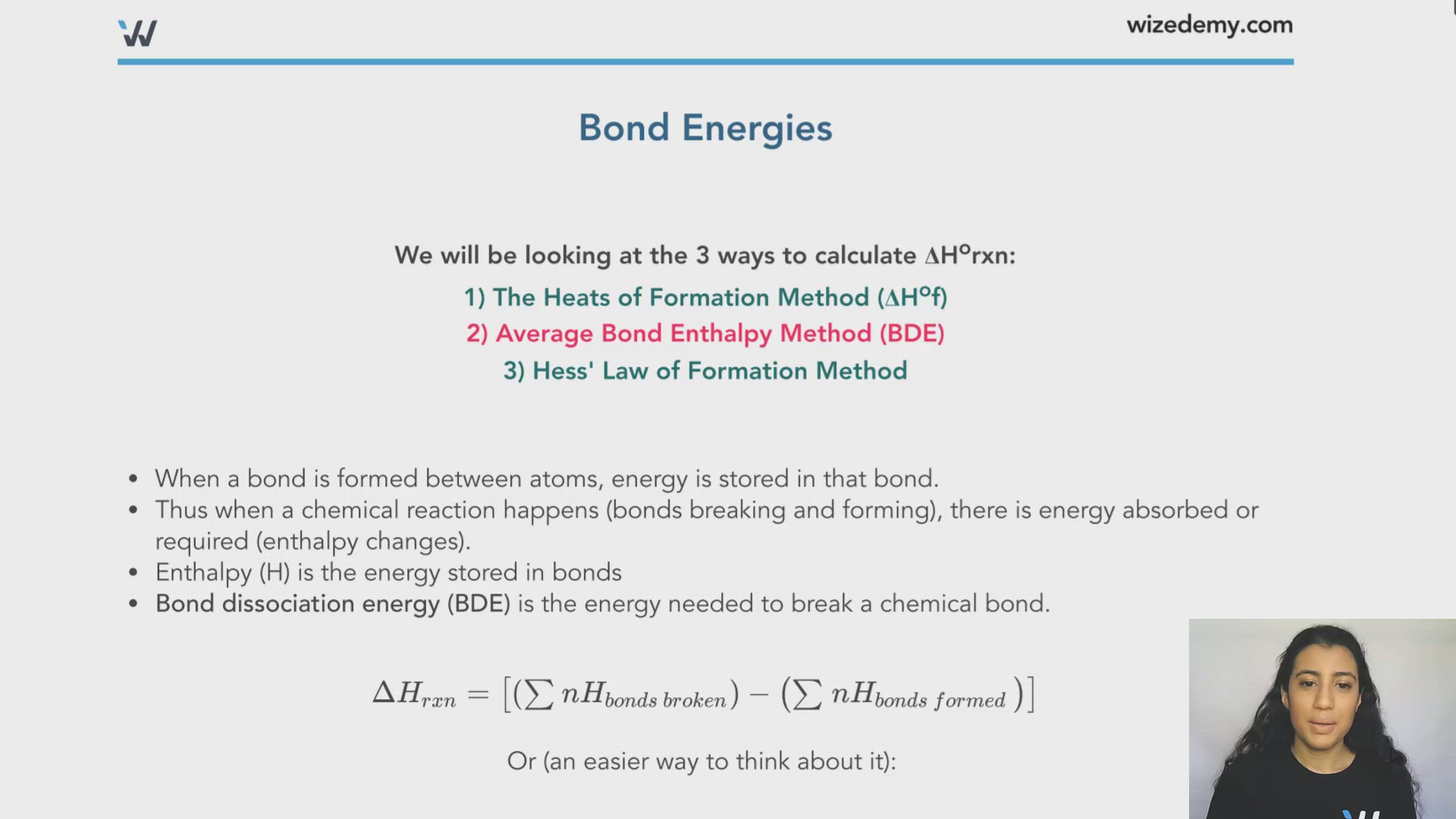
Bond Energies
Enthalpy (H) is the energy stored in bonds.
Bond dissociation energy (BDE) is the energy needed to break a chemical bond.
Or (an easier way to think about it):
enthalpy change for the reaction (kJ/mol)
BDE = bond energy per mole of bonds (kJ/mol), always positive
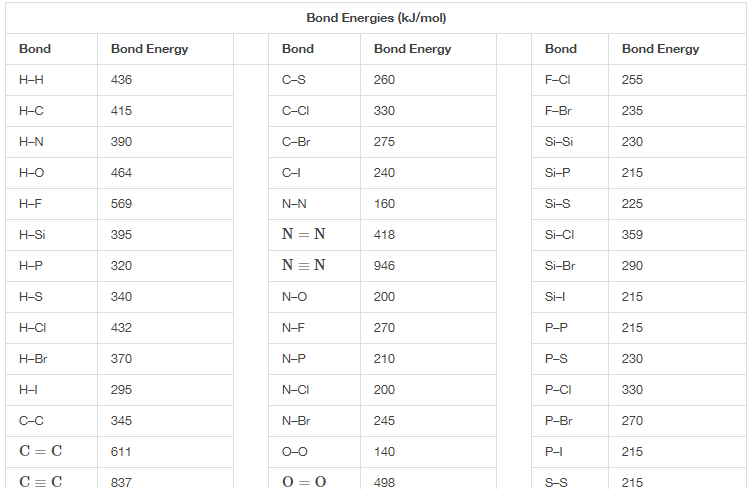
Example: Using Bond Dissociation Energies to Calculate Enthalpy of a Reaction
What is ΔHrxn for the following reaction?
Bond Bond Energy (kJ/mol)
H-H 436
O=O 499
O-H 463
ΔHrxn=[(2x436 + 499) - (4x463)]
=1371 - 1852
=-481kJ
Practice: Calculating Enthalpy of a Reaction Using Bond Energies
Use the table of average bond energies to calculate the for the following reaction: