
Acidic, Basic, and Neutral Salts
Salts are ionic compounds that dissociate (incompletely/completely) ________ in water!
Salts are formed in neutralization reactions (reaction where an acid and base react together)
Example:
NaOH(aq) + HCl(aq) → NaCl(s) + H2O(l)
These reactions are exothermic (and produce a salt and water!)
The resulting pH of a solution will depend on whether an acidic, basic, or neutral salt is made
When deciding if a salt is acidic, basic, or neutral, consider the ions that make up the salt:
If we have the conjugate acid of a strong base, would this be a very weak or decent acid?
- It would be very ________
- So ________ that we can ignore it!!
If we had the conjugate base of a strong acid, would this be a very weak or decent base?
- Very ________
- So ________that we can ignore it!
If we had the conjugate acid of a weak base, would that be a very weak or decent acid?
- Would be a ________ acid
If we had the conjugate base of a weak acid, would that be a very weak or decent base?
- Would be a ________ base
Examples:
1) CH3COONa
- Consider the anion we get from this salt: ________________________
- This is a conjugate ________ (acid/base) of a ________(weak/strong) ________(acid/base) which is: ________________________
- Does this contribute to pH? If so, how?
- ________
- Consider the cation we get from this salt: ________
- This is a conjugate ________ of a ________ ________ (NaOH)
- Does this contribute to pH? If so, how?
- ________
Therefore, this is a(n) ________ salt since the resulting pH is ________.
2) NaNO3
- Consider the cation we get from this salt: ________
- We already found this does not contribute to pH
- Consider the anion we get from this salt: ________________________
- This is a conjugate ________ of a ________ ________ which is: ________
- Does this contribute to pH? If so, how?
- ________
Therefore, this is a(n) ________ salt since the resulting pH is ________.
3) NH4Cl
- Consider the anion we get from this salt: ________
- This is a conjugate ________ (acid/base) of a ________ (weak/strong) ________ (acid/base) which is: ________
- Does it contribute to pH? If so, how?
- ________
- Consider the cation we get from this salt: ________
- This is a conjugate ________ (acid/base) of a ________ (weak/strong) ________ (acid/base) which is: ________
- Does it contribute to pH? If so, how?
- ________
Therefore, this is a(n) ________ salt since the resulting pH is ________.
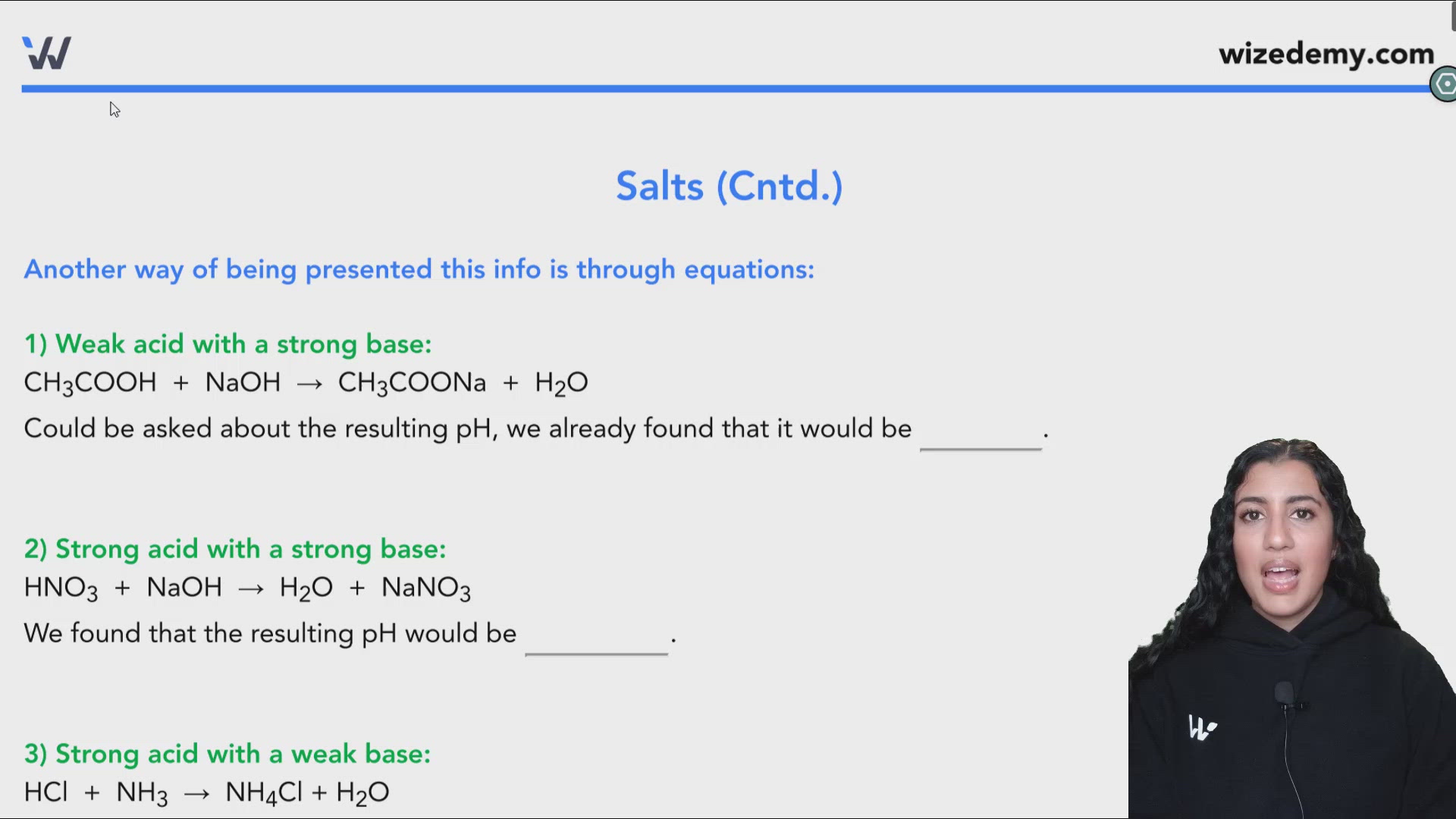
Salts (Cntd.)
Another way of being presented this info is through equations:
1) Weak acid with a strong base:
CH3COOH + NaOH → CH3COONa + H2O
Could be asked about the resulting pH, we already found that it would be ________.
2) Strong acid with a strong base:
HNO3 + NaOH → H2O + NaNO3
We found that the resulting pH would be ________.
3) Strong acid with a weak base:
HCl + NH3 → NH4Cl + H2O
We found that the resulting pH would be ________.
4) There is one last scenario where we could have a weak acid with a weak base
To determine whether the resulting pH is acidic, neutral, or basic, we need to figure out if the weak acid or weak base is stronger!
- If the Ka of the weak acid > Kb of the weak base, the resulting pH is: ________
- pH would be (</=/>) ________ 7
- If the Kb of the weak base > Ka of the weak acid, the resulting pH is: ________
- pH would be (</=/>) ________ 7
- Finally, if the Ka of the weak acid = Kb of the weak base, the resulting pH is: ________
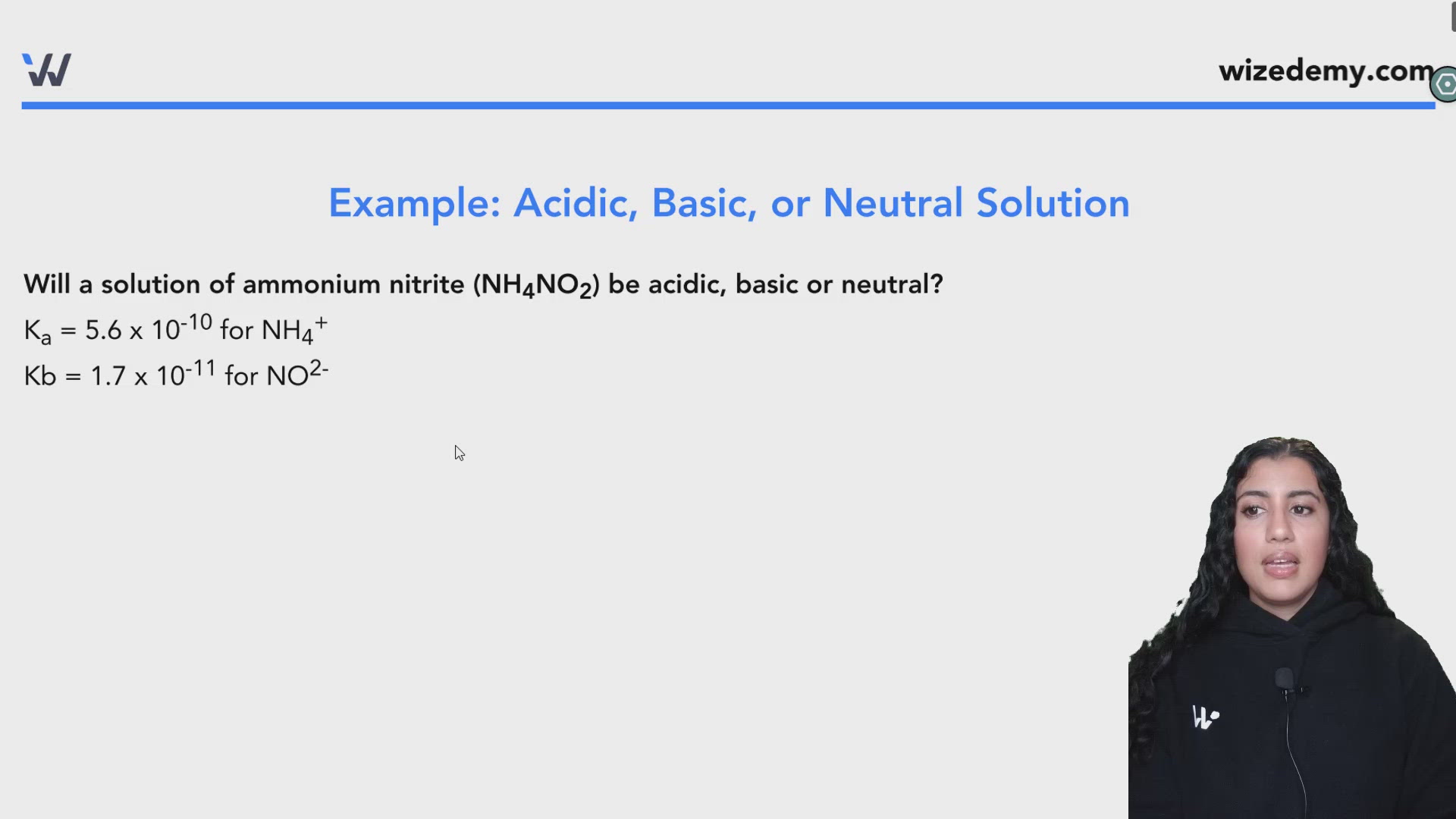
Example: Acidic, Basic, or Neutral Solution
Will a solution of ammonium nitrite (NH4NO2) be acidic, basic or neutral?
Ka = 5.6 x 10⁻¹⁰ for NH4+
Kb = 1.7 x 10⁻¹¹ for NO2-
The cation of the salt is NH4+ (we are given a Ka value)
The anion of the salt is NO2-. (we are given a Kb value)
The value for Ka > Kb. Therefore, the solution will be slightly acidic.
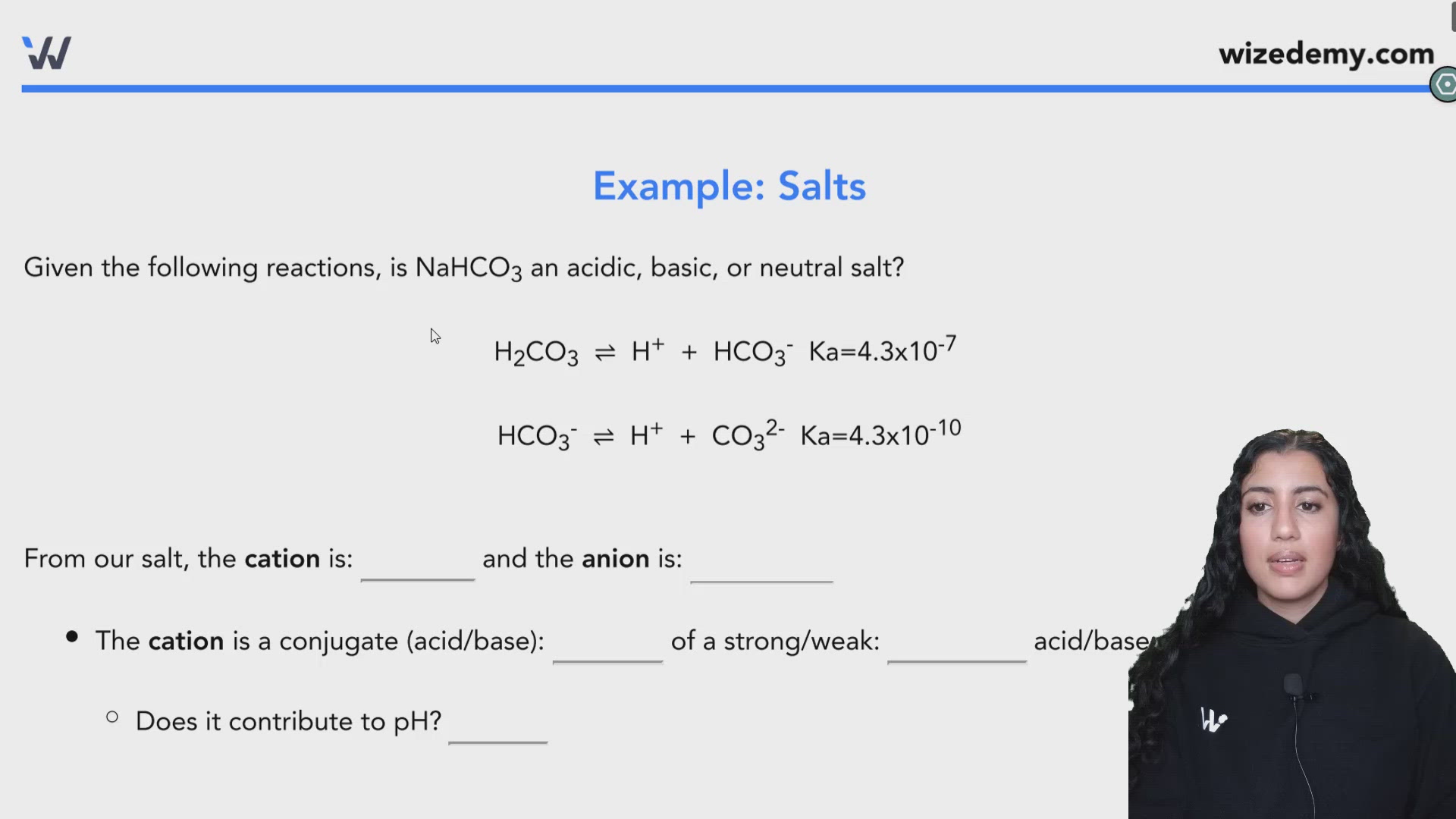
Example: Salts
Given the following reactions, is NaHCO3 an acidic, basic, or neutral salt?
H2CO3 ⇌ H+ + HCO3- Ka=4.3x10⁻⁷
HCO3- ⇌ H+ + CO32- Ka=4.3x10⁻¹⁰
From our salt, the cation is: ________ and the anion is: ________________________
- The cation is a conjugate (acid/base): ________ of a strong/weak: ________ acid/base: ________
- Does it contribute to pH? ________
Look at the above equations for HCO3-.
In equation 1, HCO3- is acting as an (acid/base): ________
In equation 2, HCO3- is acting as an (acid/base): ________
To figure out whether HCO3- will cause the pH to be more acidic or basic, we will need to compare the Ka value for HCO3- (when it acts as an acid) to the Kb value for HCO3- (when it acts as a base)
The larger value (Ka or Kb) will help us know how the pH would be affected!
H2CO3 ⇌ H+ + HCO3- Ka=4.3x10⁻⁷
HCO3- ⇌ H+ + CO32- Ka=4.3x10⁻¹⁰
Ka of HCO3- = ________________
Kb=?
Kw=Ka(Kb)
Kb=Kw/Ka
Kb=1x10-14/4.3x10-7
Kb~0.25x10⁻⁷
Kb=2.5x10⁻⁸
- Which is larger, Ka or Kb? ________
- How would HCO3- affect the pH? (lower/neutral/raise): ________ pH
- Therefore the salt is (acidic/neutral/basic): ________
Salts Cheatsheet
Some salts that dissociate completely in water exhibit aicd/base properties. In order to determine if the solution will be acidic or basic, first separate the substance into it’s positive and negative ions.
If neither the cation nor the anion can affect the pH, the solution should be neutral
If only the cation of the salt is acidic, the solution will be acidic (NH4Cl)
If only the anion of the salt is basic, the solution will be basic (NaCN)
If a salt has a cation that is acidic and an anion that is basic:
The pH of the solution is determined by the relative strengths of the acid and the base, based on the Ka and Kb of the ions.
If Ka>Kb, it will be acidic.
If Kb>Ka, it will be basic.