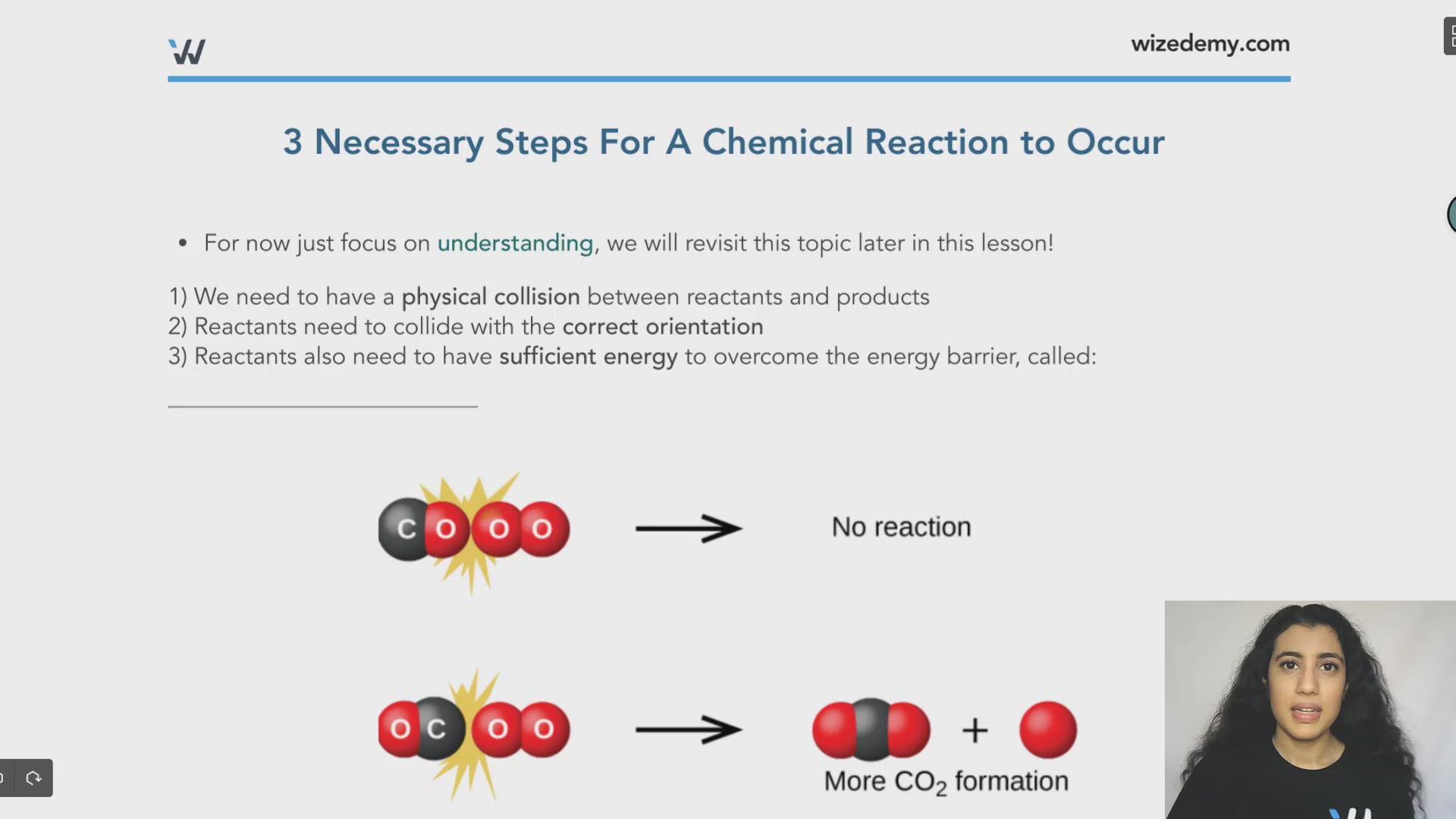
3 Necessary Steps For A Chemical Reaction to Occur
- For now just focus on understanding, we will revisit this topic later in this lesson!
1) We need to have a physical collision between reactants and products
2) Reactants need to collide with the correct orientation
3) Reactants also need to have sufficient energy to overcome the energy barrier, called: ________


Collision Theory
Collision theory has to do with the 3 necessary steps for a reaction to occur that we looked at earlier:
Recall:
1) We need to have a physical collision between reactants and products
2) Reactants need to collide with the correct orientation
3) Reactants also need to have sufficient energy to overcome the energy barrier, called activation energy

Collision Theory: according to this theory, a reaction only occurs when 2 particles collide with the correct orientation and with sufficient energy to overcome the activation energy barrier
Rate = frequency of collisions x fraction of collisions that are effective
- This shows that if we can increase the frequency of collisions, it results in an (increase/decrease) in rate: ________
- It also shows that if we increase the fraction of collisions that are effective, it results in an (increase/decrease) in rate: ________
Understanding Activity:
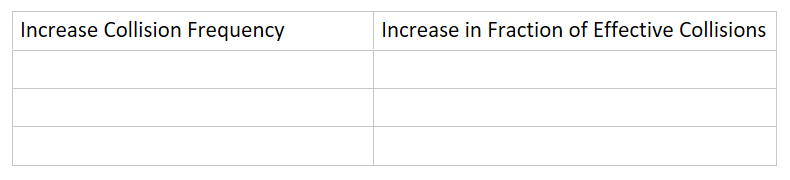
Fill in the following table with the factors that affect rate (nature of reactant, concentration of reactant, surface area, catalyst, temperature)
Hint: One factor increases both the frequency of collisions and fraction of effective collisions!

Collision Theory

- the fraction of molecules (f) that collide with a kinetic energy that is equal to or higher than Ea for a reaction is shown by the shaded areas under each curve
- the fraction increases as T increases
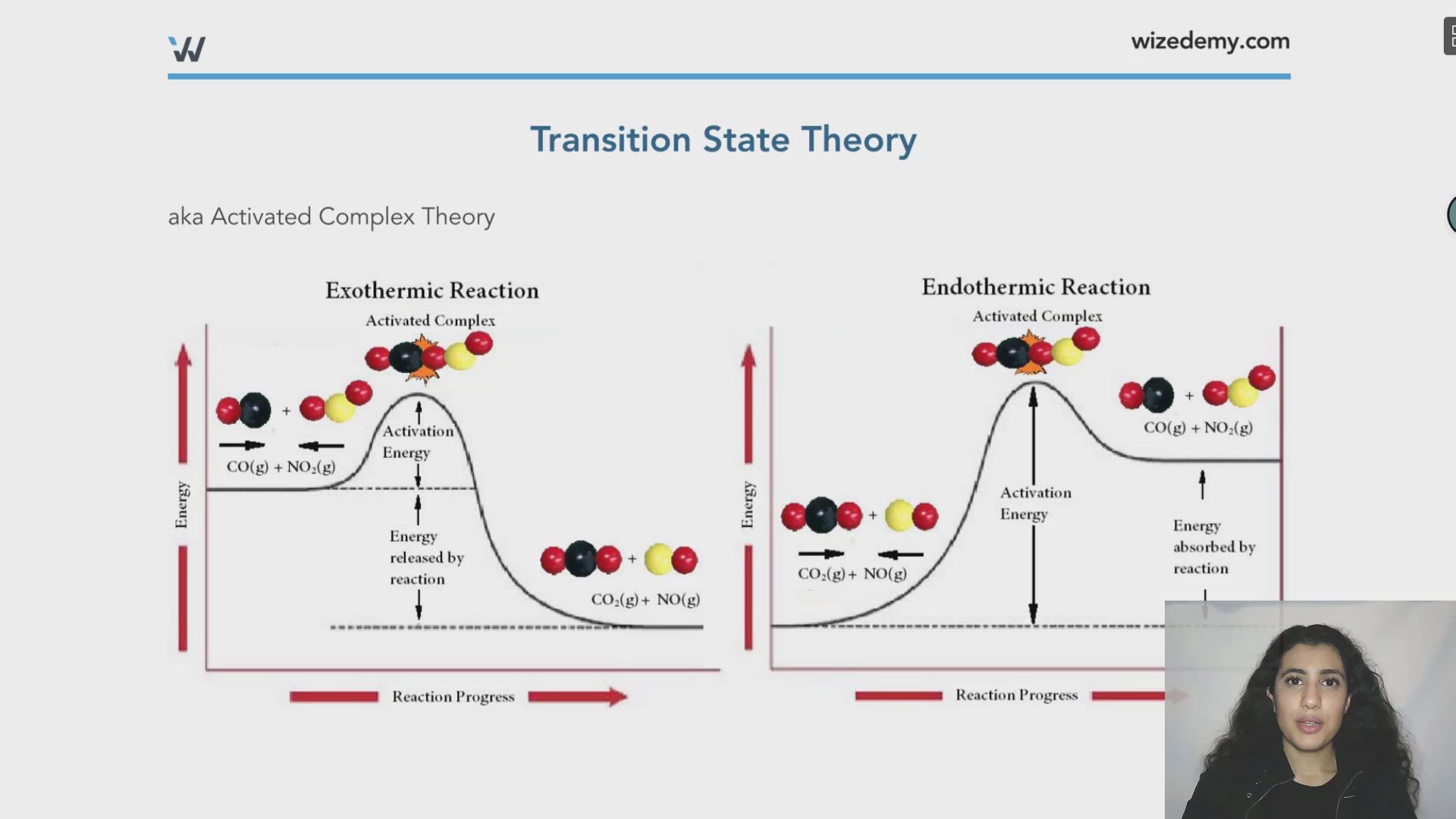
Transition State Theory
aka Activated Complex Theory

- Activated Complex/Transition State=maximum energy
- Once energy has increased enough to reach this activated complex, energy then decreases as products are formed
- Must have enough energy to overcome the activation barrier in order to react and form products!
- Note: the activated complex cannot by isolated (it's hypothetical!)
- Transition state is a hypothetical state where we are halfway between reactants and products (bonds are about to be broken and formed)
- The barrier height=Ea
- Catalysts only lower the energy of the transition state!
- A note on enthalpy:
- ΔH > 0 = endothermic (energy needs to be added/absorbed for the reaction to occcur)
- ΔH < 0 = exothermic (energy is released in the reaction)
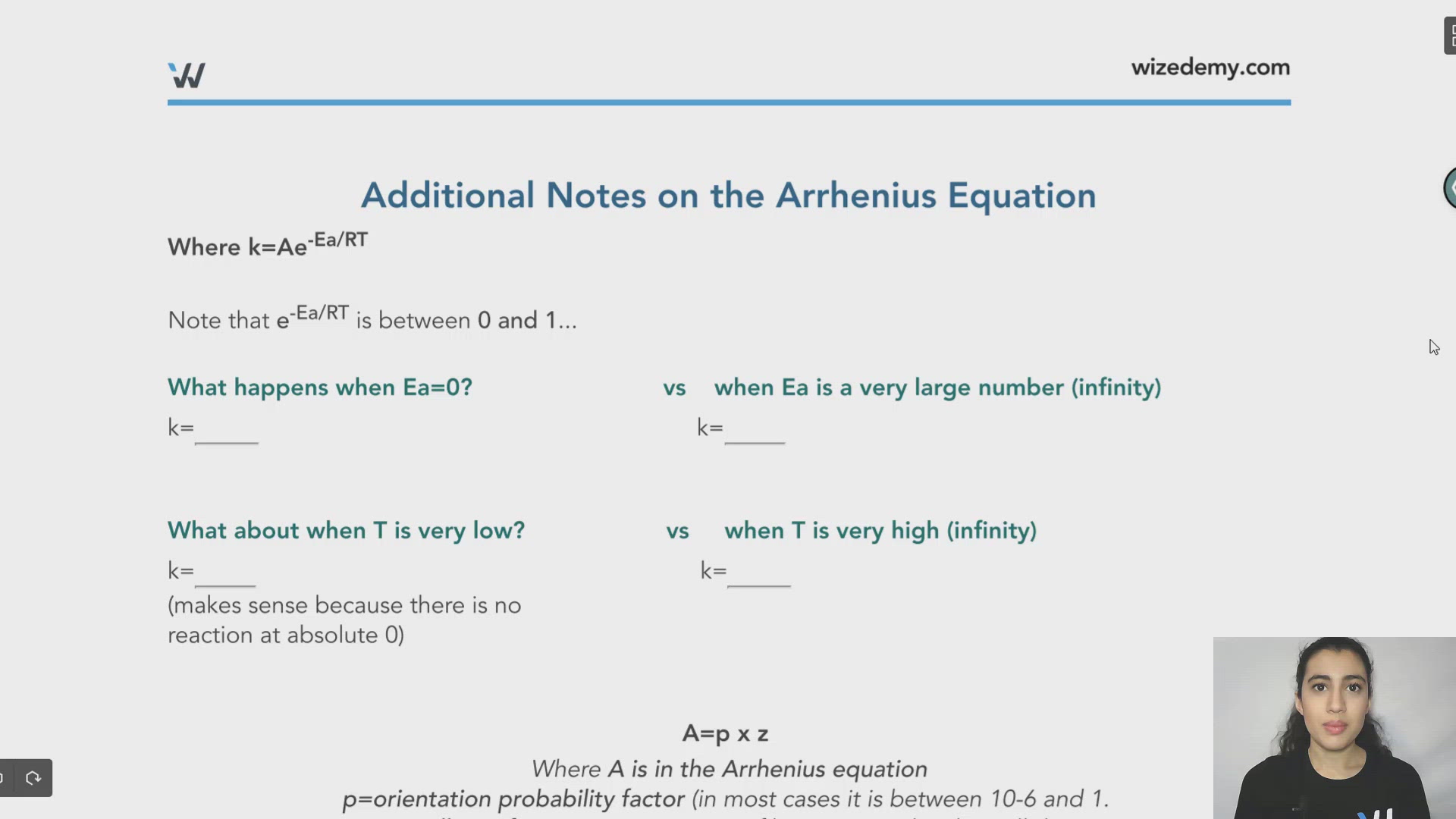
Additional Notes on the Arrhenius Equation
Where k = Ae–Ea/RT
Note that e–Ea/RT is between 0 and 1...
What happens when Ea = 0? vs when Ea is a very large number (infinity)
k = ________ k = ________
What about when T is very low? vs when T is very high (infinity)
k = ________ k = ________
(makes sense because there is no
reaction at absolute 0)
A = p × z
Where A is in the Arrhenius equation
p = orientation probability factor (in most cases it is between 10–6 and 1.
z = collision frequency (a measure of how easy molecules collide)
If there are more molecules then would z be a higher or lower #? ________
If the reactant molecules were very large, would they arrange themselves into the correct orientation more of the time or less of the time compared to reactant molecules that were tiny? ________
What about if you had many reactants that needed to come together in one reaction, but in a different reaction only a couple of reactants need to come together to form products? Which reaction would have the correct orientation more of the time? ________
If we know rate of reaction = k[A][B], where [A] and [B] are reactants in the RDS of the mechanism, and we know k = Ae–Ea/RT (Arrhenius),
then... rate of reaction = Ae–Ea/RT[A][B], we also know A = pz so we could plug that in as well:
rate of reaction = (p)(z)e–Ea/RT[A][B]
Based on this equation, we can see the 3 necessary components for a successful reaction where reactantss are converted into products!
1) Molecules need to be colliding into one another (what will cause more collisions?)
2) Molecules need to be colliding in the correct orientation
3) While molecules are colliding in the correct orientation, they also need to have enough energy to overcome the energy barrier in order to form products
Only when we have all 3 of these factors do we have an effective collision and get products. The more of these effective collisions we have per second, the higher the rate of reaction!