
Properties of Alkanes, Alkenes, & Alkynes

- Are non-polar
- Soluble in non-polar solvents (Like dissolves like)
- Don't dissolve in water (polar)
- Boiling point increases as the chain gets longer due to increased intermolecular forces (London dispersion forces)
- Highly branched alkanes have lower boiling points
- *Think: tree trunk vs small branches
- Alkenes have lower boiling points than alkanes with the same number of carbon atoms
- Alkynes have higher boiling points than alkanes with the same number of carbon atoms (it has to do with the triple bond and how it creates a linear structure, which causes the atoms to attract each other more strongly, so it takes more energy to break them apart)
- Aromatic hydrocarbons have similar boiling points as aliphatic hydrocarbons with the same # of carbons
- Benzene is a liquid at room temperature
- Aromatic compounds were named this because they are "aromatic" and often have strong odours
Boiling Points of the First 10 Straight Alkanes

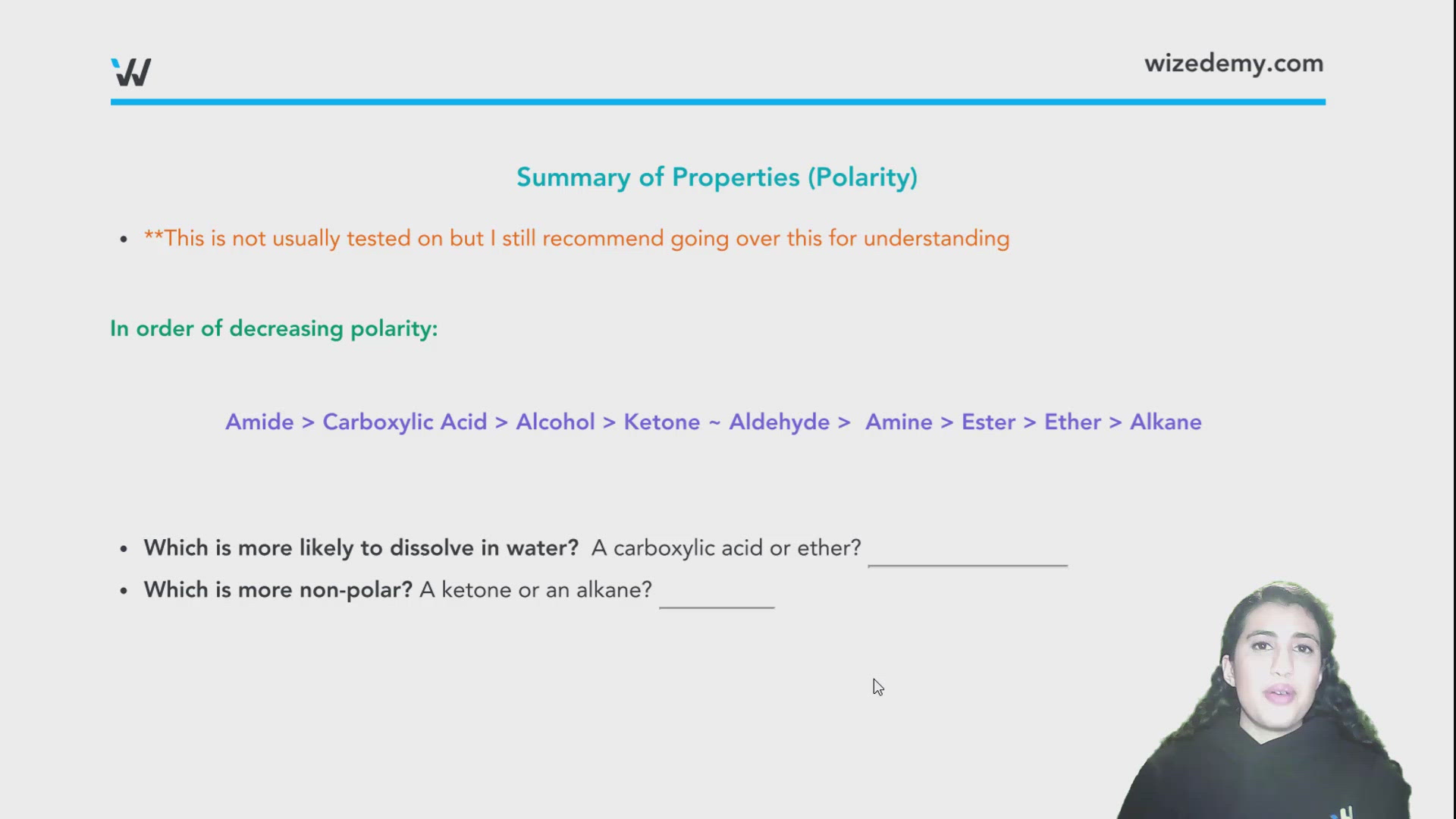
Summary of Properties (Polarity)
**This is not usually tested on but I still recommend going over this for understanding 💡.
In order of decreasing polarity:
Amide > Carboxylic Acid > Alcohol > Ketone ~ Aldehyde > Amine > Ester > Ether > Alkane
- Which is more likely to dissolve in water? A carboxylic acid or ether? ________
- Which is more non-polar? A ketone or an alkane? ________