Introduction to Functional Groups

Functional groups determine whether:
- The molecules are soluble in polar or non-polar solvents
- The molecules have high or low melting and boiling points
- Molecules readily react with other molecules
3 Main Components of Functional Groups
There are many different functional groups but they essentially consist of only 3 main components:
- Carbon-Carbon multiple bonds (-C=C- or -C≡C-)
- Single bonds between a Carbon atom and a more electronegative atom (eg. C-O, C-N, or C-Cl)
- Carbon atom double bonded to an oxygen atom (-C=O)

A More Detailed Look at Functional Groups
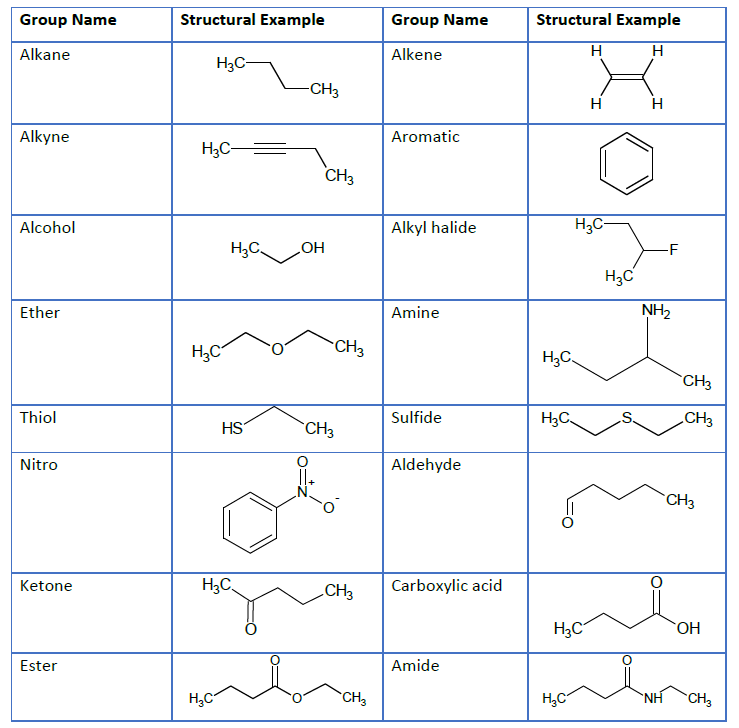
To study organic chemistry in a systematic way we need to be able to look at a molecule and find common fragments (called functional groups) which we can the generalize to all organic molecules.
Note: "SN" in the table below Is the name you use when that functional group is not highest priority but is a substituent

Some other common functional groups are shown below. You will be expected to identify them but they do not have a priority (they have a much lower priority than the functional groups in the table above).

Example: Functional Groups of Vitamin C
The structural formula of vitamin C is shown below. What are the functional groups in vitamin C?


Example: Identifying Functional Groups
Identify all of the functional groups in the following molecule, you don't need to circle multiple instances of the same functional group.
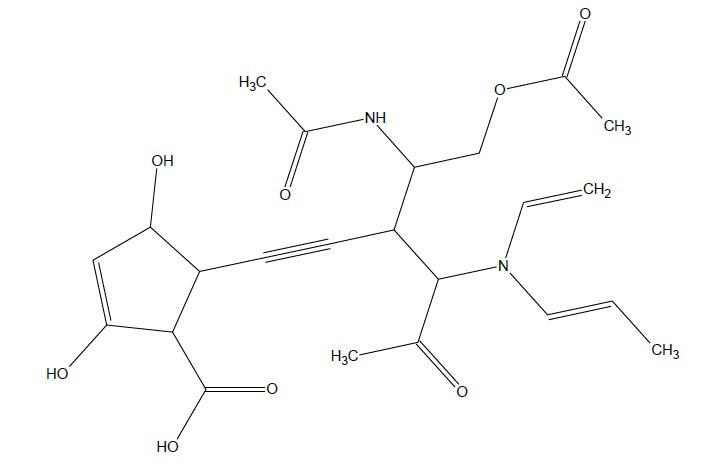
Sol:
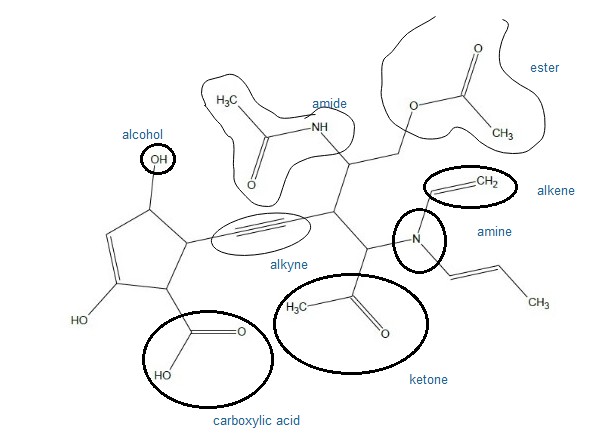
Functional Groups Cheatsheet