Wize University Chemistry Textbook > Introduction to Organic Chemistry
Properties of Functional Groups
Popular Courses
General Chemistry
University Study Guides
CHEM 112
Queen's University
Chemistry
General Course
General Chemistry
University Study Guides
CHEM 123
University of British Columbia
APSC 132
Queen's University
CHEM 112B
Queen's University
CHEM 130
University of British Columbia
CHEM 1100
University of Manitoba
CHEM 1481
Texas A & M University
CEM 141
Michigan State University
CHMA10H3
University of Toronto
SC/CHEM 1100 4.00
York University
CHM 2045
University of Florida
CHEM 1001
Carleton University
CHEM 111
University of British Columbia
CHEM 112
University of Saskatchewan
CHEM 1P91
Brock University
CHMA11H3
University of Toronto
CHM 1301
University of Ottawa

0:00 / 0:00
Properties of Alkanes, Alkenes, & Alkynes

- Are non-polar
- Soluble in non-polar solvents (Like dissolves like)
- Don't dissolve in water (polar)
- Boiling point increases as the chain gets longer due to increased intermolecular forces (London dispersion forces)
- Highly branched alkanes have lower boiling points
- *Think: tree trunk vs small branches
- Alkenes have lower boiling points than alkanes with the same number of carbon atoms
- Alkynes have higher boiling points than alkanes with the same number of carbon atoms (it has to do with the triple bond and how it creates a linear structure, which causes the atoms to attract each other more strongly, so it takes more energy to break them apart)
- Aromatic hydrocarbons have similar boiling points as aliphatic hydrocarbons with the same # of carbons
- Benzene is a liquid at room temperature
- Aromatic compounds were named this because they are "aromatic" and often have strong odours
Boiling Points of the First 10 Straight Alkanes

0:00 / 0:00
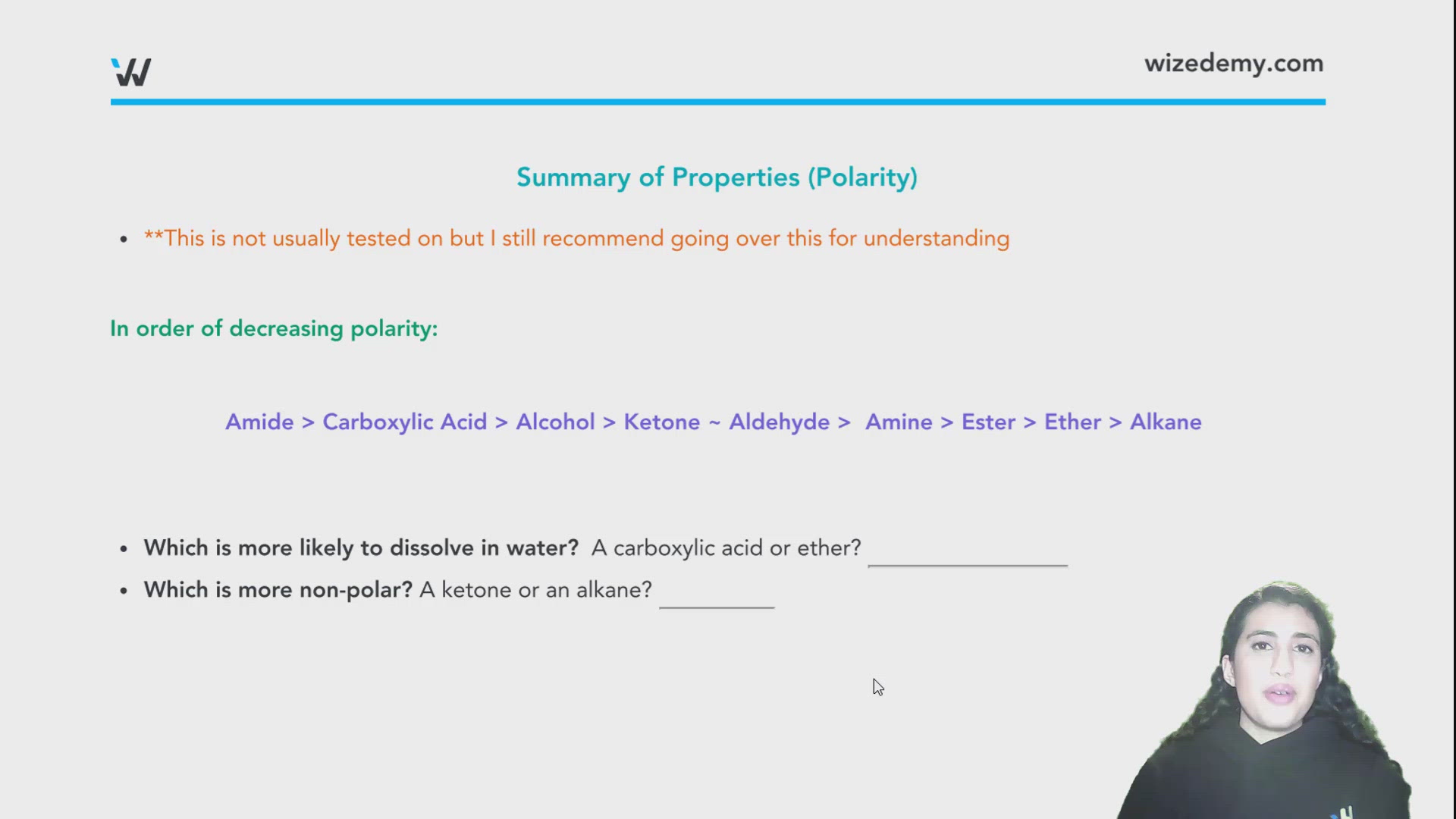
Summary of Properties (Polarity)
**This is not usually tested on but I still recommend going over this for understanding 💡.
In order of decreasing polarity:
Amide > Carboxylic Acid > Alcohol > Ketone ~ Aldehyde > Amine > Ester > Ether > Alkane
Wize Tip
For exams, it can be helpful to have a general idea of which functional groups are more polar and which are less polar!
See examples below
- Which is more likely to dissolve in water? A carboxylic acid or ether?carboxylic acid
- Which is more non-polar? A ketone or an alkane?alkane
Practice: Ranking Boiling Points
Rank the following compounds in order of increasing boiling point.