Create a free account to get started

Unlock full course notes by signing up

  • Video lessons taught by top educators
  • Practice questions with guided solutions
  • Written review notes for reference
  • Expert answers anytime from course tutors

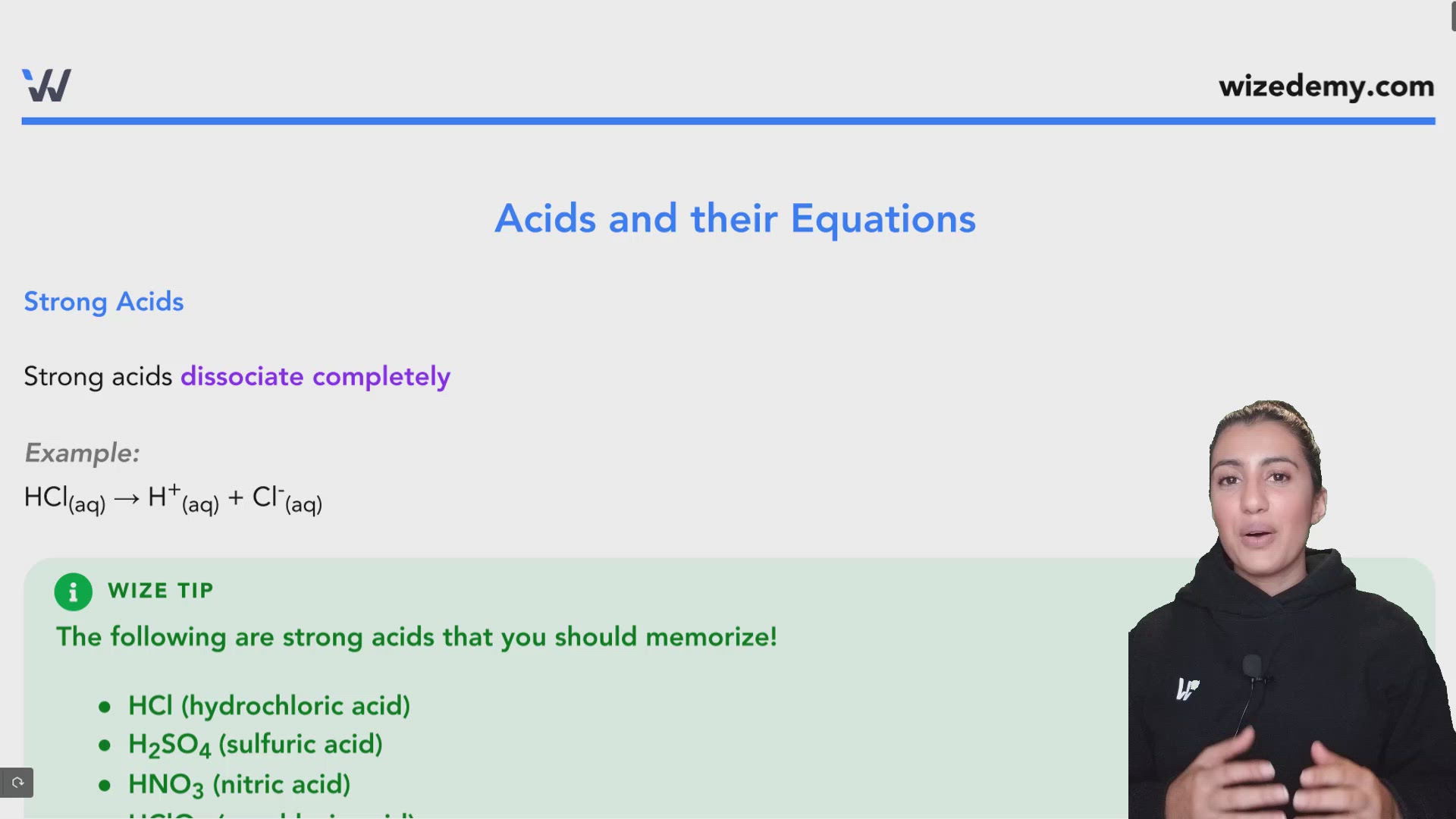
Acids and their Equations

Strong Acids

Strong acids dissociate completely

Example:

HCl(aq) → H+(aq) + Cl-(aq)


Weak Acids

Weak acids dissociate incompletely, so they have a Ka value (acid dissociation constant)


Ka is defined as the equilibrium constant for the reaction below:


HA+H2O⇌A−+H3O+HA+H_2O \rightleftharpoons A^-+H_3O^+


Ka=[H3O+][A−][HA]K_a=\cfrac{[H_3O^+][A^-]}{[HA]}


pKa=−log⁡Ka and Ka=10−pKapK_a=-\log K_a\ and\ K_a=10^{-pK_a}

Acid strength follows the following trends:


  • A weaker acid would have a higher/lower Ka value? ________
  • A weaker acid would have a higher/lower pKa value? ________


  • A weaker acid will have a higher/lower pH value: ________
  • A stronger acid will have a higher/lower Ka value? ________
  • A stronger acid will have a higher/lower pKa value? ________
  • A stronger acid will have a higher/lower pH value? ________


In general:

  • If the Ka > 1, pKa < 0 the acid is strong/weak: ________ and reactants/products: ________ are favored
  • If the Ka < 1, pKa > 0 the acid is strong/weak: ________ and reactants/products:________ are favored
Practice: Strong Acids

Which one of the following statements about strong acids is true?

Choose an answer

Create a free account to get started

Unlock full course notes by signing up

  • Video lessons taught by top educators
  • Practice questions with guided solutions
  • Written review notes for reference
  • Expert answers anytime from course tutors

Create a free account to get started

Unlock full course notes by signing up

  • Video lessons taught by top educators
  • Practice questions with guided solutions
  • Written review notes for reference
  • Expert answers anytime from course tutors

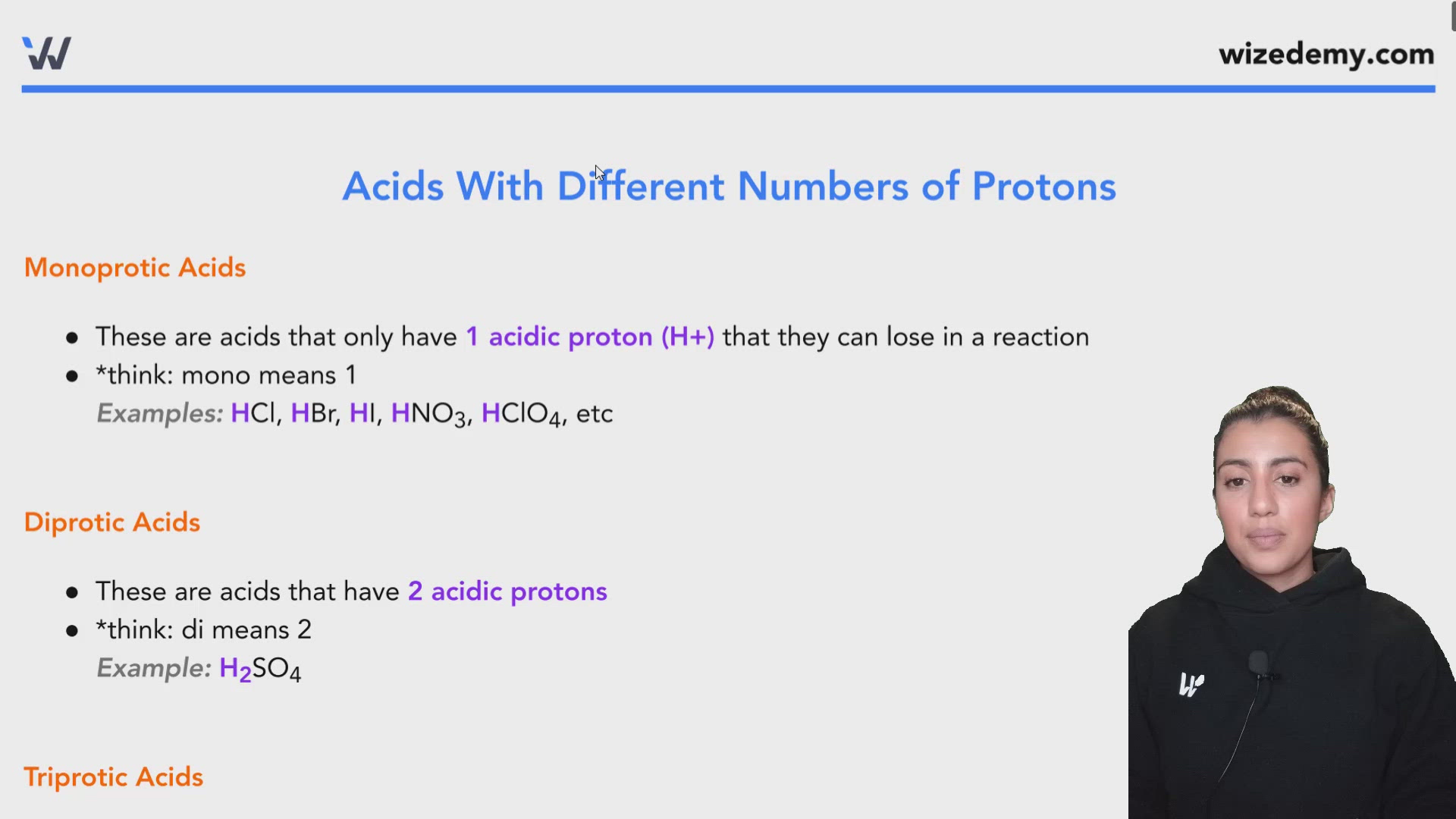
Acids With Different Numbers of Protons

Monoprotic Acids

  • These are acids that only have 1 acidic proton (H+) that they can lose in a reaction
  • *think: mono means 1 Examples: HCl, HBr, HI, HNO3, HClO4, etc


Diprotic Acids

  • These are acids that have 2 acidic protons
  • *think: di means 2 Example: H2SO4


Triprotic Acids

  • These are acids that have 3 acidic protons
  • *think: tri means 3 Example: H3PO4


Polyprotic Acids

  • This term is just referring to any acid that has more than 1 proton
  • *think: poly means many Example: H2SO4, H3BO3, H2C2O4


H3PO4 (aq) + H2O (l) ⇋ H2PO4− (aq) + H3O+ (aq)H_3PO_4\ \left(aq\right)\ +\ H_2O\ \left(l\right)\ \leftrightharpoons\ H_2PO_4^-\ \left(aq\right)\ +\ H_3O^+\ \left(aq\right)


H2PO4− (aq) + H2O (l) ⇋ HPO42− (aq) + H3O+ (aq)H_2PO_4^-\ \left(aq\right)\ +\ H_2O\ \left(l\right)\ \leftrightharpoons\ HPO_4^{2-}\ \left(aq\right)\ +\ H_3O^+\ \left(aq\right)


HPO42− (aq) + H2O (l) ⇋ PO43− (aq) + H3O+ (aq)HPO_4^{2-}\ \left(aq\right)\ +\ H_2O\ \left(l\right)\ \leftrightharpoons\ PO_4^{3-}\ \left(aq\right)\ +\ H_3O^+\ \left(aq\right)


Image illustrating Acids With Different Numbers of Protons


Extra Practice