Create a free account to get started

Unlock full course notes by signing up

  • Video lessons taught by top educators
  • Practice questions with guided solutions
  • Written review notes for reference
  • Expert answers anytime from course tutors

Functional Groups

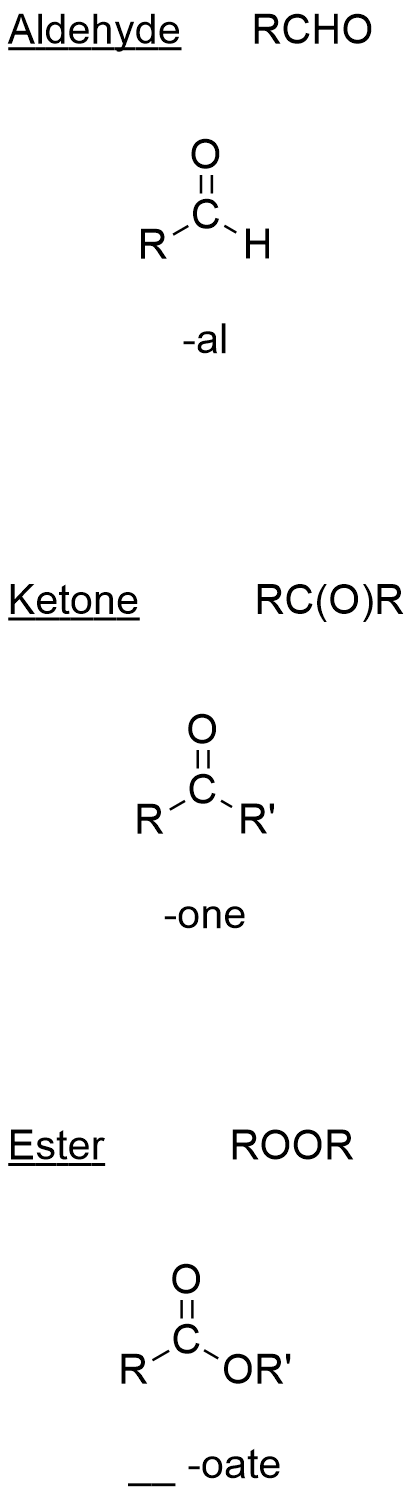
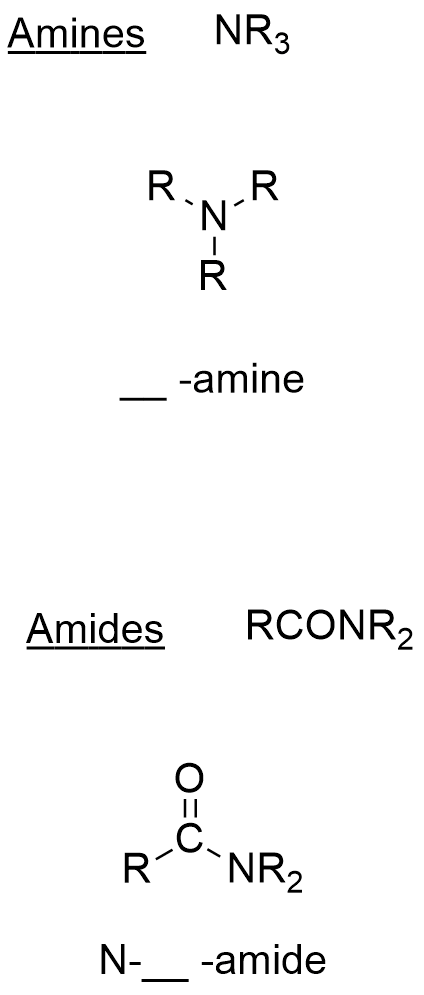
  • To study organic chemistry in a systematic way we need to be able to look at a molecule and find common fragments (called functional groups) which we can the generalize to all organic molecules
  • Functional group Identification is crucial for naming an organic molecule. The functional groups you are responsible for are shown below along with their suffix

Memorization Box

Image illustrating Functional Groups


Image illustrating Functional Groups


Image illustrating Functional Groups


Create a free account to get started

Unlock full course notes by signing up

  • Video lessons taught by top educators
  • Practice questions with guided solutions
  • Written review notes for reference
  • Expert answers anytime from course tutors

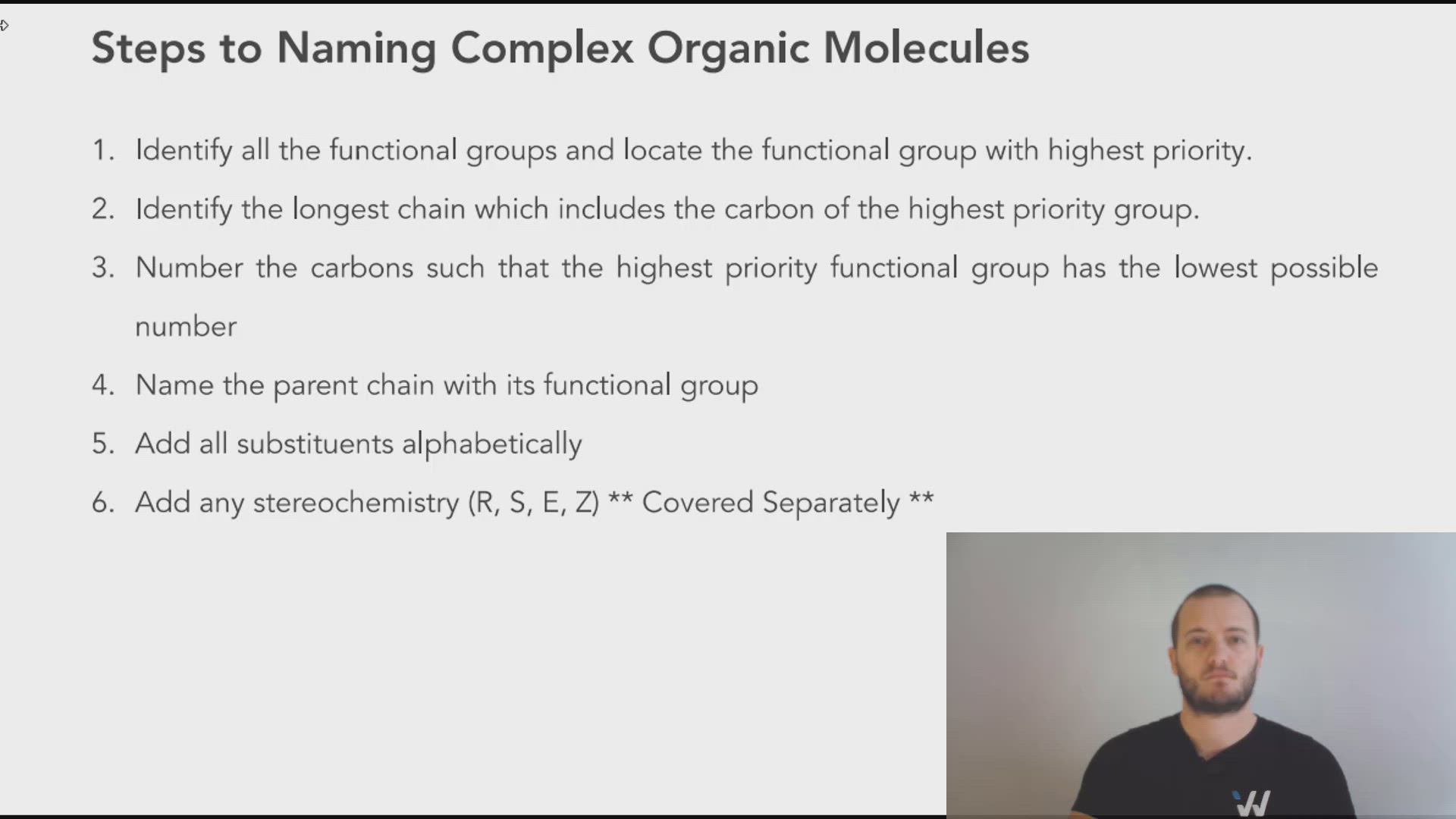
Steps to Naming Complex Organic Molecules

  1. Identify all the functional groups and locate the functional group with highest priority.
  2. Identify the longest chain which includes the carbon of the highest priority group.
  3. Number the carbons such that the highest priority functional group has the lowest possible number
  4. Name the parent chain with its functional group
  5. Add all substituents alphabetically
  6. Add any stereochemistry (R, S, E, Z) ** Covered Separately **


Image illustrating Steps to Naming Complex Organic Molecules


Image illustrating Steps to Naming Complex Organic Molecules
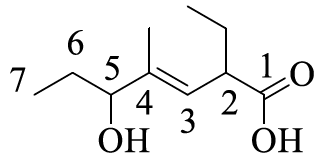
  1. The carboxylic acid is the highest priority group
  2. The Longest chain that includes the COOH is 7 carbons long
  3. Start numbering at the COOH carbon
  4. Parent molecule is hept-3-eneoic acid
  5. We have one ethyl, one hydroxyl and one methyl so the name becomes: 2−ethyl−5−hydroxyl−4−methylhept−3−eneoicacid\rm 2-ethyl-5-hydroxyl-4-methylhept-3-eneoicacid
  6. The only stereochemistry indicated is the double bond which is EE so the name is :
(E) −2−ethyl−5−hydroxy−4−methylhept−3−eneoic acid\boxed{(E)\ \rm -2-ethyl-5-hydroxy-4-methylhept-3-eneoic\ acid}


Create a free account to get started

Unlock full course notes by signing up

  • Video lessons taught by top educators
  • Practice questions with guided solutions
  • Written review notes for reference
  • Expert answers anytime from course tutors

Naming Organic Molecules with Odd Functional Groups

  • Esters, ethers, sulphides, and amides are weird because they interrupt carbon chains.
  • For ethers, sulphides, and amines we name each group coming off as a substituent and place ether, sulphide or amine at the end of the name as shown below.
Image illustrating Naming Organic Molecules with Odd Functional Groups


For esters, the group attached to the oxygen atom becomes the substituent and the carbon of the ester becomes carbon 1, as long as there is no higher priority group.


Image illustrating Naming Organic Molecules with Odd Functional Groups


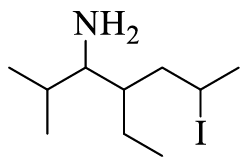
Example: Nomenclature Practice

Name the following:


a)
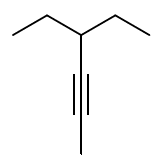
Image illustrating Example

4−ethylhex−2−yne\rm 4-ethylhex-2-yne


b)

Image illustrating Example

4−ethyl−6−iodo−2−methylheptan−3−amine\rm 4-ethyl-6-iodo-2-methylheptan-3-amine

Practice: Nomenclature

The name of the following compounds is:


Illustration for practice question: Practice: Nomenclature


Choose an answer

Create a free account to get started

Unlock full course notes by signing up

  • Video lessons taught by top educators
  • Practice questions with guided solutions
  • Written review notes for reference
  • Expert answers anytime from course tutors

Practice: Nomenclature

Choose the option below that depicts 3-methylhexanoic acid

Choose an answer

Create a free account to get started

Unlock full course notes by signing up

  • Video lessons taught by top educators
  • Practice questions with guided solutions
  • Written review notes for reference
  • Expert answers anytime from course tutors

Functional Group Parent Names Cheatsheet


Image illustrating Functional Group Parent Names Cheatsheet


Extra Practice