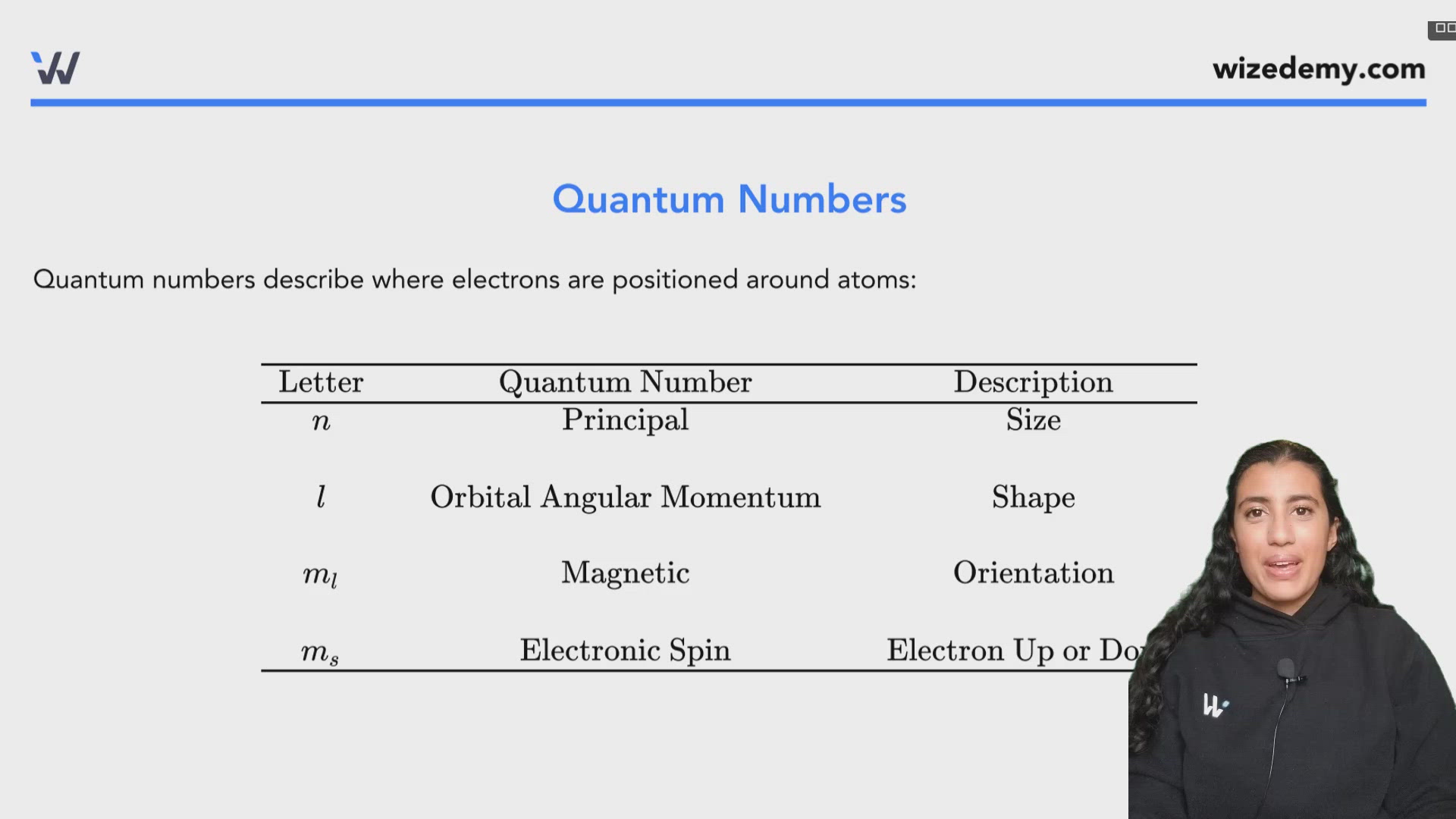
Quantum Numbers
Quantum numbers describe where electrons are positioned around atoms:
Rules:
- Can be any positive integer Example: n = (1, 2, 3, 4…)
- As n increases, energy and size of shell ________
- Can be any non-negative integer up to n-1 Example: l = (0, 1, 2, 3, …, n-1)
- l (orbital shapes) are described as:

Increasing energy →

- These shapes show us where an electron is most likely to be found
- There is a 90% chance in finding an electron somewhere inside the given shape
- Can be any integer from –l to +l Example: m1 = (-l, …, 0, …, l)
- This quantum # designates a specific orbital within a given shell Example: if n=2 and l=1, we are looking at 2p.
- ml can be -1, 0, or +1 this designates each of the 2p orbitals: 2px, 2py, and 2pz
- Spin of an electron
- Can only be +1/2 or -1/2
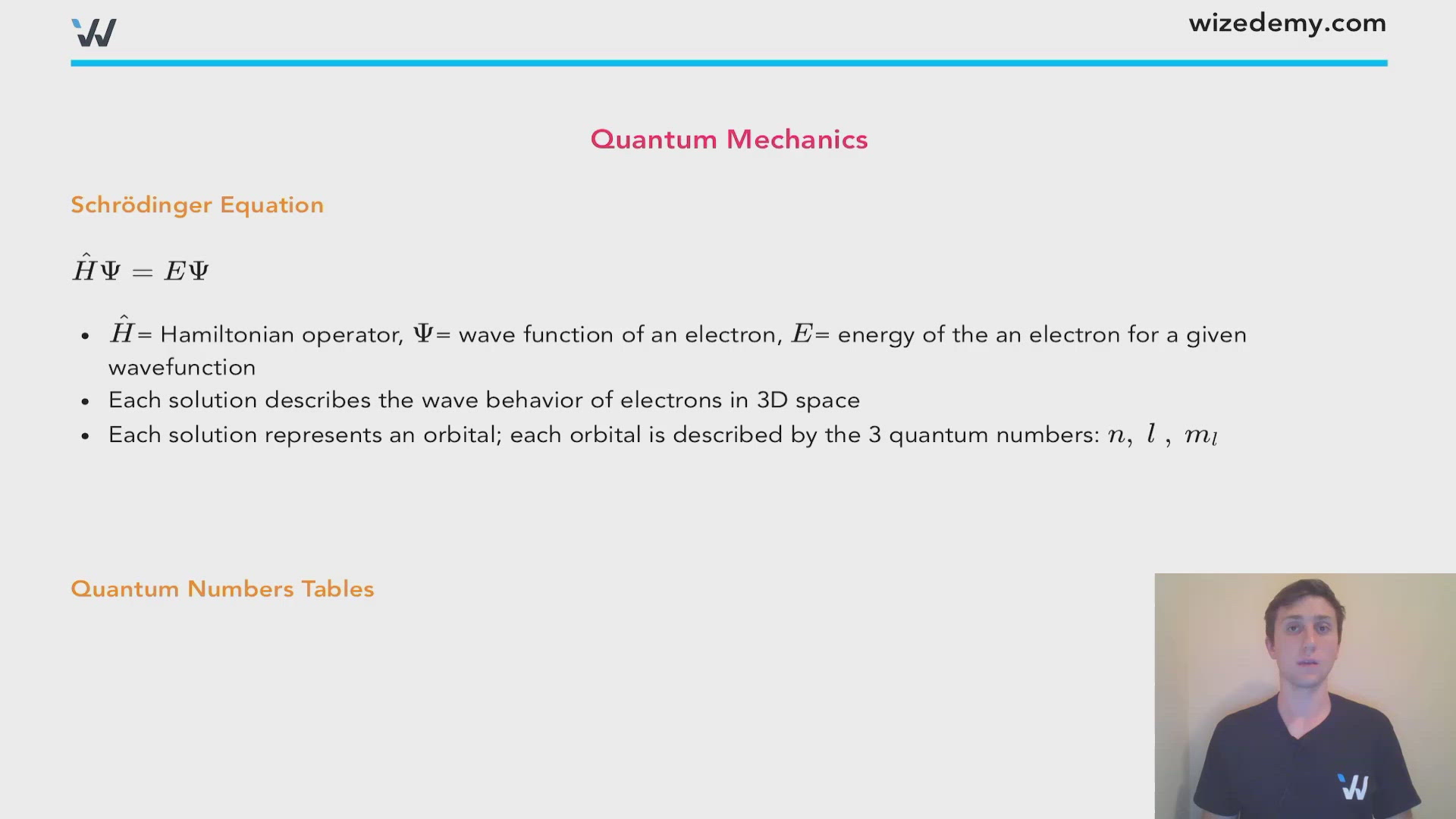
Quantum Numbers Summary

Example: Allowed Quantum Numbers
What are the allowed set of quantum numbers for the following orbitals?
a) 6s
n = 6
l = 0
ml = 0
ms= +1/2 or -1/2
b) 4p
n = 4
l = 1
ml = -1, 0, or 1
ms= +1/2 or -1/2
c) 3d
n = 3
l = 2
ml = -2, -1, 0, 1, or 2
ms= +1/2 or -1/2
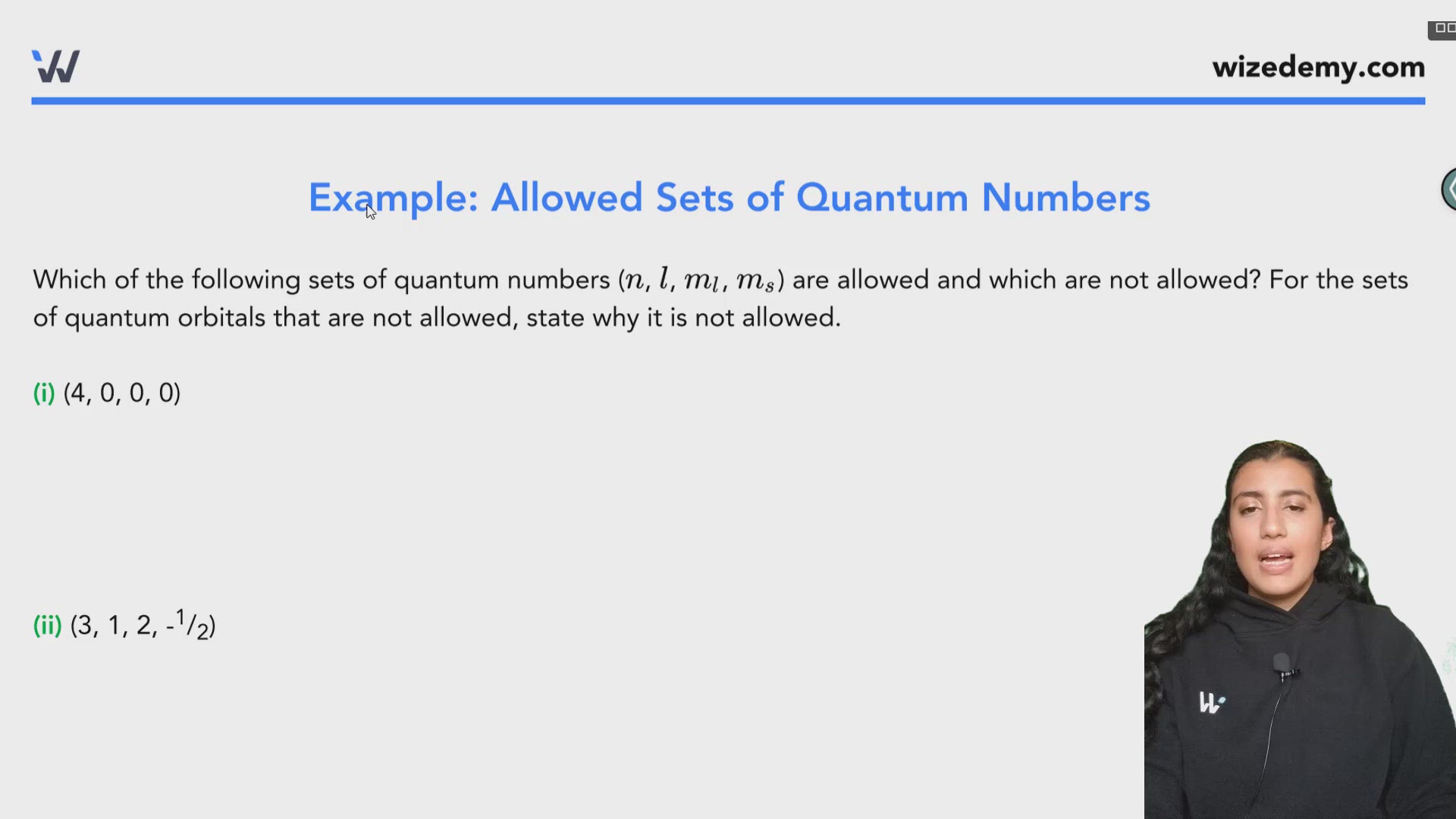
Example: Allowed Sets of Quantum Numbers
Which of the following sets of quantum numbers (, , , ) are allowed and which are not allowed? For the sets of quantum orbitals that are not allowed, state why it is not allowed.
(i) (4, 0, 0, 0)
Not allowed - cannot be equal to 0. Quantum number is always either +1/2 or -1/2.
(ii) (3, 1, 2, -1/2)
Not allowed - cannot be equal to 2 if = 1. Remember that equals all integers from to .
(iii) (5, 3, 0, +1/2)
Allowed. This set of quantum numbers describes a 5f orbital.
(iv) (4, 4, 3, -1/2)
Not allowed - cannot be equal to 4 if = 4. Remember that equals all integers from 0 to .
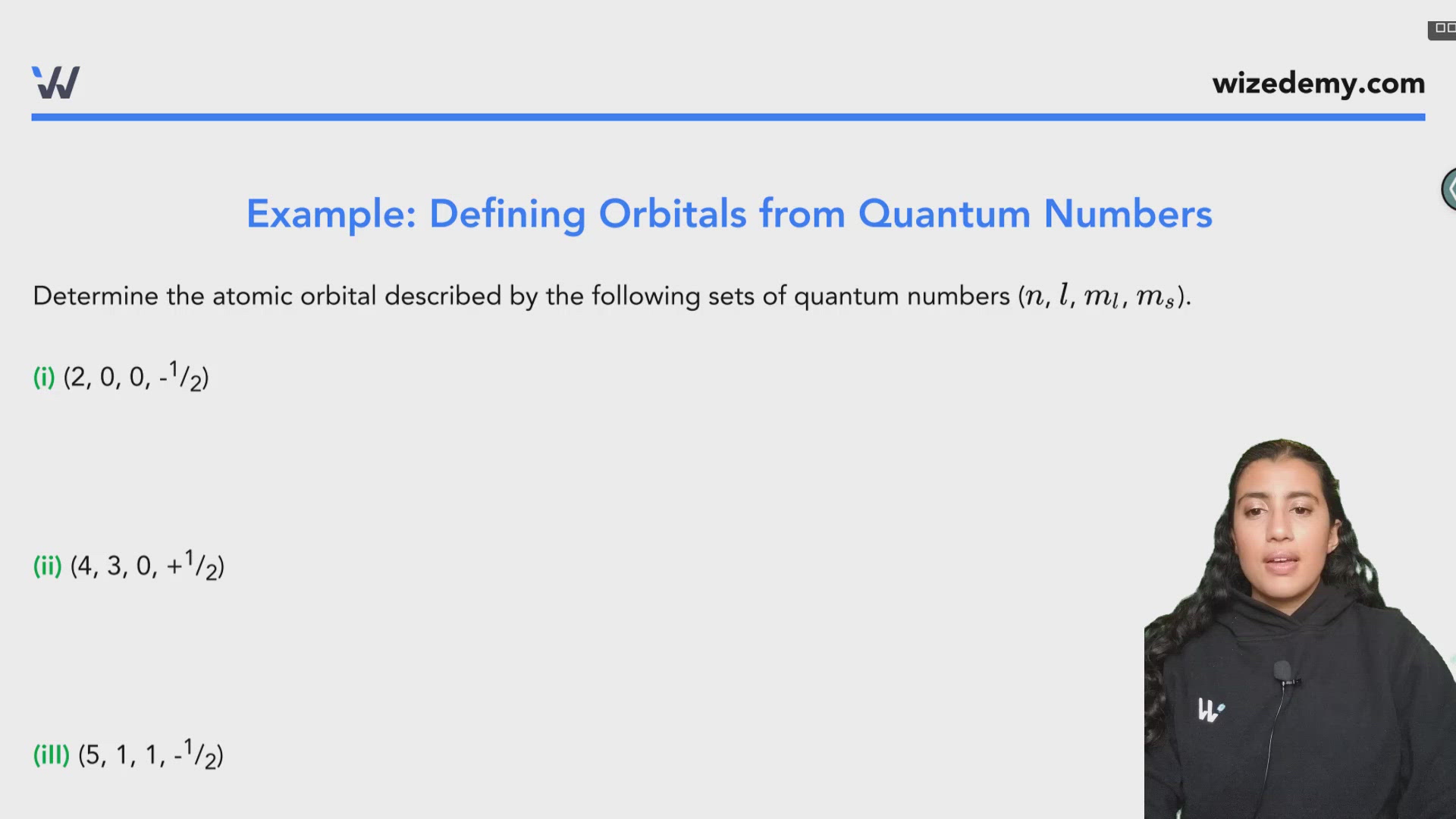
Example: Defining Orbitals from Quantum Numbers
Determine the atomic orbital described by the following sets of quantum numbers (, , , ).
(i) (2, 0, 0, –1/2)
2s orbital
(ii) (4, 3, 0, +1/2)
4f orbital
(iII) (5, 1, 1, –1/2)
5p orbital