
Relationships Between Kinetic Energy, Temperature, and Speeds!
Just focus on understanding 💡 the following lesson.
Scenario #1:
We have two different gases at the same temperature in two different containers. What can we say about the average kinetic energy of the two gases? (are they the same, different, if different how?)
Since both gases are at the same temperature, they'll have the same AVERAGE kinetic energy
Hint: This was the part of the kinetic molecular theory!
We can make sense of this using the following equation:
KEavg is the average kinetic energy of a mole of gas particles
R here is 8.314 J/mol K
How are KEavg and T related?
Directly proportional
Scenario #2:
We have two different gases at the same temperature in two different containers. What can we say about the speeds of the two gases? (are they the same, different, if different how?)
The gases are at the same temperature, so have the same average kinetic energy
Recall: KEavg = 1/2mv2avg
The gases are different so their masses will be different!
The lighter gas (smaller mass) will have a faster average speed so that it will have the same average kinetic energy.

Therefore, a heavier gas will move at a (faster/slower) ________ average speeds than a lighter gas at the same temperature.
Note: The lighter the gas molecule, the more (broad/narrow) ________ the speed distribution
Scenario #3:
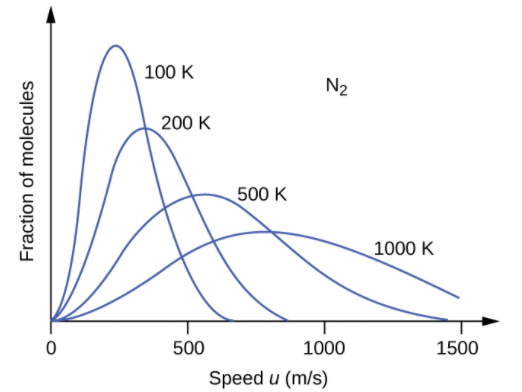
If we just consider one gas in a container, all of the gas particles in the container don't move at the exact same speed.
There is actually a distribution of speeds.
If temperature gets increased, then the average speed (increases/decreases) ________ and the average kinetic energy (increases/decreases) ________ and the spread in the graph below (increases/decreases) ________.
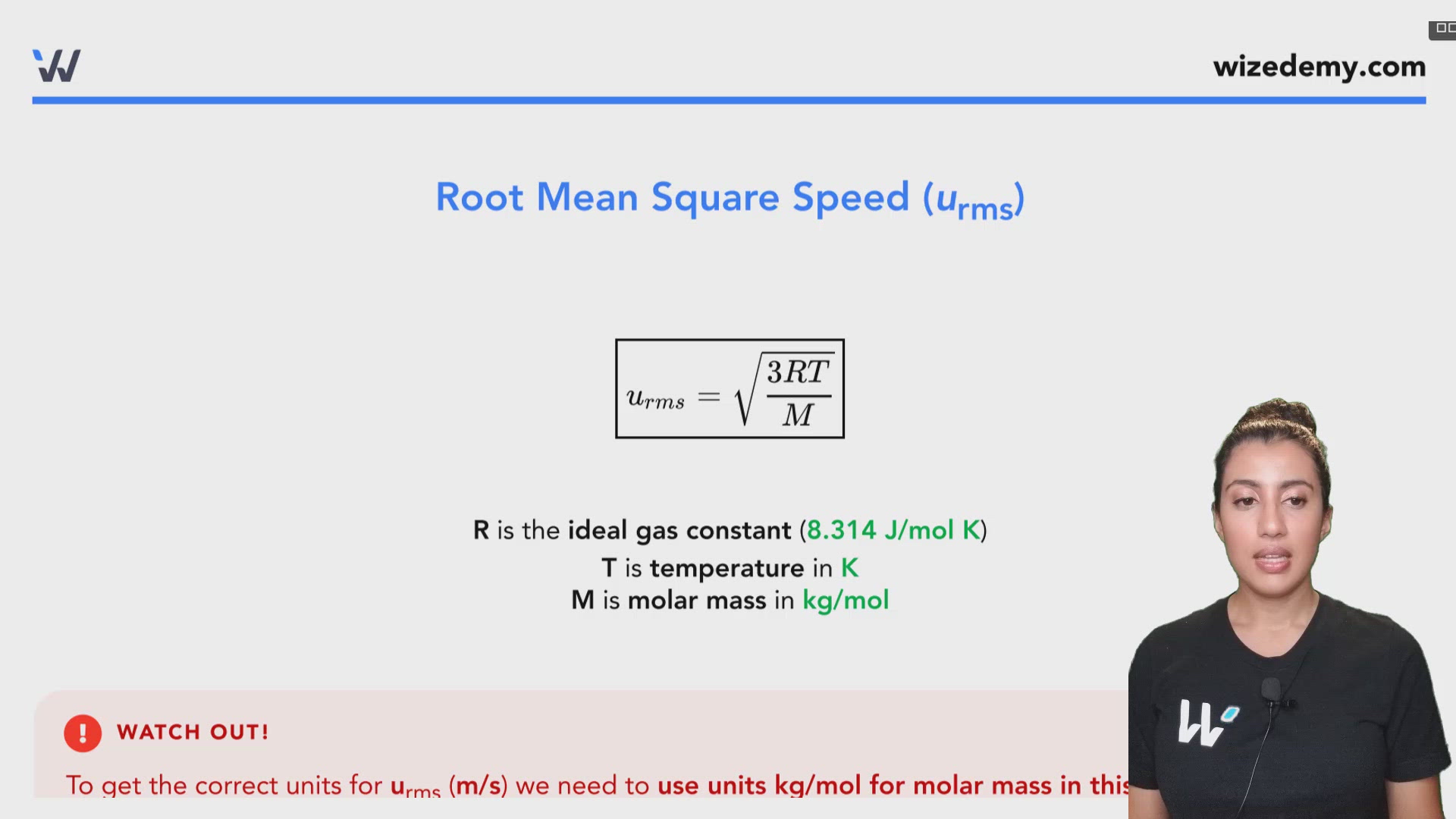
Root Mean Square Speed (urms)
R is the ideal gas constant (8.314 J/mol K)
T is temperature in K
M is molar mass in kg/mol
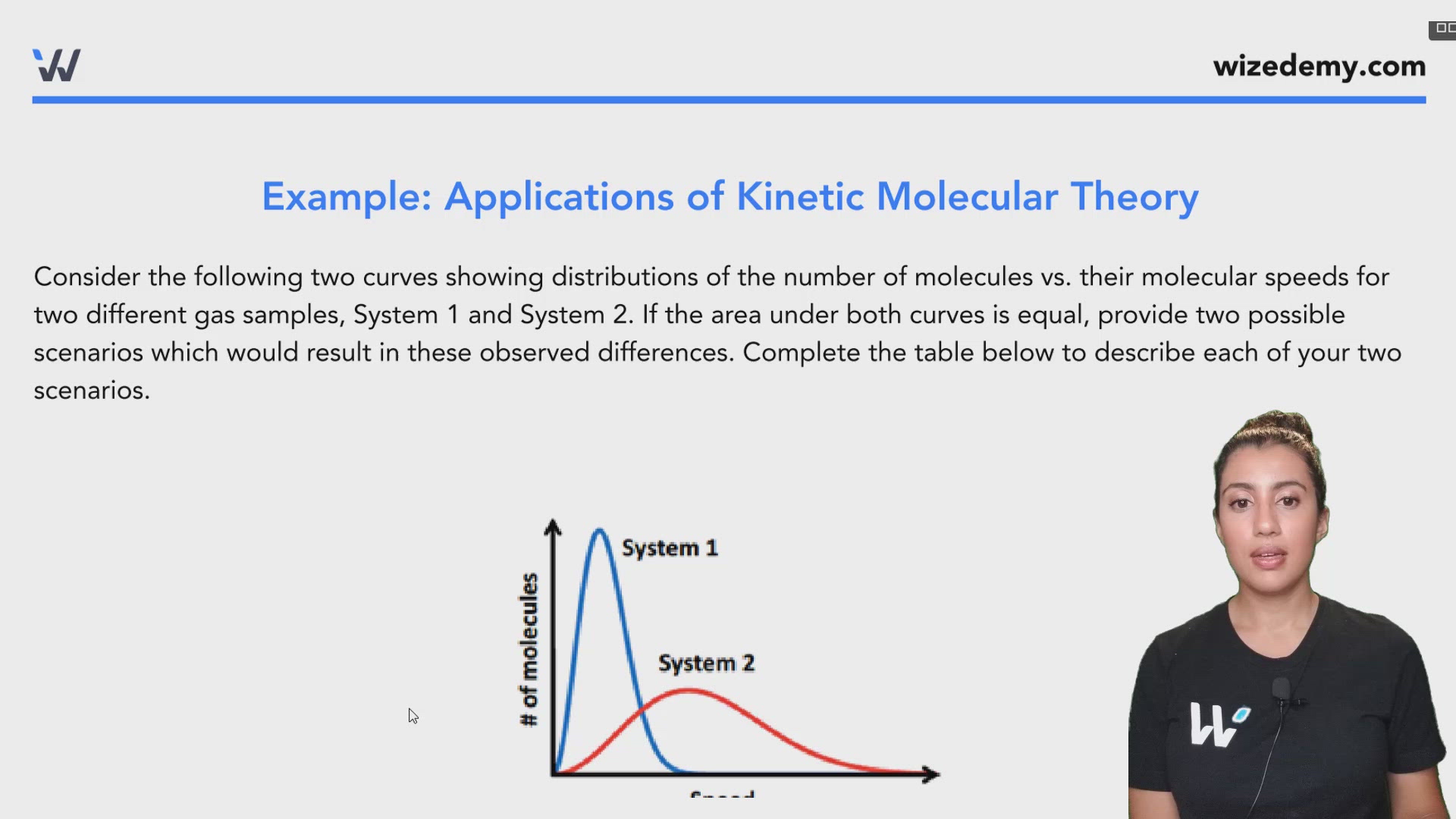
Example: Applications of Kinetic Molecular Theory
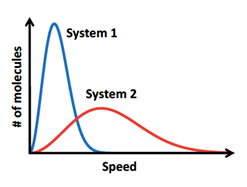
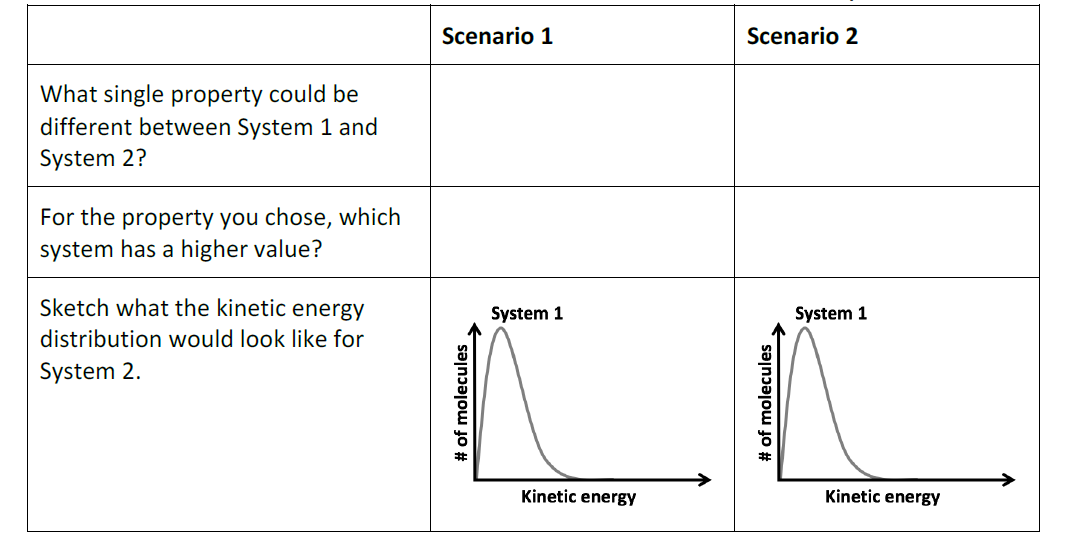
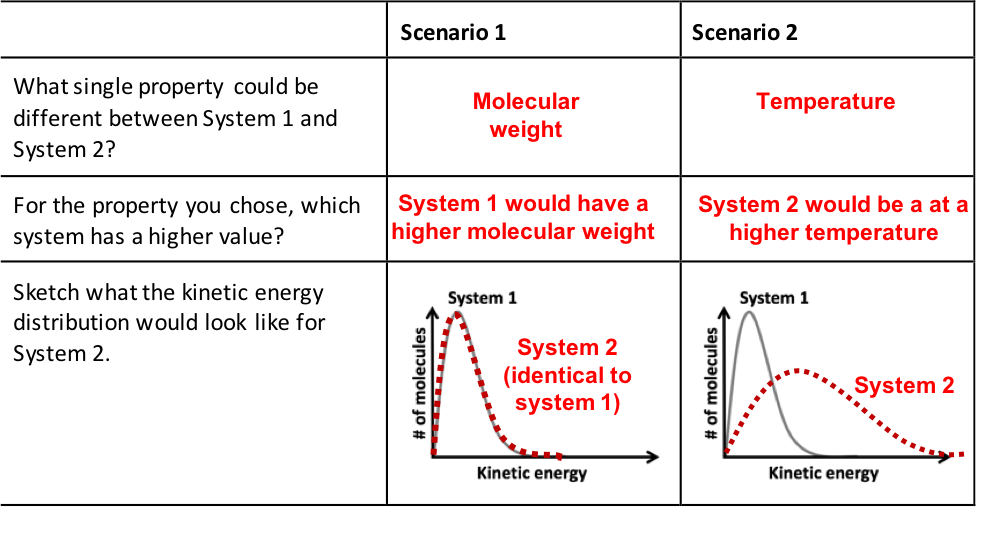
Consider the following two curves showing distributions of the number of molecules vs. their molecular speeds for two different gas samples, System 1 and System 2. If the area under both curves is equal, provide two possible scenarios which would result in these observed differences. Complete the table below to describe each of your two scenarios.

Example: Root Mean Squared Speed
Gas particles in an unknown sample are measured to have a root mean square speed of 324.2 m/s at 80 °C. If this sample is known to be a pure element, what is the most likely identity of this gas?
We can generally identify an unknown gas based on its molar mass.
The root mean square speed and temperature are all we need to find this information:
Notice that our molar mass is initially found with units of kg/mol due to the units included in the Joule [kg m2/s2)! Look over the unit analysis to prove it to yourself.
Given the molar mass is 83.80 g/mol, a quick review of the periodic table tells us that this sample is most likely Krypton.