Wize University Chemistry Textbook > Gases and their Properties
Graham's Law of Effusion
Popular Courses
MCAT
General Course
CHEM 1302A/B
Western University
General Chemistry
University Study Guides
CHEM 101
University of Alberta
CHEM 112
Queen's University
Chemistry
General Course
DAT
General Course
CHEM 103
University of Alberta
General Chemistry
University Study Guides
CHM135H1
University of Toronto
CHEM 120
University of Waterloo
CHY 102
Toronto Metropolitan University
CHEM 205
Concordia University
CHEM 121
Simon Fraser University
CHEM 120
McGill University
SC/CHEM 1000 3.00
York University
APSC 131
Queen's University
CHEM 130
University of British Columbia
CHEM 1100
University of Manitoba
CHEM 1481
Texas A & M University

0:00 / 0:00
Diffusion and Effusion
Diffusion: mixing molecules of one gas with another as a result of random molecular movement. (This term is seen more in biology!)
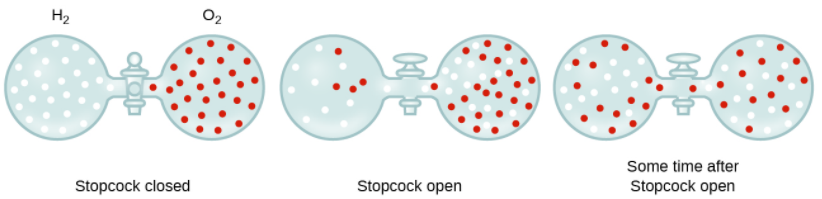
Effusion: Escape of gas molecules from their container through a tiny pinhole. This is what is important to us for gases!
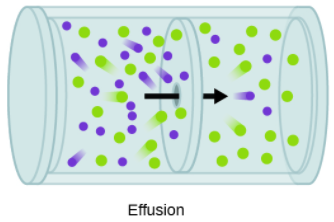
According to the image above, do the green or purple particles have a faster rate of effusion?
Green
Wize Concept
A higher or faster rate of effusion means that those particles escape through the hole at a faster rate!
Do you think lighter or heavier molecules would be able to effuse faster?
Lighter!
Graham's Law of Effusion:
where M=Molecular weight
A is for gas "A"
B is for gas "B"
Based on the equation, how is the rate of effusion for a particle related to its molecular weight? (directly proportional, inversely proportional, other, not related??)
inversely proportional to the square root of its molar mass
Practice: Graham's Law of Effusion
If we started with the same number of dark and light particles in one container and after 2 minutes we looked and saw that 4 dark particles and 2 light particles had effused to the other container, how much heavier/lighter are the dark particles than the light particles?
Practice: Speeds of Gases
An ambitious group of scientists conducted two separate experiments where they isolated 1000 atoms each of Li and Rb in a tiny volume of 5 × 10–15 m3 at a temperature of 1 Kelvin. How many times faster or slower would Li atoms be effusing than Rb atoms?