Wize University Chemistry Textbook > Gases and their Properties
Gas Mixtures & Partial Pressures
Popular Courses
MCAT
General Course
CHEM 1302A/B
Western University
General Chemistry
University Study Guides
AP Chemistry Exam Prep Course
AP Exam Prep
CHEM 1A03
McMaster University
CHEM 101
University of Alberta
CHEM 112
Queen's University
CHEM 203
University of Calgary
CHM 1311
University of Ottawa
Chemistry
General Course
DAT
General Course
CHEM 103
University of Alberta
General Chemistry
University Study Guides
CHM135H1
University of Toronto
CHEM 154
University of British Columbia
CHEM 120
University of Waterloo
CHY 102
Toronto Metropolitan University
CHEM 205
Concordia University
CHEM 121
Simon Fraser University
CHEM 120
McGill University

0:00 / 0:00
Gas Mixtures & Partial Pressures
When dealing with mixtures of gases, the total pressure of the gases is equal to the sum of the partial pressure of each component.

Dalton’s Law of Partial Pressures:
PTotal is the single measured pressure of the mixture
P1 is the partial pressure of gas 1, and so on
Partial pressure: is the pressure that would be exerted by one of the gases in the mixture if it occupied the same volume on its own.
Note: The total pressure depends on the total number of moles (not on the identity of the gases)
We can also relate the partial pressure of an individual gas (ex. Gas "A") to the total pressure by the mole fraction (X) of that gas.
The mole fraction (X) is a proportion of that gas.
0:00 / 0:00
Example: Partial Pressures
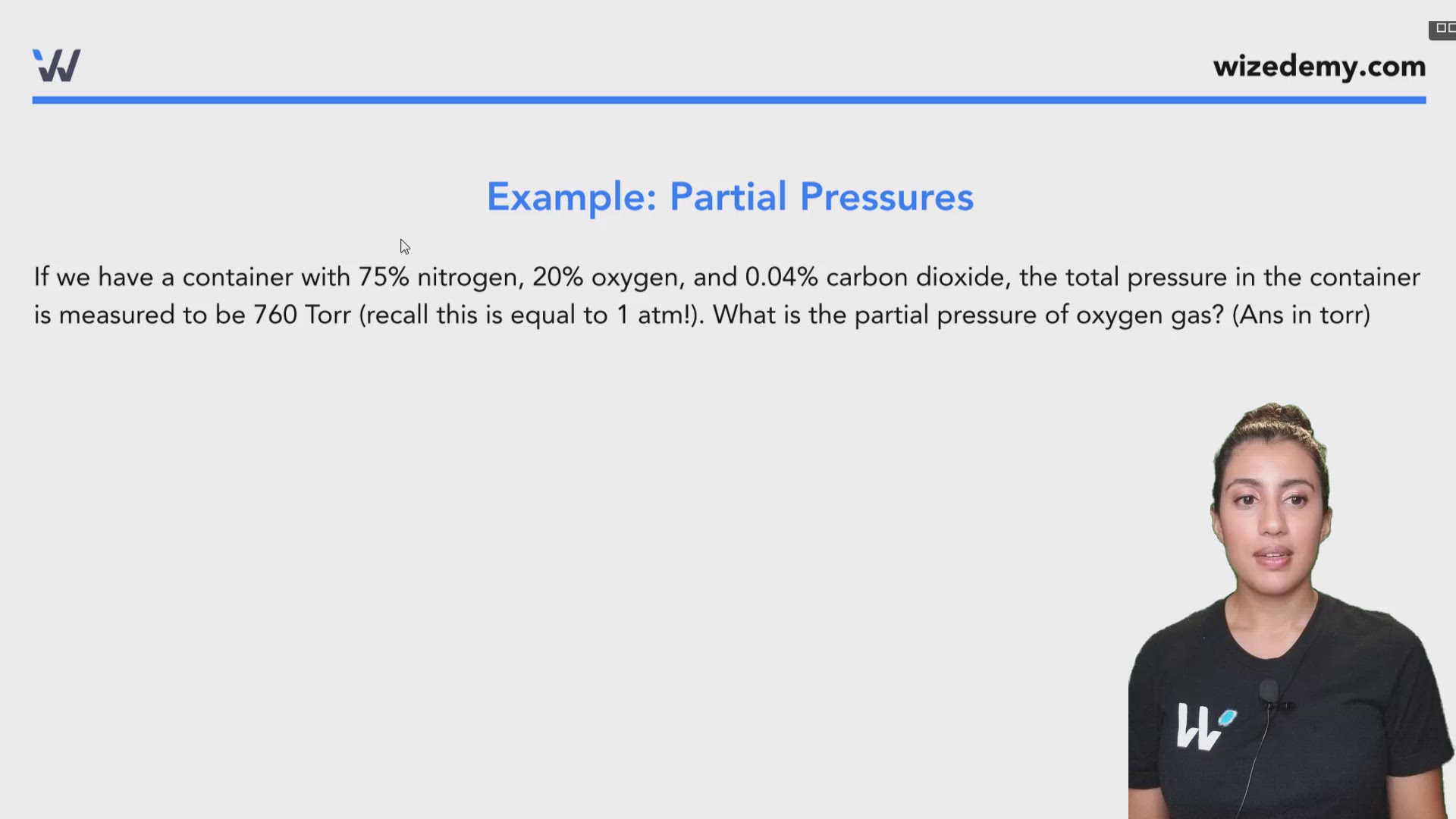
If we have a container with 75% nitrogen, 20% oxygen, and 0.04% carbon dioxide, the total pressure in the container is measured to be 760 Torr (recall this is equal to 1 atm!). What is the partial pressure of oxygen gas? (Ans in torr)
PiO2 = XPT
= 0.2(760 torr)
= 152 torr
Practice: Partial Pressures
A vessel contains He, Ne, and Ar gas. There's twice as much He as Ne and half as much Ar as He. The total pressure in the vessel is 400torr. What is the partial pressure of Ar(g)?
Practice: Partial Pressures
Two gases were mixed together in a 5 L vessel at 243 K to create a total pressure of 9.3 atm. If gas 1 has 2 moles, what is the partial pressure of gas 2? (R = 0.08206 L*atm/mole*K)