Wize University Chemistry Textbook > Gases and their Properties
Kinetic Energy, Temperature, and Speed of Gas Particles
Popular Courses
MCAT
General Course
CHEM 1302A/B
Western University
General Chemistry
University Study Guides
AP Chemistry Exam Prep Course
AP Exam Prep
CHEM 101
University of Alberta
CHEM 112
Queen's University
CHEM 203
University of Calgary
DAT
General Course
Chemistry
General Course
General Chemistry
University Study Guides
CHEM 103
University of Alberta
CHM135H1
University of Toronto
CHEM 120
University of Waterloo
CHY 102
Toronto Metropolitan University
CHEM 205
Concordia University
CHEM 121
Simon Fraser University
CHEM 120
McGill University
SC/CHEM 1000 3.00
York University
APSC 131
Queen's University
CHEM 205
University of British Columbia

0:00 / 0:00
Relationships Between Kinetic Energy, Temperature, and Speeds!
Just focus on understanding 💡 the following lesson.
Scenario #1:
We have two different gases at the same temperature in two different containers. What can we say about the average kinetic energy of the two gases? (are they the same, different, if different how?)
Since both gases are at the same temperature, they'll have the same AVERAGE kinetic energy
Hint: This was the part of the kinetic molecular theory!
We can make sense of this using the following equation:
KEavg is the average kinetic energy of a mole of gas particles
R here is 8.314 J/mol K
How are KEavg and T related?
Directly proportional
Watch Out!
The molar masses of the gases are not important when it comes to the average kinetic energy so if you're ever asked about the average kinetic energy, you just need to think about how it relates to temperature!
Scenario #2:
We have two different gases at the same temperature in two different containers. What can we say about the speeds of the two gases? (are they the same, different, if different how?)
The gases are at the same temperature, so have the same average kinetic energy
Recall: KEavg = 1/2mv2avg
The gases are different so their masses will be different!
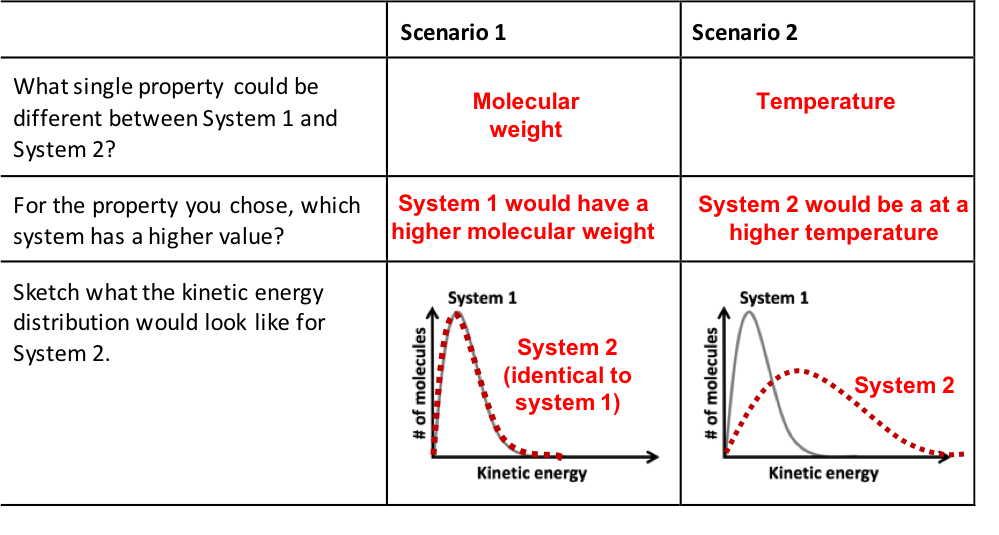
The lighter gas (smaller mass) will have a faster average speed so that it will have the same average kinetic energy.

Therefore, a heavier gas will move at a (faster/slower)
slower
average speeds than a lighter gas at the same temperature.Note: The lighter the gas molecule, the more (broad/narrow)
broad
the speed distributionScenario #3:
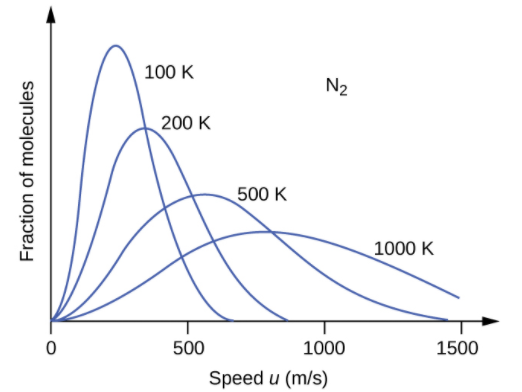
If we just consider one gas in a container, all of the gas particles in the container don't move at the exact same speed.
There is actually a distribution of speeds.
If temperature gets increased, then the average speed (increases/decreases)
increases
and the average kinetic energy (increases/decreases) increases
and the spread in the graph below (increases/decreases) increases
.
0:00 / 0:00
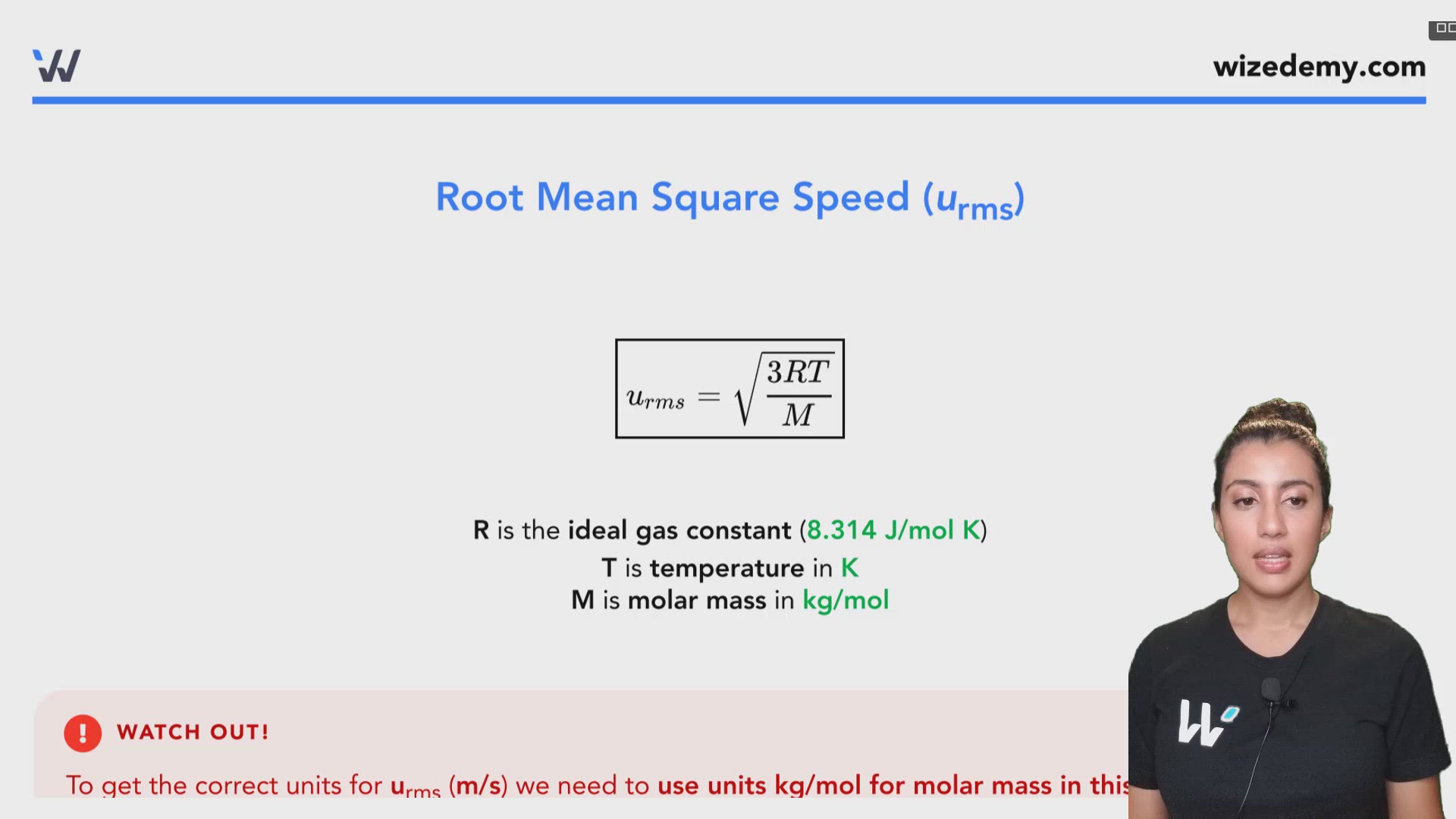
Root Mean Square Speed (urms)
R is the ideal gas constant (8.314 J/mol K)
T is temperature in K
M is molar mass in kg/mol
Watch Out!
To get the correct units for urms (m/s) we need to use units kg/mol for molar mass in this equation.
The good thing is that for all other equations, we use the units g/mol for molar mass.
0:00 / 0:00
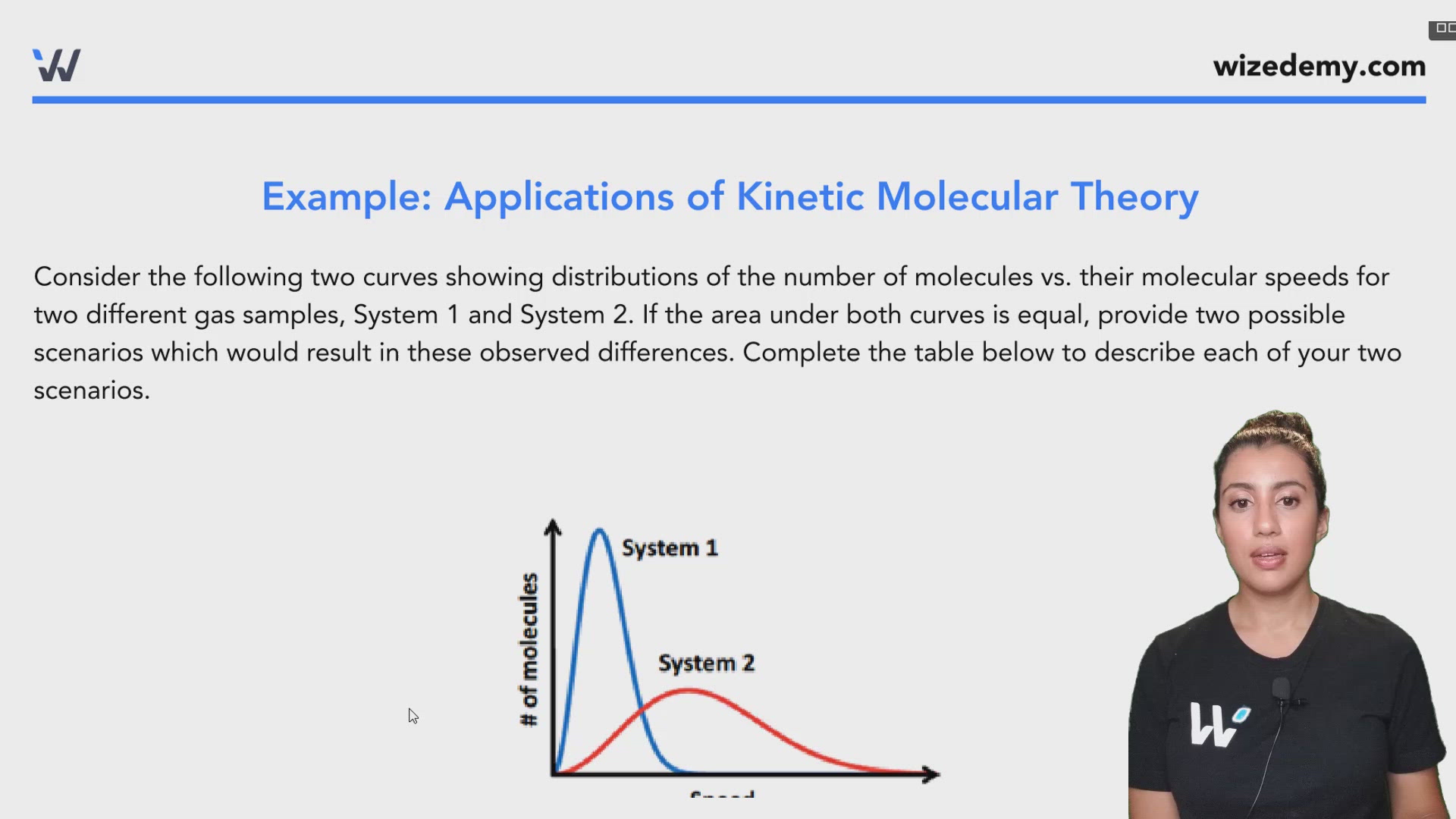
Example: Applications of Kinetic Molecular Theory
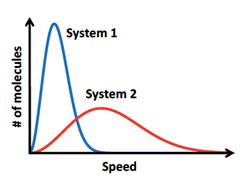
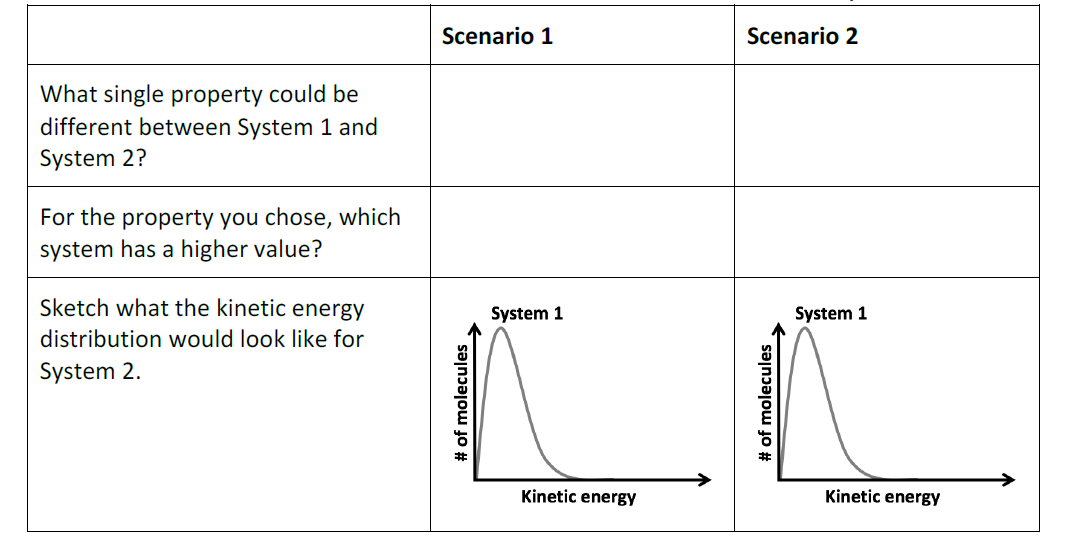
Consider the following two curves showing distributions of the number of molecules vs. their molecular speeds for two different gas samples, System 1 and System 2. If the area under both curves is equal, provide two possible scenarios which would result in these observed differences. Complete the table below to describe each of your two scenarios.

0:00 / 0:00
Example: Root Mean Squared Speed
Gas particles in an unknown sample are measured to have a root mean square speed of 324.2 m/s at 80 °C. If this sample is known to be a pure element, what is the most likely identity of this gas?
We can generally identify an unknown gas based on its molar mass.
The root mean square speed and temperature are all we need to find this information:
Notice that our molar mass is initially found with units of kg/mol due to the units included in the Joule [kg m2/s2)! Look over the unit analysis to prove it to yourself.
Given the molar mass is 83.80 g/mol, a quick review of the periodic table tells us that this sample is most likely Krypton.
Practice: Root Mean Squared Speed
Which of the following would have the lowest urms?
Practice: Kinetic Energy of Gases
Which of the following have the same average kinetic energy?
I. He at 297 K
II. He at 351 K
III. H2 at 297 K
IV. O2 at 212 K
V. SO2 at 297 K