Create a free account to get started

Unlock full course notes by signing up

  • Video lessons taught by top educators
  • Practice questions with guided solutions
  • Written review notes for reference
  • Expert answers anytime from course tutors

Factors Influencing Acid/Base Strength
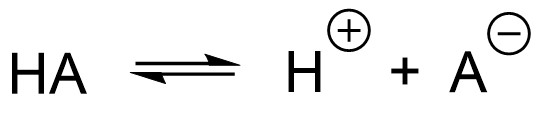


Image illustrating Factors Influencing Acid/Base Strength


A strong acid (HA) will make a stable/weak conjugate base (A-). A weak acid (HA) will make an unstable/strong conjugate base (A-).


Factors Influencing Acid/Base Strength

  1. Electronegativity
  2. Atom Size
  3. Resonance
  4. Hybridization
  5. Induction
  6. Aromaticity


Create a free account to get started

Unlock full course notes by signing up

  • Video lessons taught by top educators
  • Practice questions with guided solutions
  • Written review notes for reference
  • Expert answers anytime from course tutors

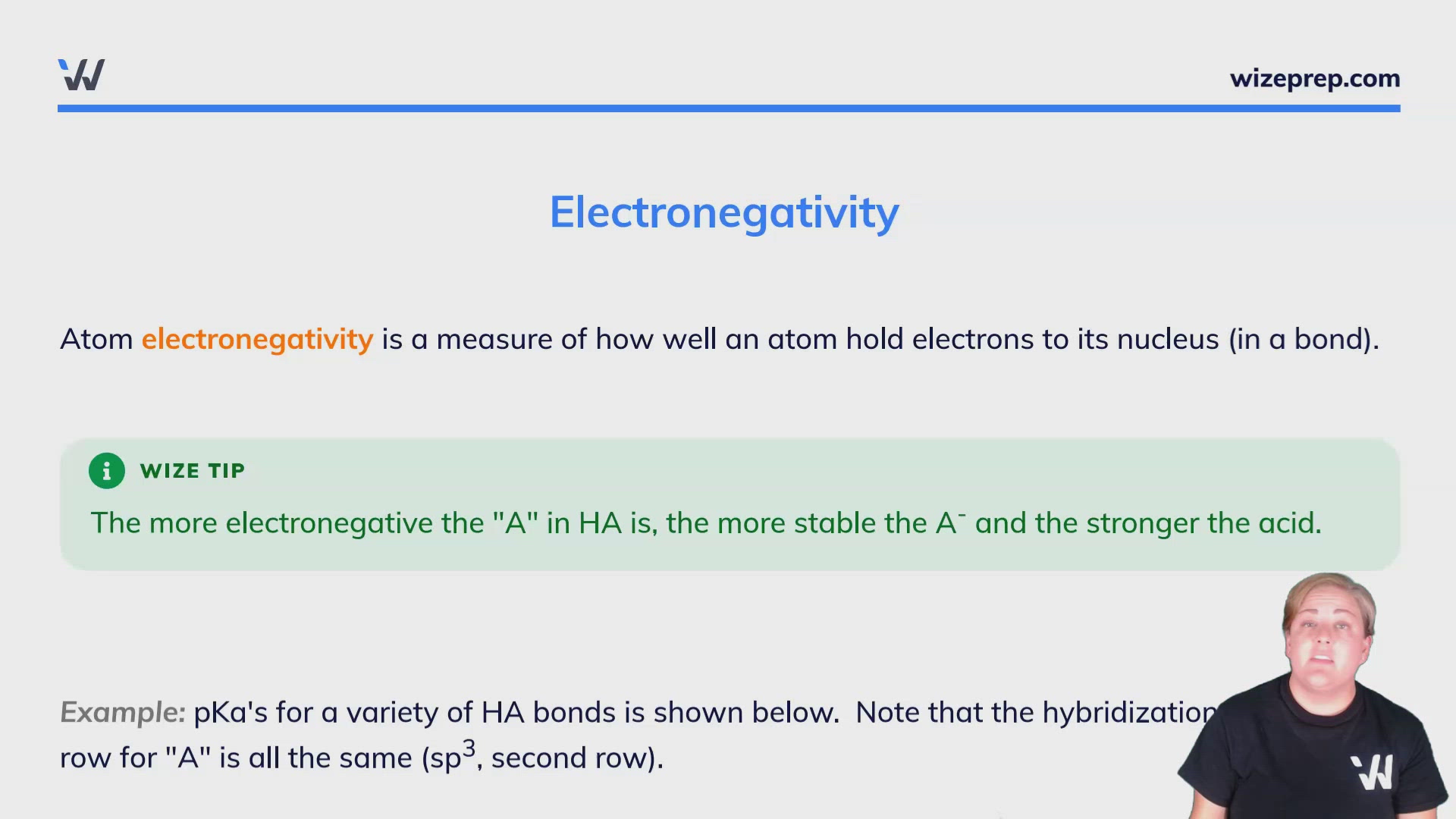
Electronegativity


Atom electronegativity is a measure of how well an atom hold electrons to its nucleus (in a bond).


Example: pKa's for a variety of HA bonds is shown below. Note that the hybridization and atomic row for "A" is all the same (sp3, second row).
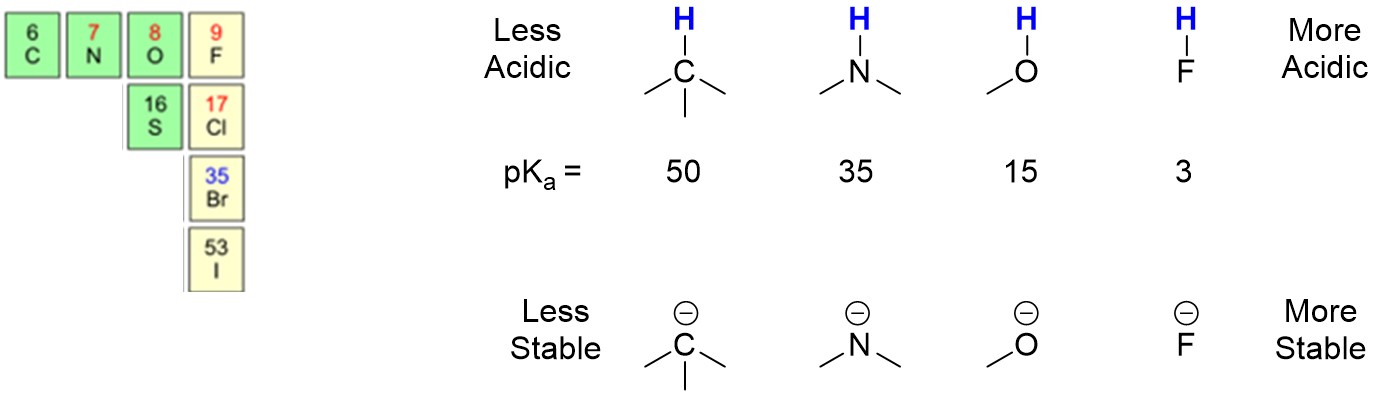
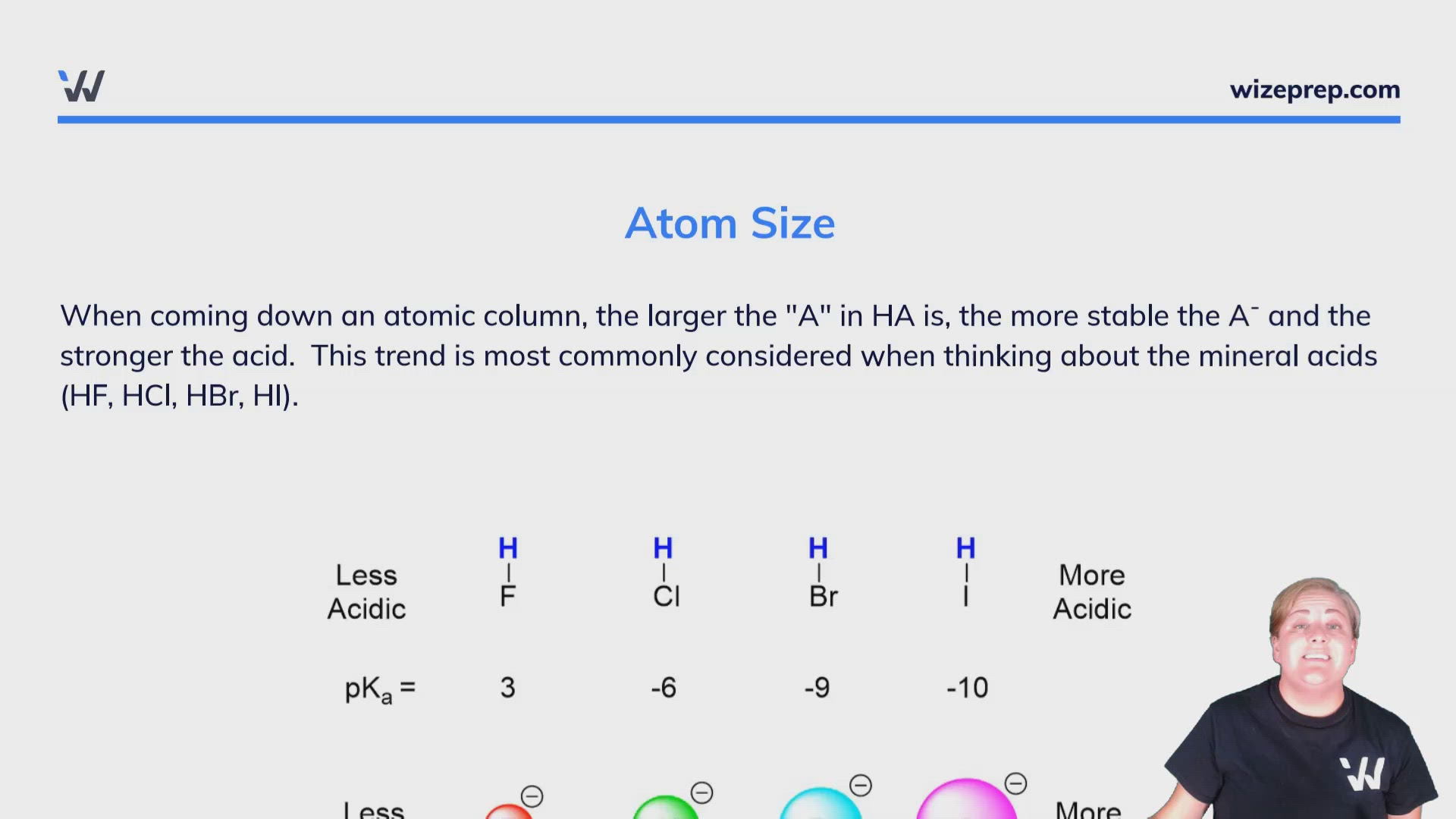
Image illustrating Electronegativity


Create a free account to get started

Unlock full course notes by signing up

  • Video lessons taught by top educators
  • Practice questions with guided solutions
  • Written review notes for reference
  • Expert answers anytime from course tutors

Atom Size

When coming down an atomic column, the larger the "A" in HA is, the more stable the A- and the stronger the acid. This trend is most commonly considered when thinking about the mineral acids (HF, HCl, HBr, HI).
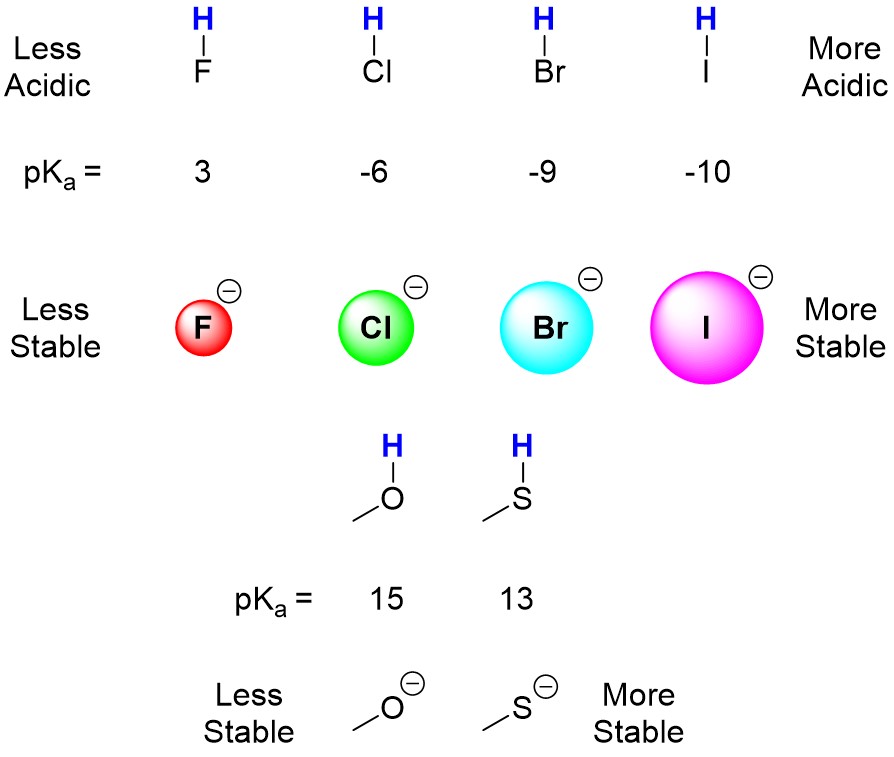
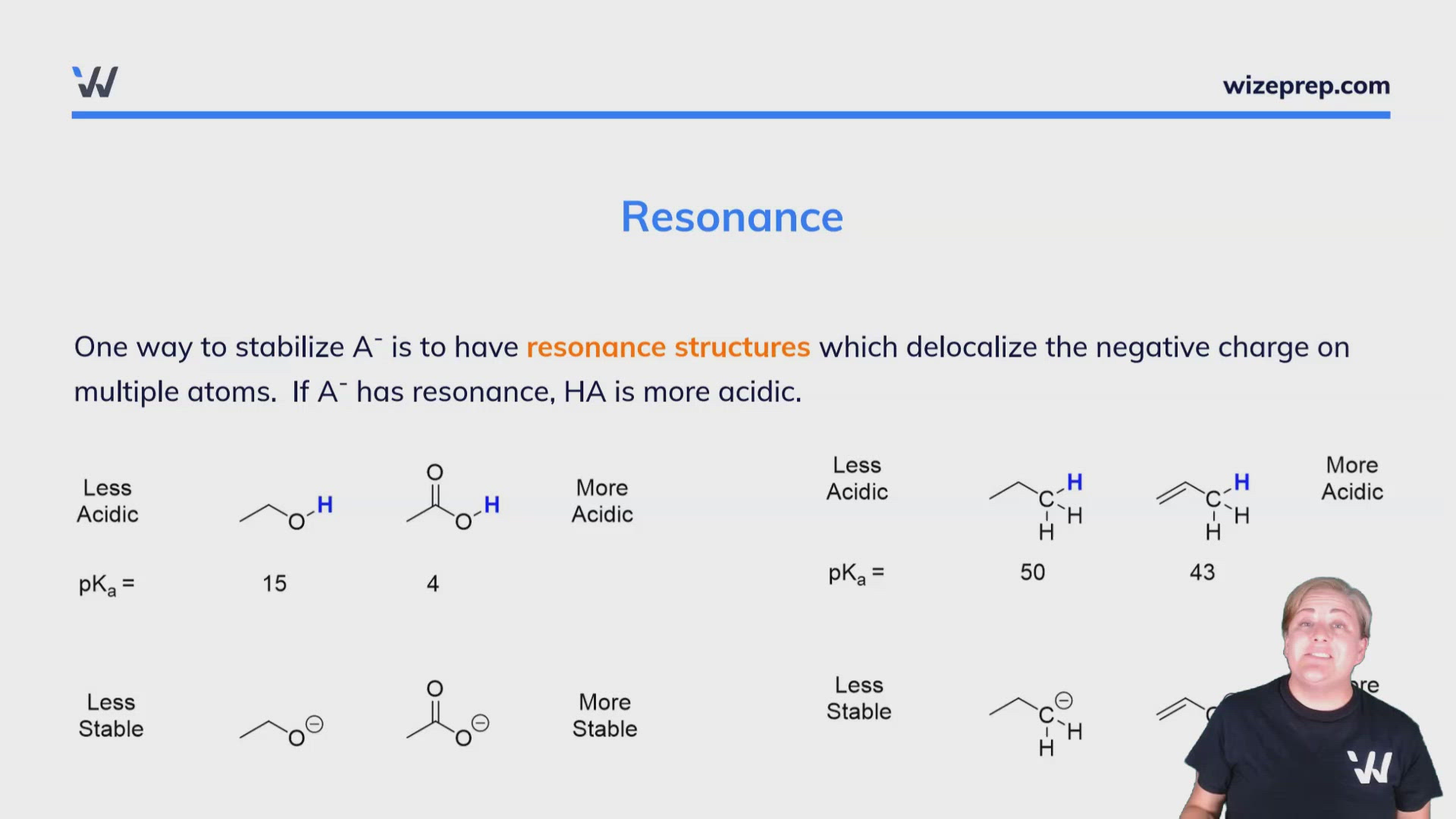
Image illustrating Atom Size


Create a free account to get started

Unlock full course notes by signing up

  • Video lessons taught by top educators
  • Practice questions with guided solutions
  • Written review notes for reference
  • Expert answers anytime from course tutors

Resonance


One way to stabilize A- is to have resonance structures which delocalize the negative charge on multiple atoms. If A- has resonance, HA is more acidic.

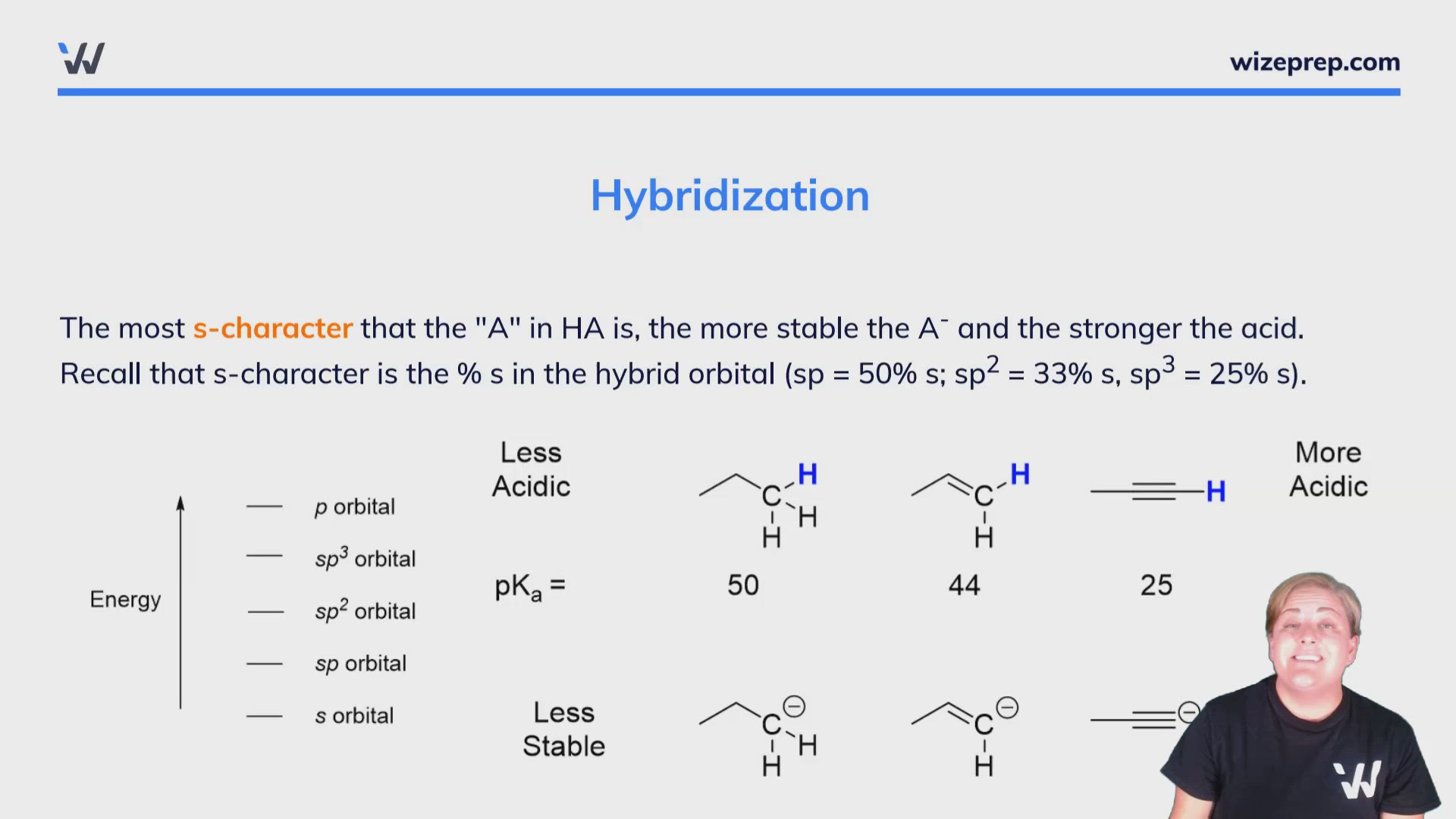
Image illustrating Resonance


Create a free account to get started

Unlock full course notes by signing up

  • Video lessons taught by top educators
  • Practice questions with guided solutions
  • Written review notes for reference
  • Expert answers anytime from course tutors

Hybridization


The most s-character that the "A" in HA is, the more stable the A- and the stronger the acid. Recall that s-character is the % s in the hybrid orbital (sp = 50% s; sp2 = 33% s, sp3 = 25% s).


Image illustrating Hybridization


For bases, if the lone pair is in an orbital with more s-character (e.g. an sp orbital) it will be lower in energy, more stable, and less likely to get protonated. For this reason amines are generally more basic than imines and nitriles.

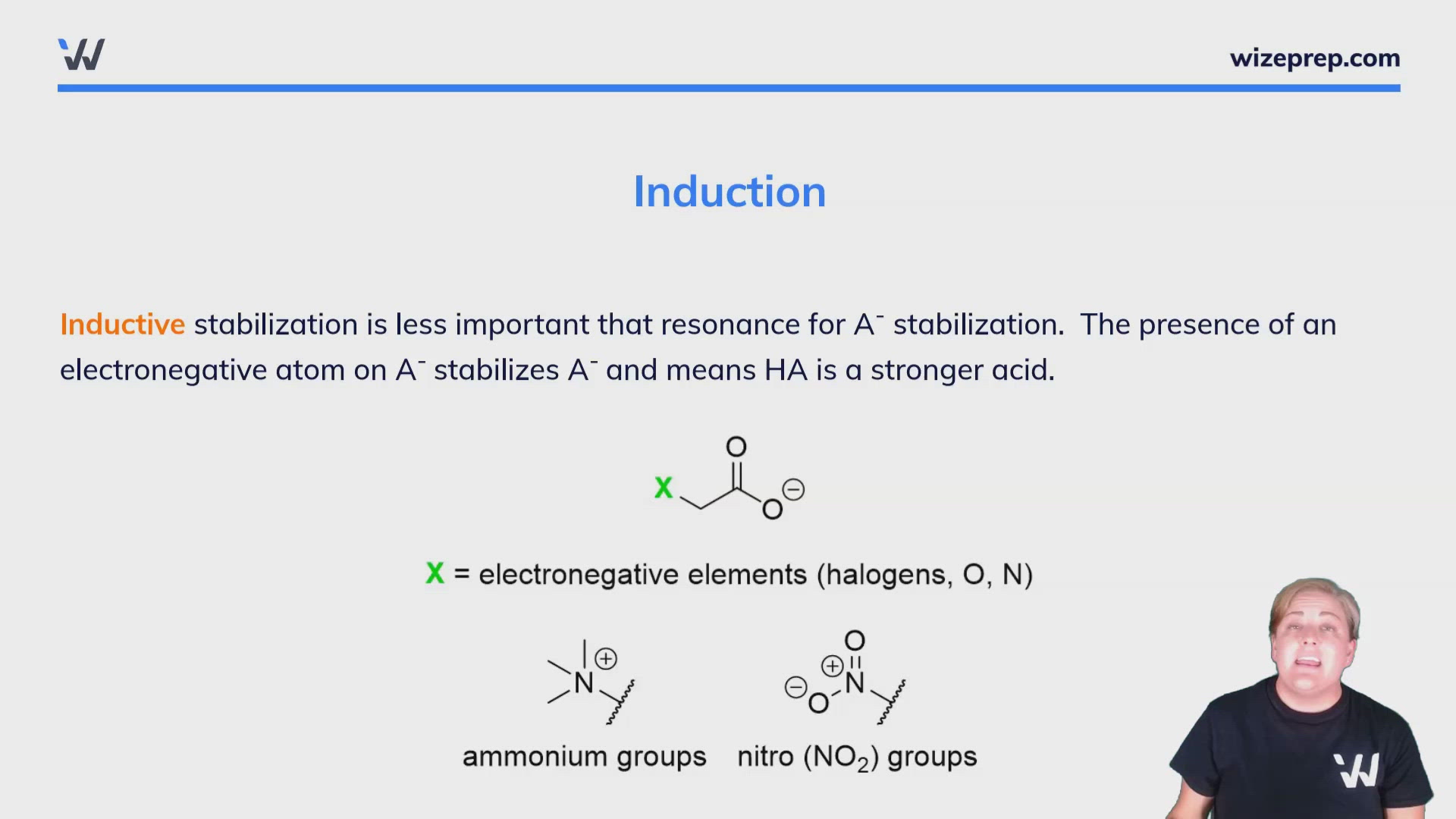
Image illustrating Hybridization


Create a free account to get started

Unlock full course notes by signing up

  • Video lessons taught by top educators
  • Practice questions with guided solutions
  • Written review notes for reference
  • Expert answers anytime from course tutors

Induction


Inductive stabilization is less important that resonance for A- stabilization. The presence of an electronegative atom on A- stabilizes A- and means HA is a stronger acid.
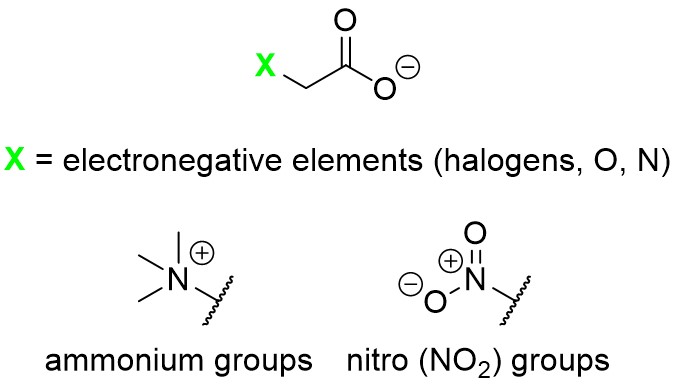
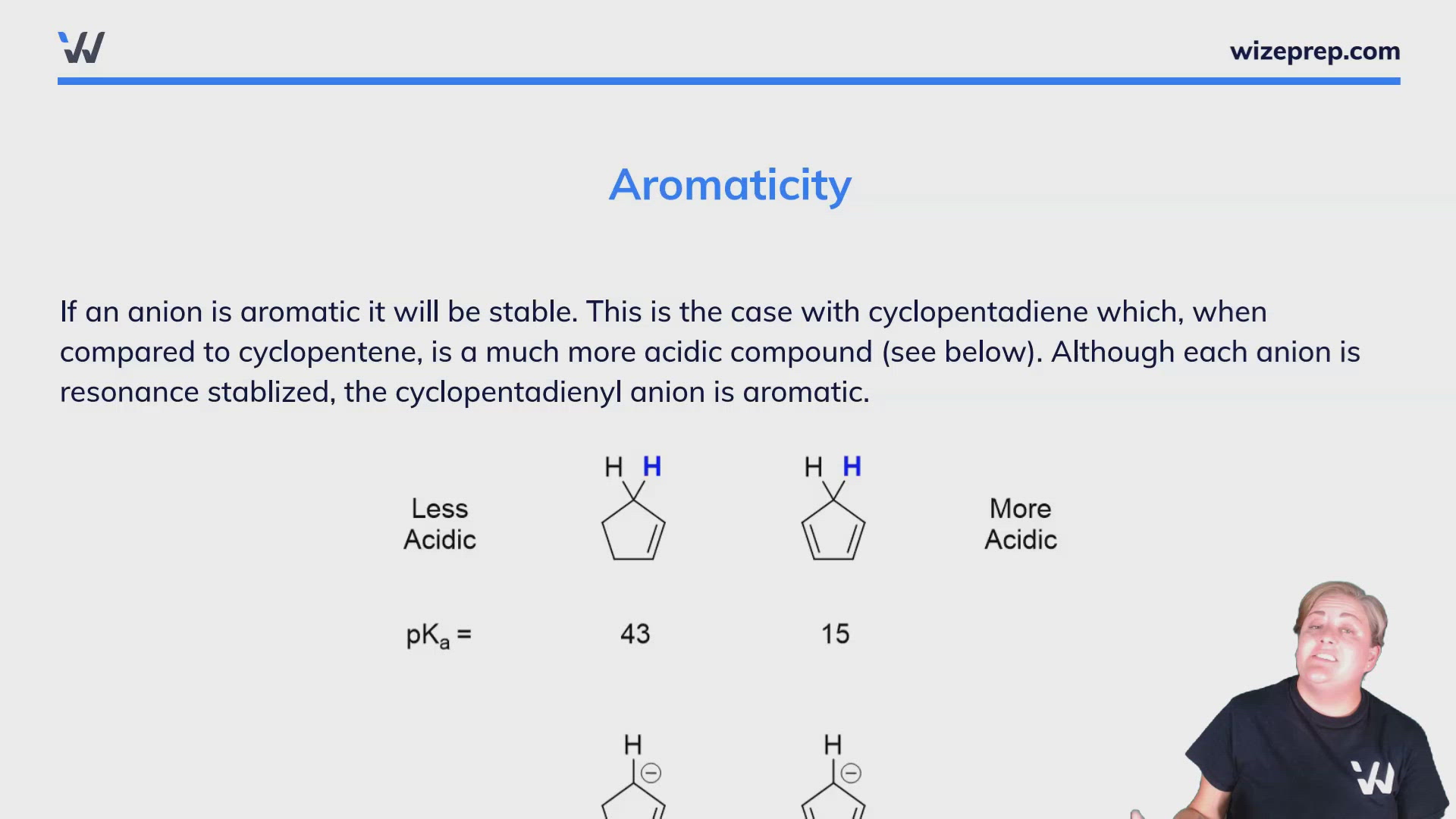
Image illustrating Induction


Create a free account to get started

Unlock full course notes by signing up

  • Video lessons taught by top educators
  • Practice questions with guided solutions
  • Written review notes for reference
  • Expert answers anytime from course tutors

Aromaticity


If an anion is aromatic it will be stable. This is the case with cyclopentadiene which, when compared to cyclopentene, is a much more acidic compound (see below). Although each anion is resonance stablized, the cyclopentadienyl anion is aromatic.


Image illustrating Aromaticity

Aromaticity also plays a role in base strength. If a lone pair of electrons is necessary for a compound to be aromatic it will be less likely to get protonated. For example, which way does the equilibrium lie in the following example:

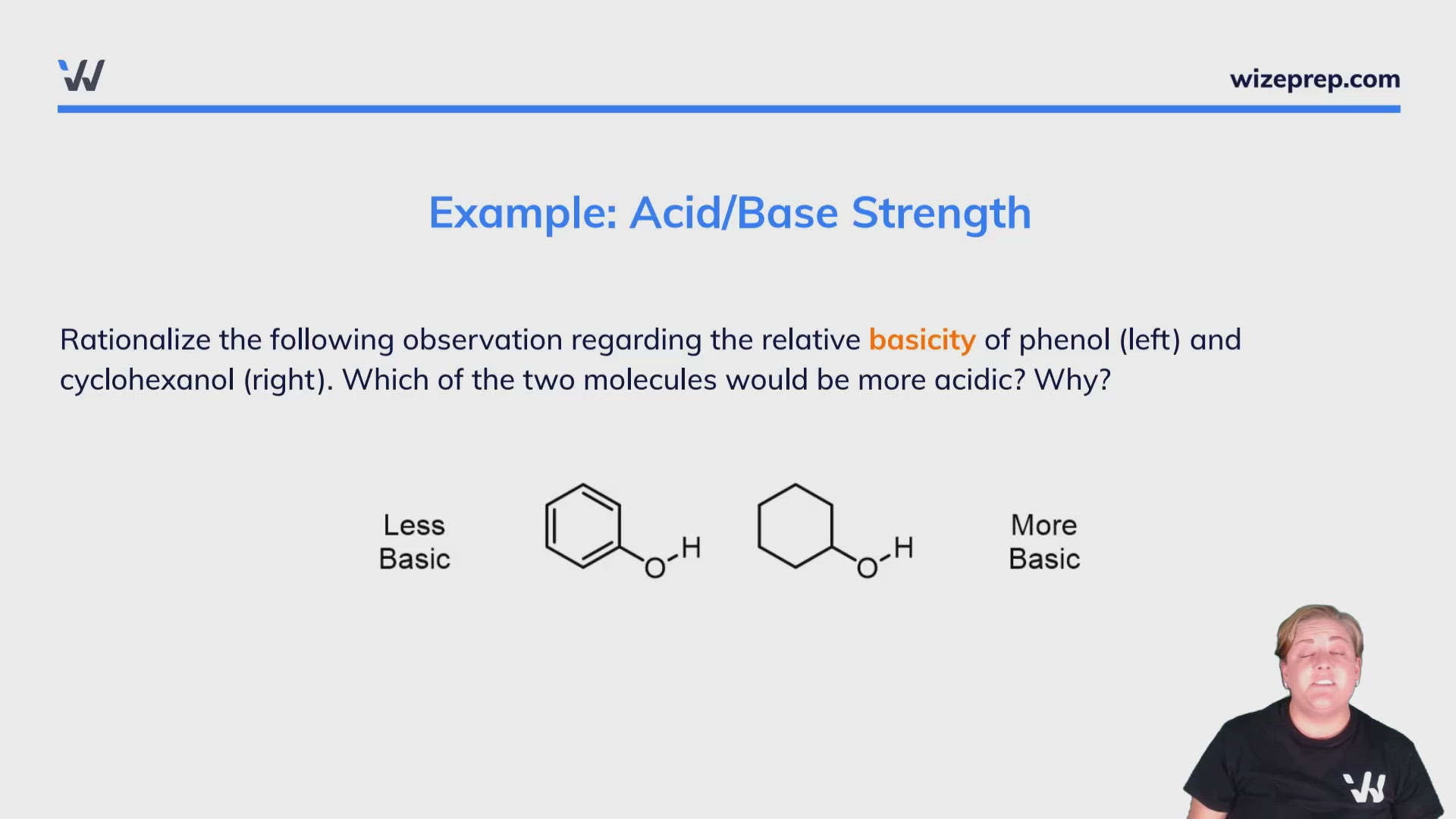
Image illustrating Aromaticity


Create a free account to get started

Unlock full course notes by signing up

  • Video lessons taught by top educators
  • Practice questions with guided solutions
  • Written review notes for reference
  • Expert answers anytime from course tutors

Example: Acid/Base Strength


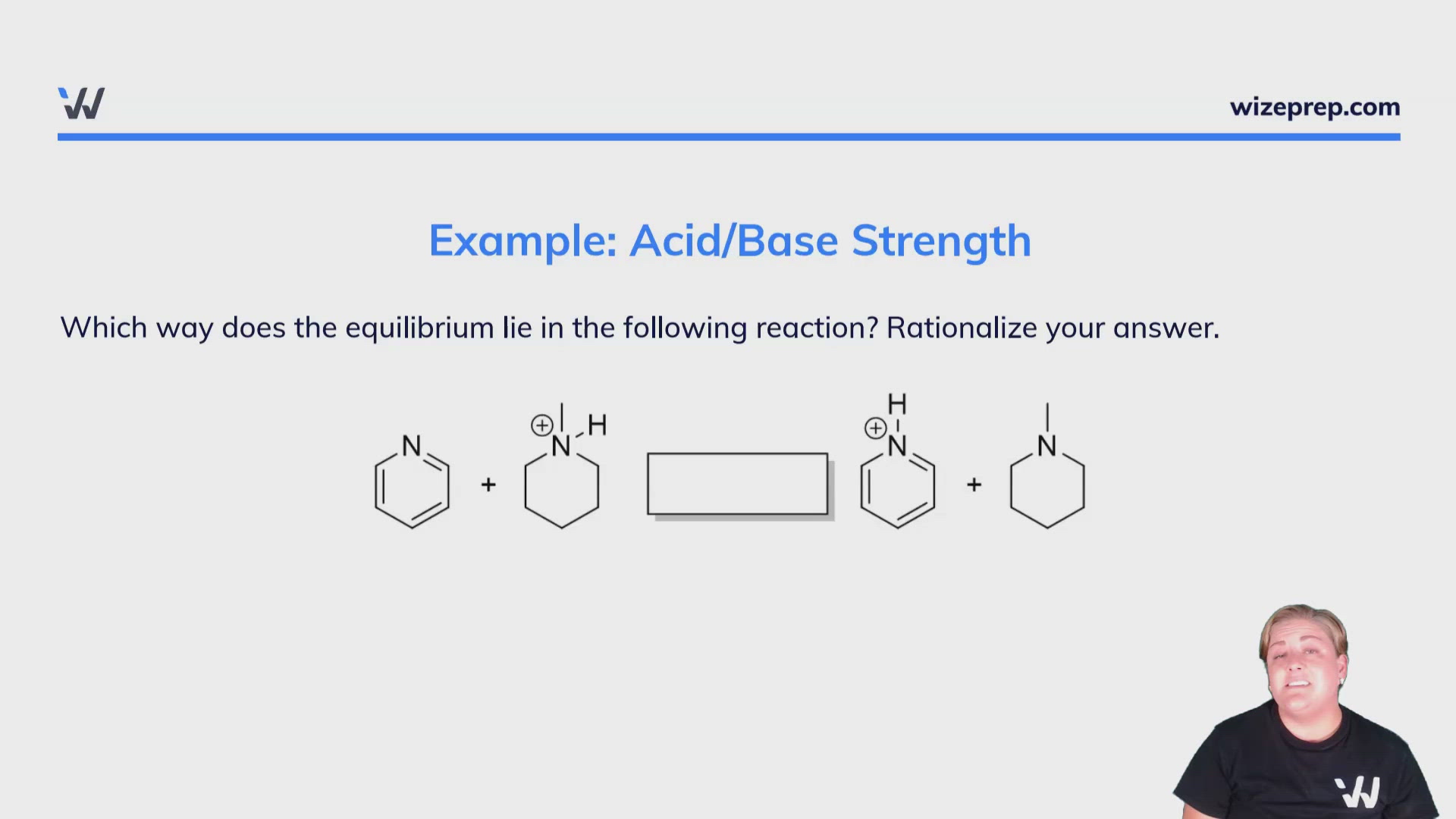
Rationalize the following observation regarding the relative basicity of phenol (left) and cyclohexanol (right). Which of the two molecules would be more acidic? Why?



Image illustrating Example: Acid/Base Strength


Phenol is less basic as the oxygen atom's lone pair is tied up in resonance structure with the aromatic ring that cyclohexanol's lone pair is not (see video solution).


Phenol is more acidic because the conjugate base has a stabilizing resonance structure (see video solution).
Create a free account to get started

Unlock full course notes by signing up

  • Video lessons taught by top educators
  • Practice questions with guided solutions
  • Written review notes for reference
  • Expert answers anytime from course tutors

Example: Acid/Base Strength

Which way does the equilibrium lie in the following reaction? Rationalize your answer.
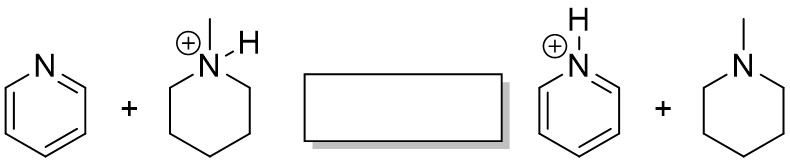

Image illustrating Example: Acid/Base Strength


The equilibrium lies to the left because the sp2 hybridized nitrogen is more acidic than the sp3 hybridized nitrogen atom (see video solution).

Practice: Acid/Base Equilibrium


Which way does the equilibrium lie in the following reactions (right/left)?


Illustration for practice question: Acids and Bases: Equilibrium


Your answers

Create a free account to get started

Unlock full course notes by signing up

  • Video lessons taught by top educators
  • Practice questions with guided solutions
  • Written review notes for reference
  • Expert answers anytime from course tutors

Practice: Acid/Base Equilibrium


Which way does the equilibrium lie in the following reactions?


Illustration for practice question: Acids and Bases: Equilibria


Your answers

Create a free account to get started

Unlock full course notes by signing up

  • Video lessons taught by top educators
  • Practice questions with guided solutions
  • Written review notes for reference
  • Expert answers anytime from course tutors