Wize University Organic Chemistry Textbook > Acid/Base Chemistry & Intro to Organic Reactions
Acid/Base Equilibrium Fundamentals
Popular Courses
MCAT
General Course
CHEM 2213A/B
Western University
Organic Chemistry
University Study Guides
DAT
General Course
Organic Chemistry
General Course
CHEM 261
University of Alberta
CHEM 233
University of British Columbia
Organic Chemistry
University Study Guides
CHEM 351
University of Calgary
CHEM 123
University of British Columbia
CHEM 281
Queen's University
CHM 1321
University of Ottawa
CHM136H1
University of Toronto
CHEM 212
McGill University
CHEM 231
University of Victoria
CHEM 2OA3
McMaster University
CHEM 2223B
Western University
CHM 2120
University of Ottawa
CHEM 263
University of Alberta
CHEM 282
Queen's University

0:00 / 0:00
Acid/Base Equilibrium Fundamentals
It is important to understand acids and bases because this will dictate a lot of organic chemistry you will cover in this course! Understanding acids and bases allows you to understand nucleophiles and electrophiles which prepares you for all of second year organic chemistry (and beyond!).
Why do we use Acids in Organic Chemistry?
Bronsted-Lowry acids, which are sources of protons (H+ ions), are key catalysts in a number of organic transformations. Less reactive functional groups (like a ketone, see below) are converted to more reactive/electrophilic functionalities by the addition of a strong acid (hydronium in the example below).

Why do we use Bases in Organic Chemistry?
Bronsted-Lowry bases, which are proton acceptors, are used to deprotonate compounds. The resulting anion is more nucleophilic and can form new bonds. This is a key step in many carbon-carbon bond forming reactions. For example, the α-proton of a ketone or proton of a terminal alkyne can be deprotonated with an appropriate base and reacted with 1-bromopropane to form a new C-C bond.

0:00 / 0:00
Key Definitions of Acids/Bases
Bronsted-Lowry Acids/Bases
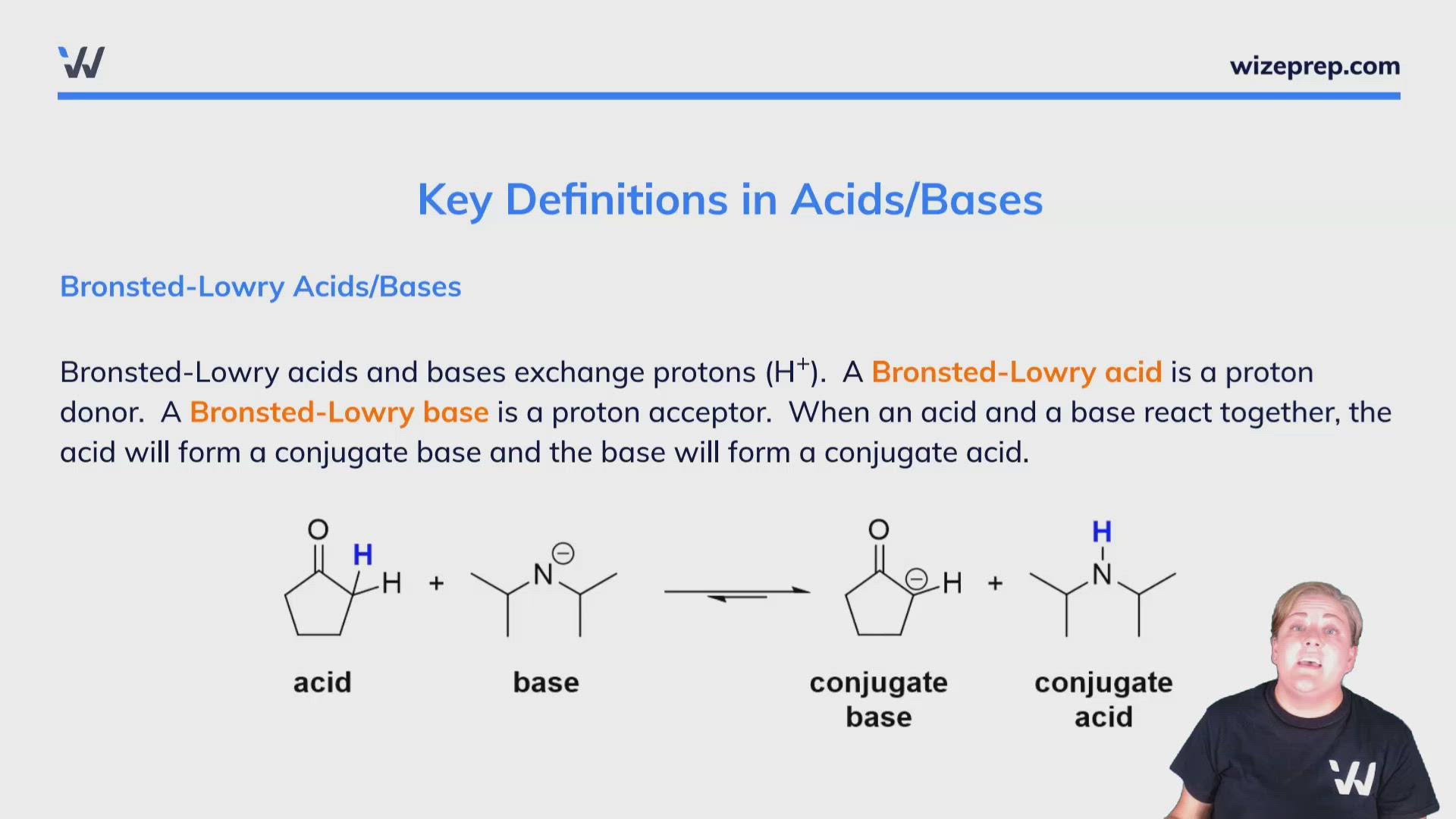
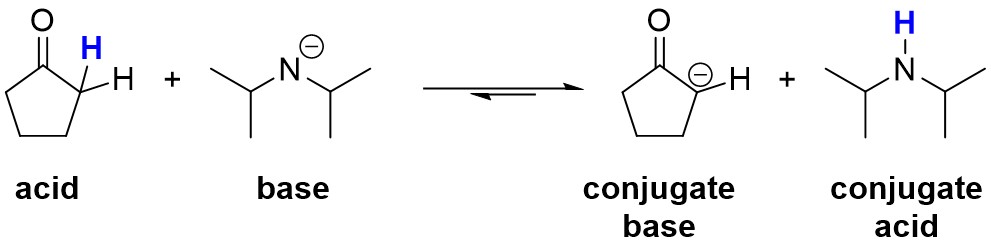
Bronsted-Lowry acids and bases exchange protons (H+). A Bronsted-Lowry acid is a proton donor. A Bronsted-Lowry base is a proton acceptor. When an acid and a base react together, the acid will form a conjugate base and the base will form a conjugate acid.
Arrhenius Acids/Bases
Arrhenius acids and bases do chemistry in aqueous (water) solution. An Arrhenius acid is a proton donor. An Arrhenius base is a hydroxide donor. These definitions are out of date are not really used anymore.


Lewis Acids and Bases
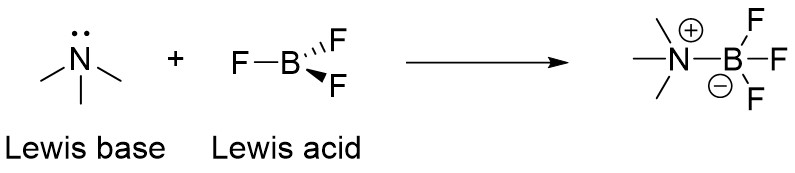
Lewis acids and bases are electron donors and acceptors; it is for this reason that this definition is less common in organic chemistry. A Lewis acid in an electron pair acceptor. A Lewis base is an electron pair donor.
0:00 / 0:00
Acid/Base Equilibrium Constants
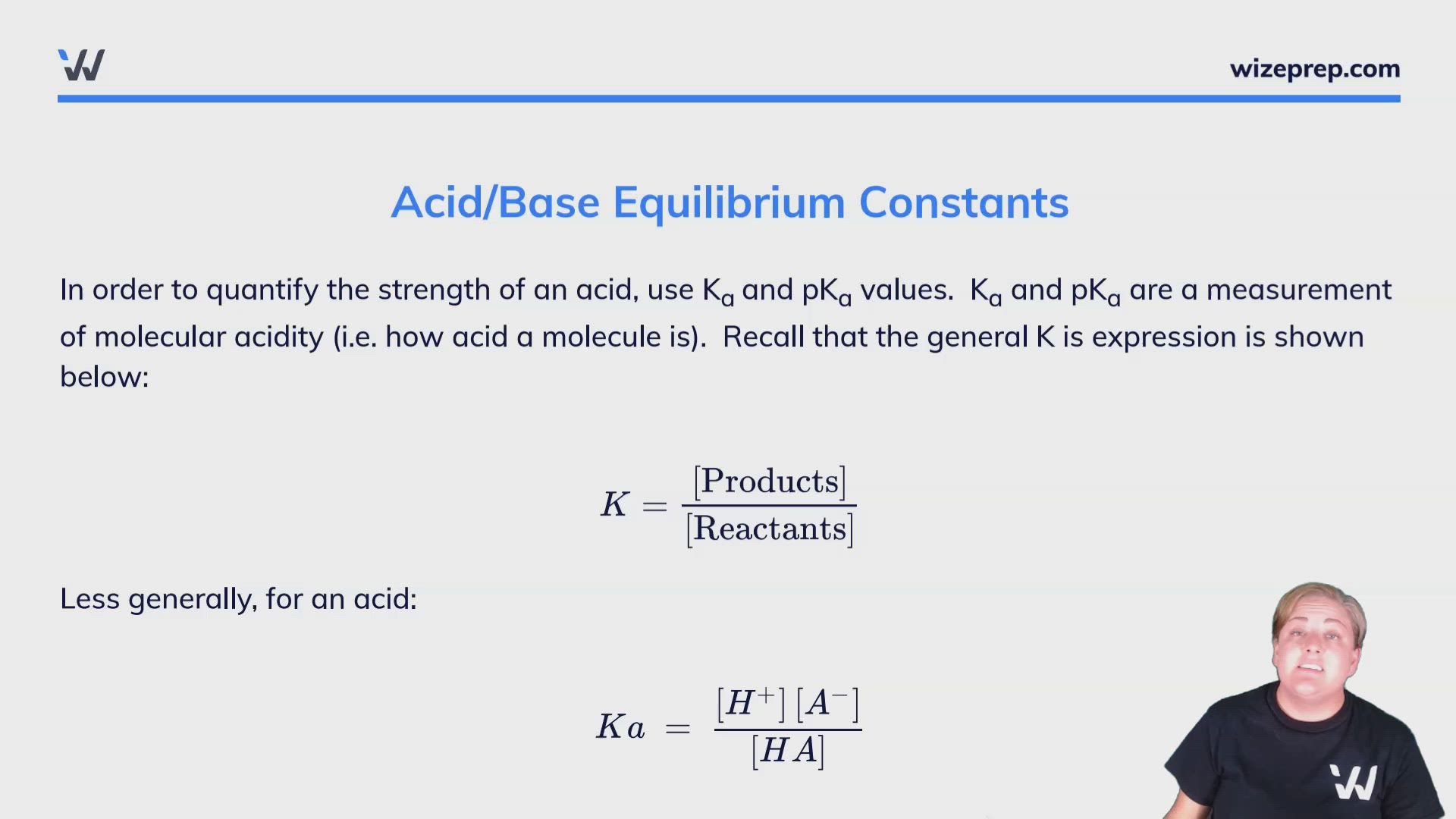
In order to quantify the strength of an acid, use Ka and pKa values. Ka and pKa are a measurement of molecular acidity (i.e. how acid a molecule is). Recall that the general K is expression is shown below:
Less generally, for an acid:
Wize Concept
Remember that as Ka goes up pKa goes down and acidity goes up!
0:00 / 0:00
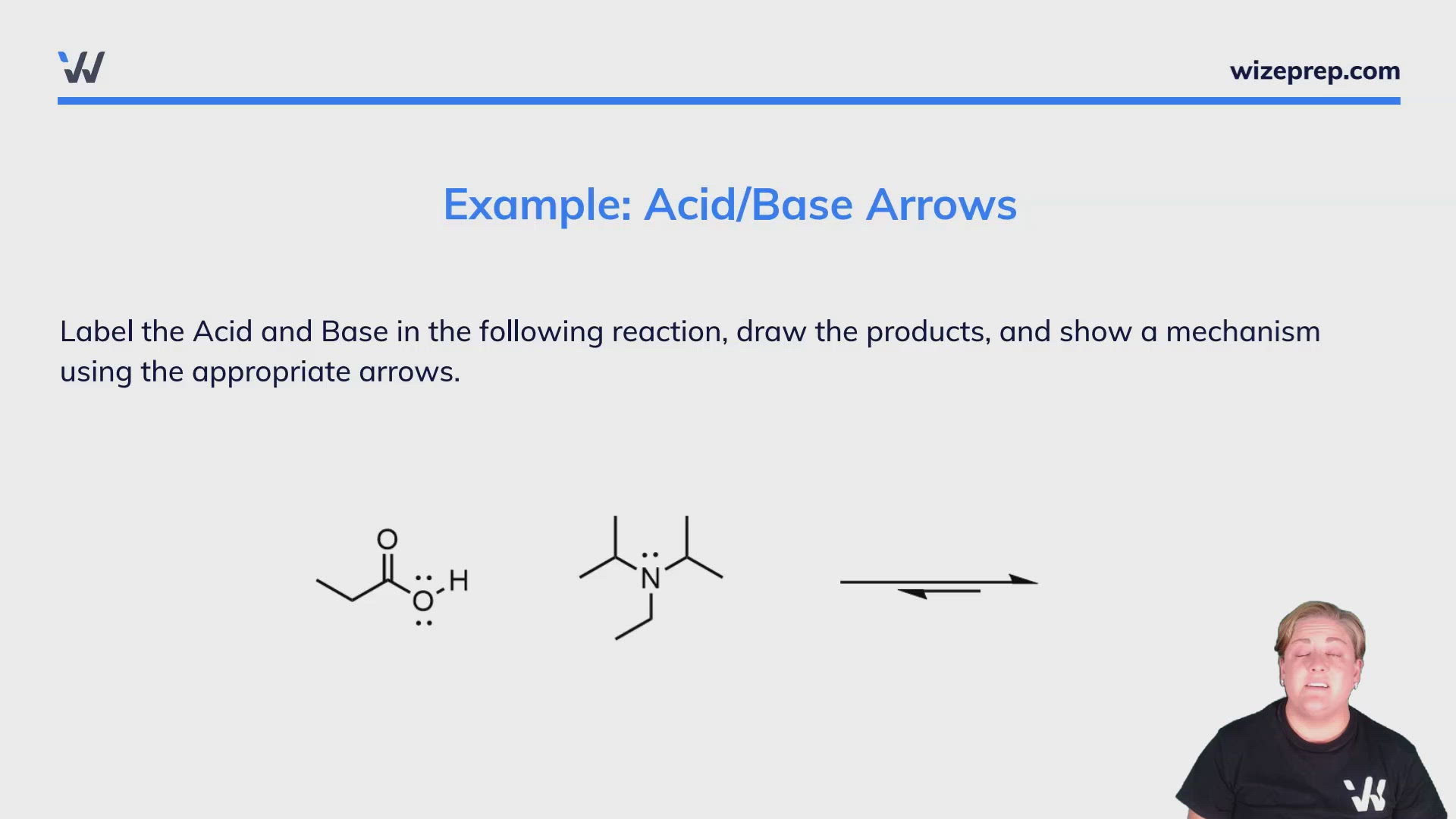
Example: Acid/Base Arrows
Label the Acid and Base in the following reaction, draw the products, and show a mechanism using the appropriate arrows.
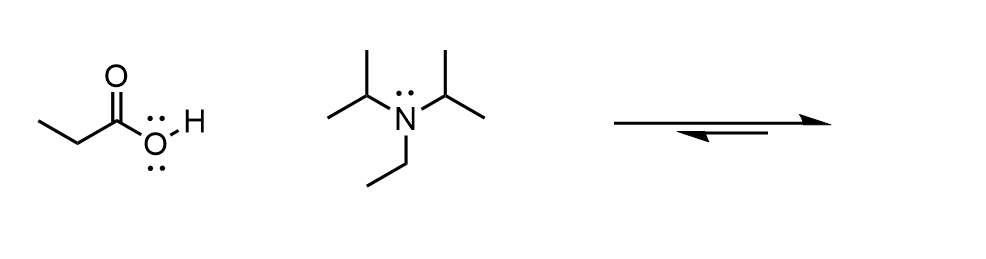
Recall, Bronsted-Lowry acid/base chemistry involves the exchange of a hydrogen atom. The equilibrium will lie to the side with the most stable conjugate acid/base pair.