Popular Courses
MCAT
General Course
DAT
General Course
CHEM 2213A/B
Western University
Organic Chemistry
University Study Guides
Organic Chemistry
General Course
CHEM 233
University of British Columbia
CHEM 261
University of Alberta
Organic Chemistry
University Study Guides
CHEM 351
University of Calgary
CHEM 123
University of British Columbia
CHEM 281
Queen's University
CHM 1321
University of Ottawa
CHM136H1
University of Toronto
CHEM 212
McGill University
CHEM 231
University of Victoria
CHEM 2OA3
McMaster University
CHEM 2223B
Western University
CHM 2120
University of Ottawa
CHEM 263
University of Alberta
CHEM 282
Queen's University

0:00 / 0:00
IUPAC Systematic Naming
General Naming Rules
- Identify and name the longest carbon chain
- If present, assign stereochemistry (R/S or E/Z)
- Identify and name any substituents on the carbon chain
- Give these substituents the appropriate 'address' - i.e. which carbon atom they are bonded to
- Add substituent names as a prefix to the carbon chain
- Change suffix of the carbon chain if necessary (for functional groups)
Important Things to Consider
- The length of the longest carbon chain (you may have to look for this!)
- The types of C-C bonds in that chain
- The functional groups incorporated in the chain
- The priority of each of those functional groups
The Carbon Chain
The root of the name will always identified as number corresponding to the longest continuous chain of carbon atoms.
This carbon chain must include any C-C multiple bonds present in the molecule, as this will complete the name of the carbon chain.

The Substituents
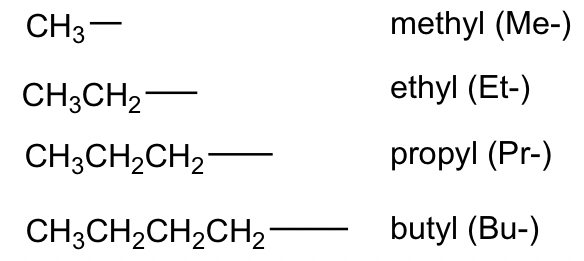
Additional Considerations
Lower priority functional groups (alkyl groups, alkoxy groups and halides) that are attached to the carbon chain are listed before the name of the carbon chain.
Substituents that have similar priority as the ones listed above must be listed with the lowest possible numbering system, or 'address'. For example:
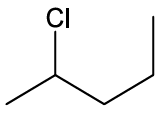
Going from left to right, the Cl has an address of 2. Going from right to left, the Cl has an address of 4. Since 2 < 4, we have a 2-chloro substituent - the name is 2-chloropentane.
Wize Concept
Note that each number and letter is separated by a hyphen (-).
If there is more than one substituent, then the two numbers combined must give the lowest possible numbers. For example:
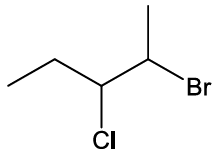
Going from left to right, the Cl is on 3 and the Br is on 4. Going from right to left, the Cl is on 3 and the Br is on 2. Since 2,3 <3,4, we have 2-bromo-3-chloro. The name is 2-bromo-3-chloropentane.
Wize Concept
Substituents are listed in alphabetical order.
If there is more than one substituent of the same type, then we don’t list them separately, instead we combine them with a prefix. Each number is separated by a comma (,). Also notice that the prefixes used are as follows:
Functional Groups
These are higher priority groups that occur along the carbon chain. These often result in a modification of the suffix of the carbon chain. These also effect the 'addressing' of the chain, as many of these groups are terminal and must start on Carbon-1.
Wize Tip
(Highest priority) Carboxylic Acids, Esters, Amides, Aldehydes, Ketones, Alcohols, Thiols, Alkenes, Alkynes, Alkyl Halides, Alkanes (Lowest priority)
Examples:


0:00 / 0:00
Example: Converting Names to Structures
Draw the following molecules as line drawings.
- 4-methylpent-3-en-2-one
- 6-bromo-6-chloro-5-ethylheptan-3-ol
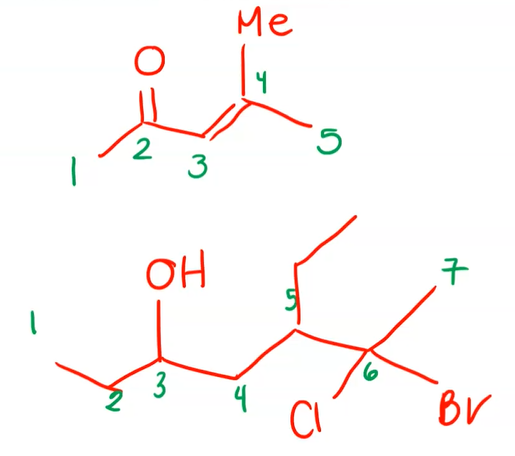

0:00 / 0:00
Example: IUPAC Systematic Naming
Name the following molecule using IUPAC systematic naming.
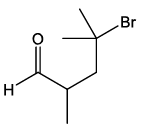
4-bromo-2,4-dimethylpentanal

0:00 / 0:00
Example: IUPAC Systematic Naming
Name the following molecules using IUPAC systematic naming.
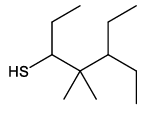
5-ethyl-4,4-dimethylheptane-3-thiol
Practice: IUPAC Nomenclature
Name the following molecule using IUPAC systematic naming.
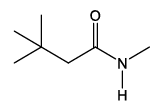
Practice: IUPAC Nomenclature
Name the following molecule using IUPAC systematic naming:
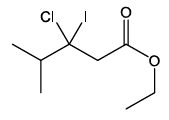
Summary Sheet: IUPAC Naming
General Naming Rules
- Identify and name the longest carbon chain
- If present, assign stereochemistry (R/S or E/Z)
- Identify and name any substituents on the carbon chain
- Give these substituents the appropriate 'address'
- Add substituent names as a prefix to the carbon chain
- Change suffix of the carbon chain if necessary (for functional groups)
