Wize University Organic Chemistry Textbook > Acid/Base Chemistry & Intro to Organic Reactions
Factors Influencing Acid/Base Strength
Popular Courses
MCAT
General Course
DAT
General Course
CHEM 2213A/B
Western University
Organic Chemistry
University Study Guides
Organic Chemistry
General Course
CHEM 233
University of British Columbia
CHEM 261
University of Alberta
Organic Chemistry
University Study Guides
CHEM 351
University of Calgary
CHEM 123
University of British Columbia
CHEM 281
Queen's University
CHM 1321
University of Ottawa
CHM136H1
University of Toronto
CHEM 212
McGill University
CHEM 231
University of Victoria
CHEM 2OA3
McMaster University
CHEM 2223B
Western University
CHM 2120
University of Ottawa
CHEM 263
University of Alberta
CHEM 282
Queen's University

0:00 / 0:00
Factors Influencing Acid/Base Strength
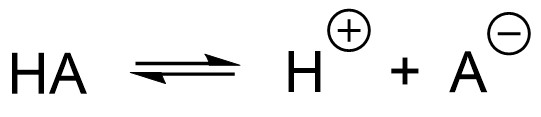
A strong acid (HA) will make a stable/weak conjugate base (A-). A weak acid (HA) will make an unstable/strong conjugate base (A-).
Factors Influencing Acid/Base Strength
- Electronegativity
- Atom Size
- Resonance
- Hybridization
- Induction
- Aromaticity
0:00 / 0:00
Electronegativity
Atom electronegativity is a measure of how well an atom hold electrons to its nucleus (in a bond).
Wize Tip
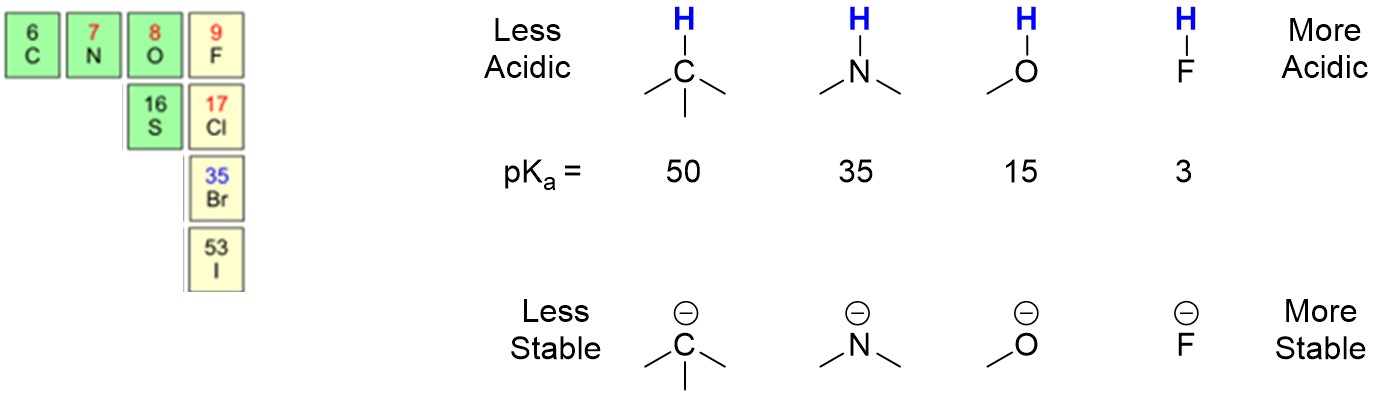
The more electronegative the "A" in HA is, the more stable the A- and the stronger the acid.
Example: pKa's for a variety of HA bonds is shown below. Note that the hybridization and atomic row for "A" is all the same (sp3, second row).
0:00 / 0:00
Atom Size
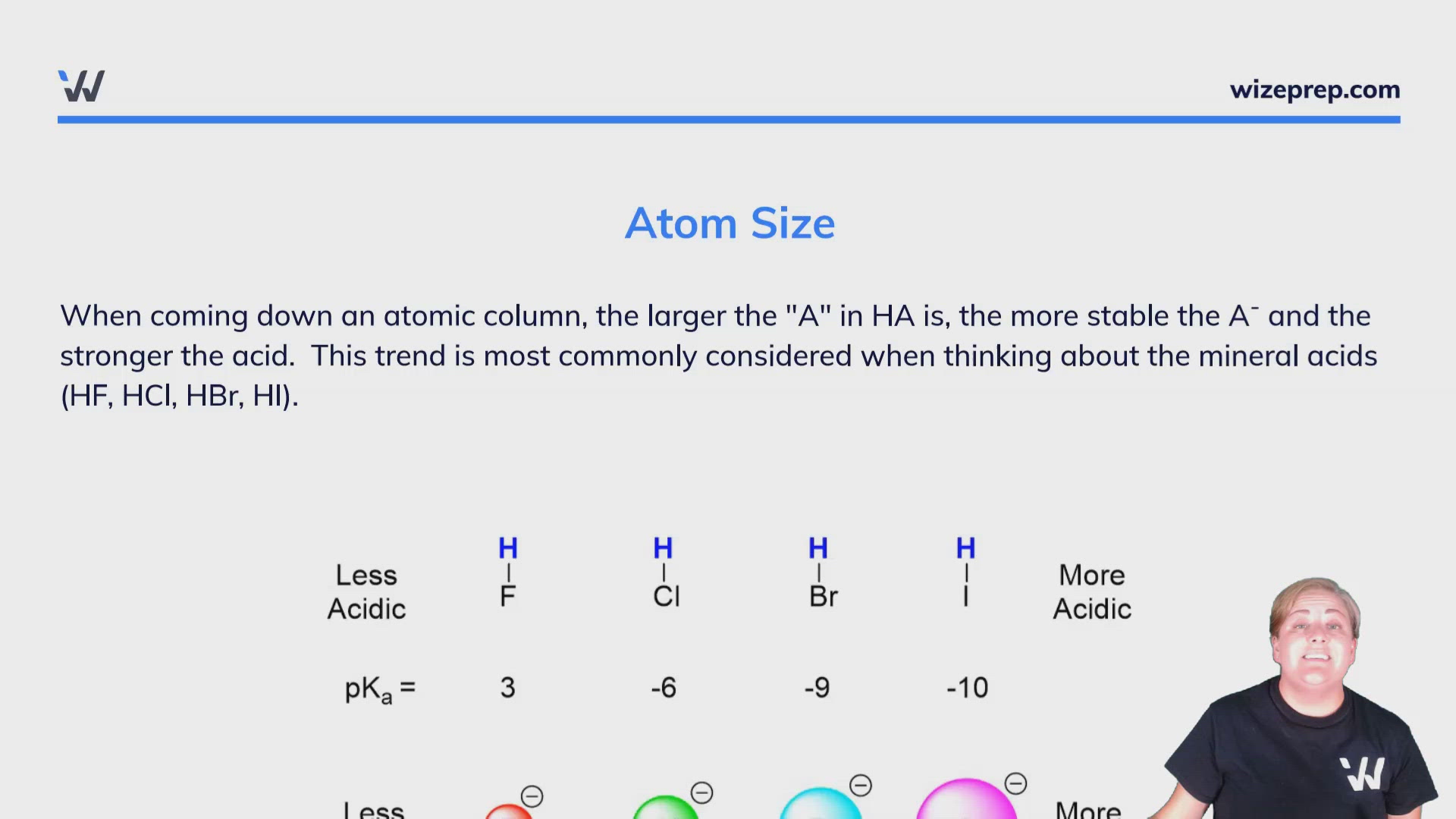
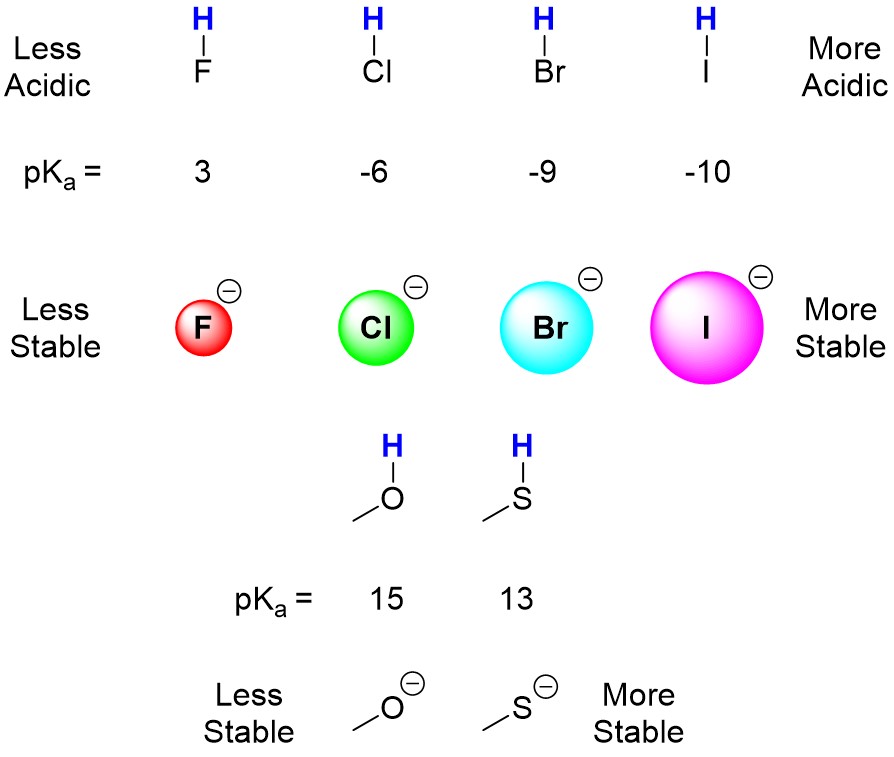
When coming down an atomic column, the larger the "A" in HA is, the more stable the A- and the stronger the acid. This trend is most commonly considered when thinking about the mineral acids (HF, HCl, HBr, HI).
0:00 / 0:00
Resonance
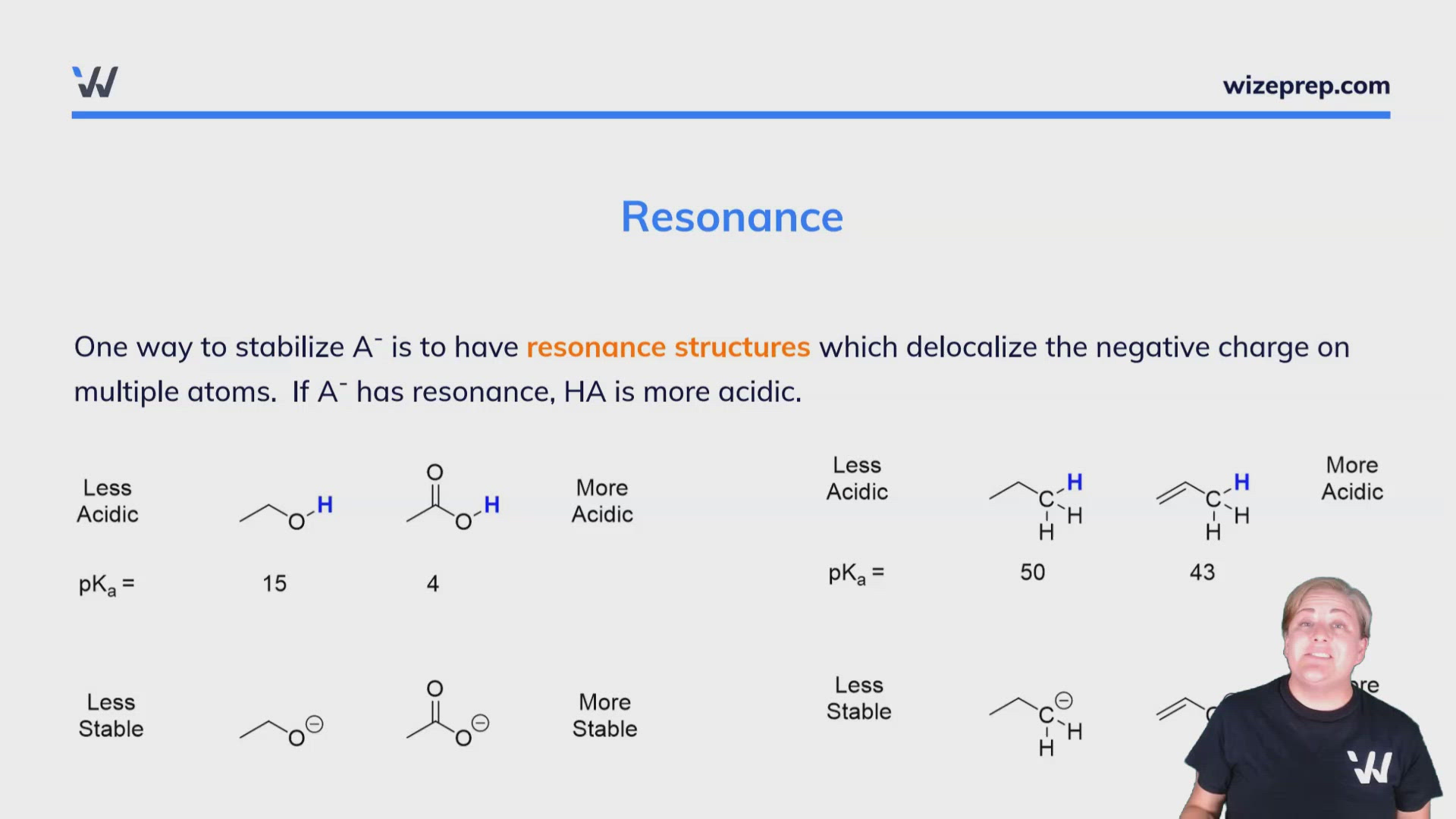
One way to stabilize A- is to have resonance structures which delocalize the negative charge on multiple atoms. If A- has resonance, HA is more acidic.

0:00 / 0:00
Hybridization
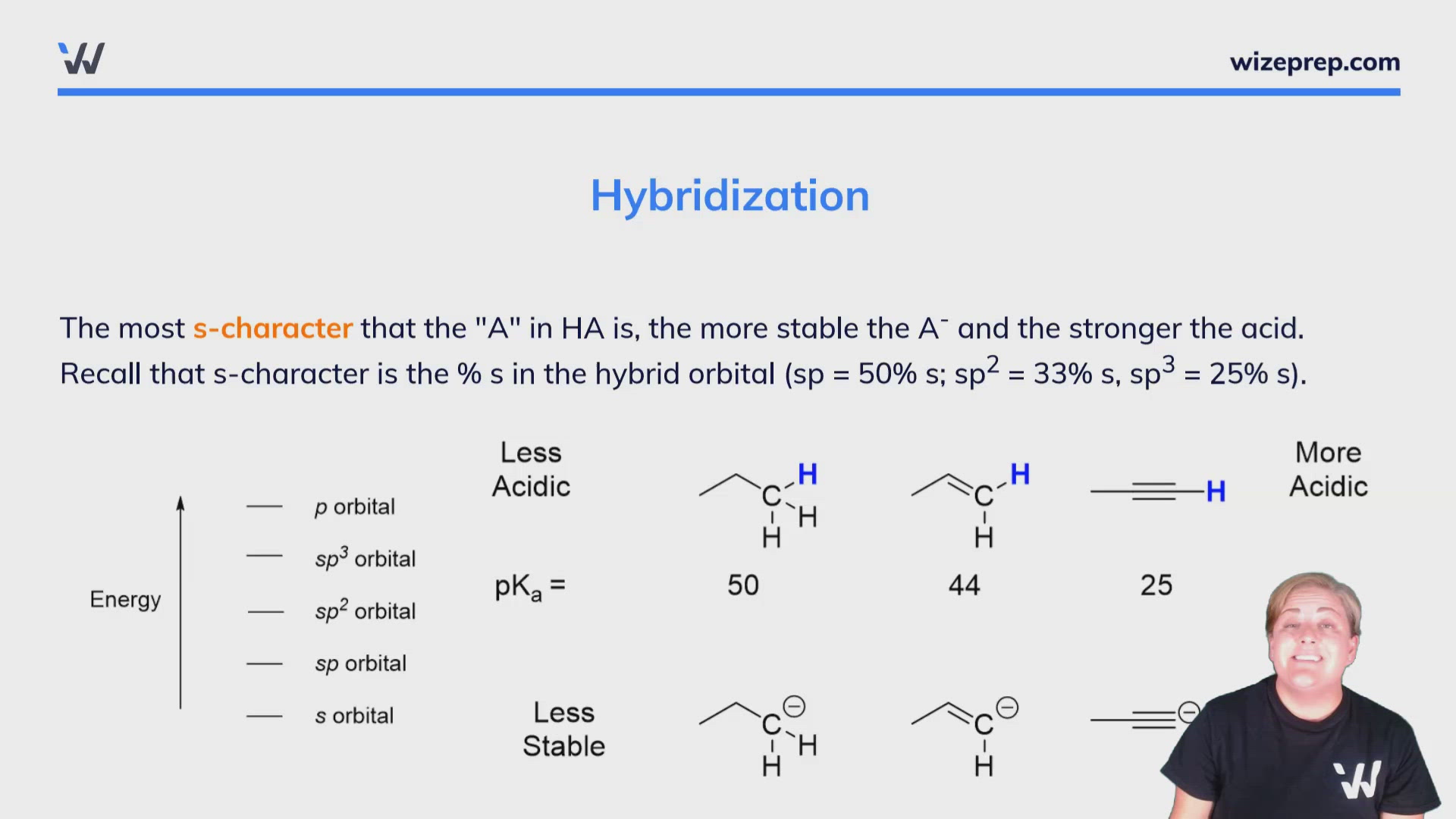
The most s-character that the "A" in HA is, the more stable the A- and the stronger the acid. Recall that s-character is the % s in the hybrid orbital (sp = 50% s; sp2 = 33% s, sp3 = 25% s).

For bases, if the lone pair is in an orbital with more s-character (e.g. an sp orbital) it will be lower in energy, more stable, and less likely to get protonated. For this reason amines are generally more basic than imines and nitriles.

0:00 / 0:00
Induction
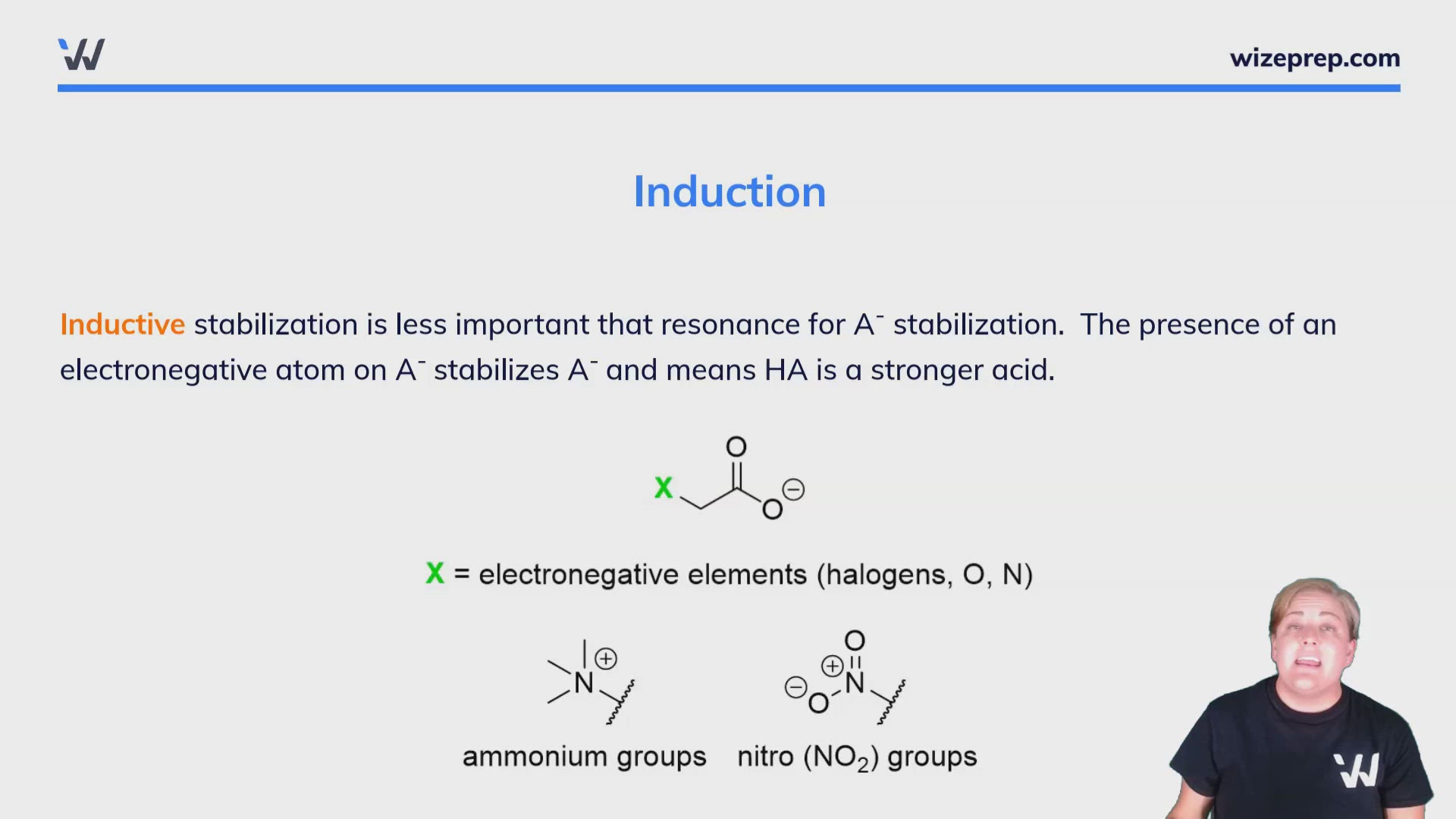
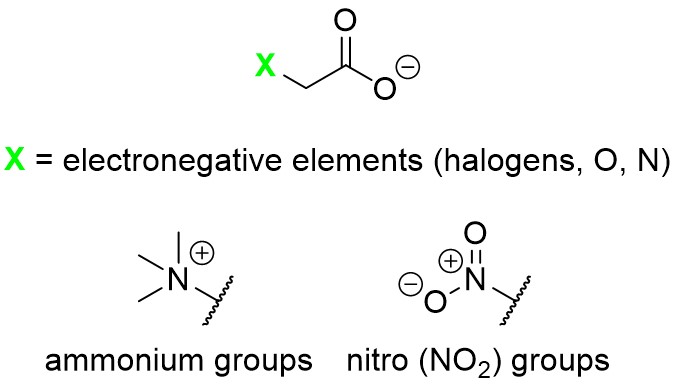
Inductive stabilization is less important that resonance for A- stabilization. The presence of an electronegative atom on A- stabilizes A- and means HA is a stronger acid.
Wize Tip
There are three factors to consider with induction! First, the electronegativity of X; the more electronegative X is, the stronger acid HA will be. Second, the proximity of X; the closer X is to the negatively charged atom, the strong acid HA will be. Third, the number of X atoms; the more atoms there are, the strong acid HA will be.
0:00 / 0:00
Aromaticity
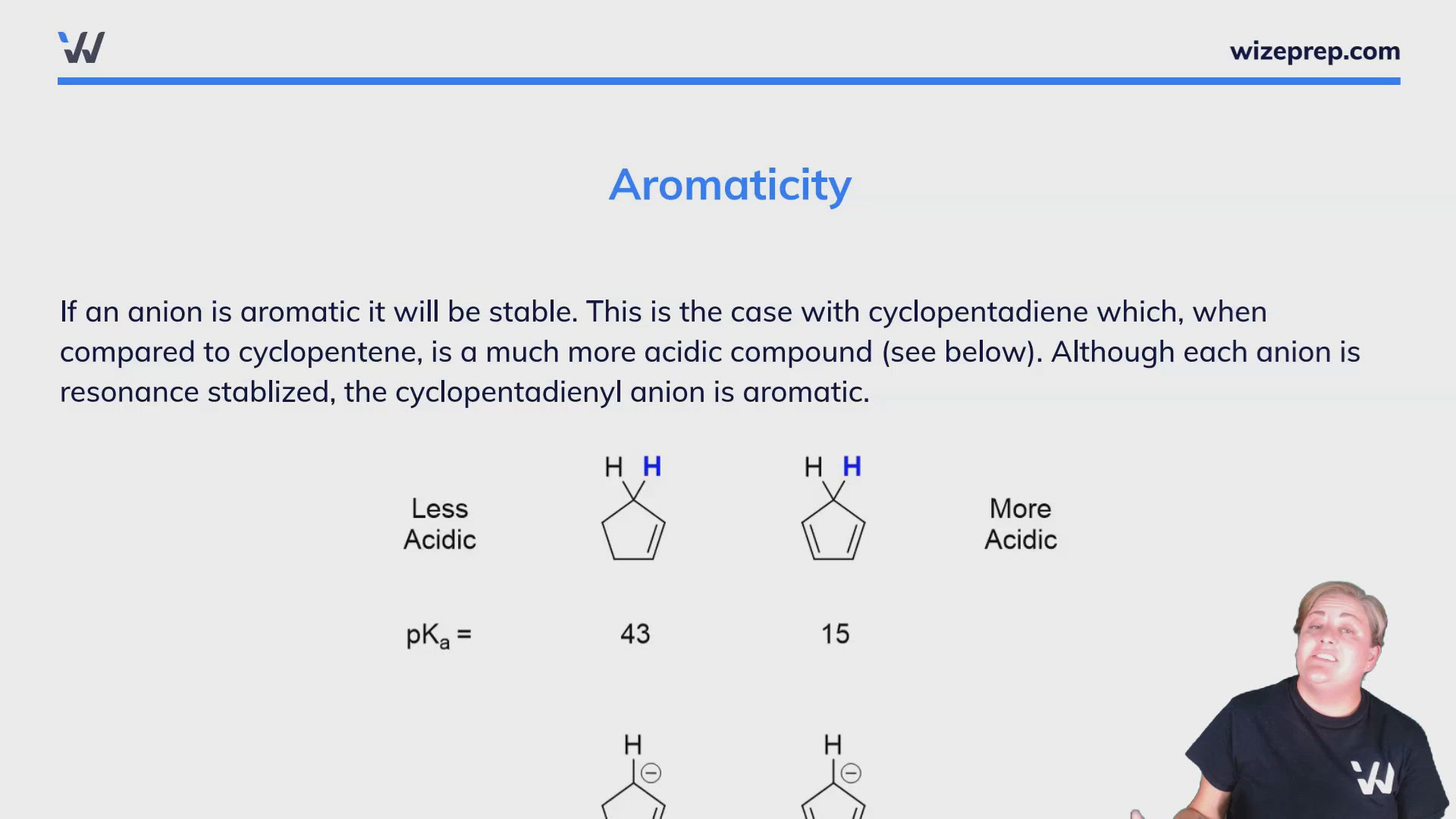
If an anion is aromatic it will be stable. This is the case with cyclopentadiene which, when compared to cyclopentene, is a much more acidic compound (see below). Although each anion is resonance stablized, the cyclopentadienyl anion is aromatic.

Aromaticity also plays a role in base strength. If a lone pair of electrons is necessary for a compound to be aromatic it will be less likely to get protonated. For example, which way does the equilibrium lie in the following example:

0:00 / 0:00
Example: Acid/Base Strength
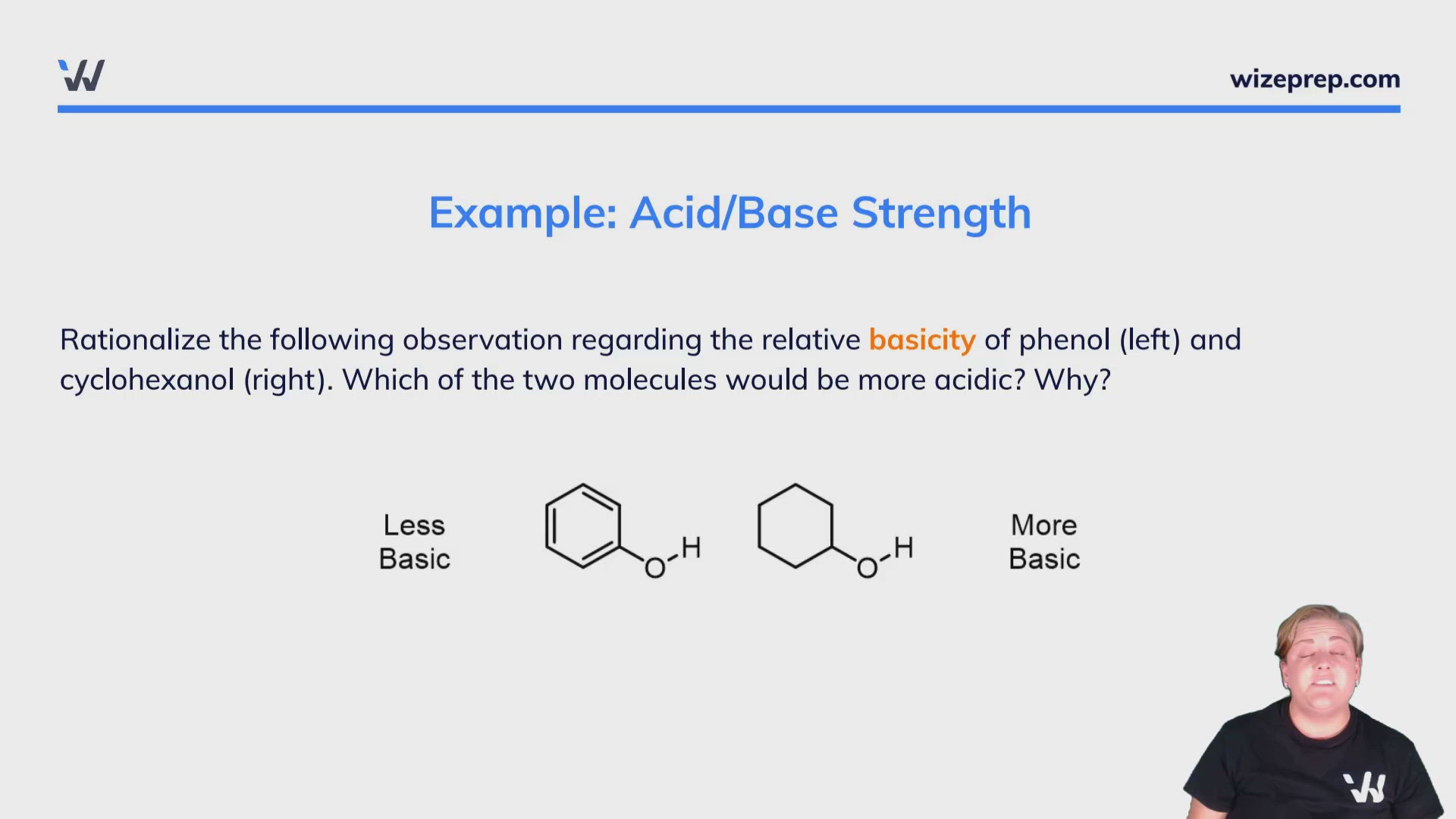
Rationalize the following observation regarding the relative basicity of phenol (left) and cyclohexanol (right). Which of the two molecules would be more acidic? Why?

Phenol is less basic as the oxygen atom's lone pair is tied up in resonance structure with the aromatic ring that cyclohexanol's lone pair is not (see video solution).
Phenol is more acidic because the conjugate base has a stabilizing resonance structure (see video solution).
0:00 / 0:00
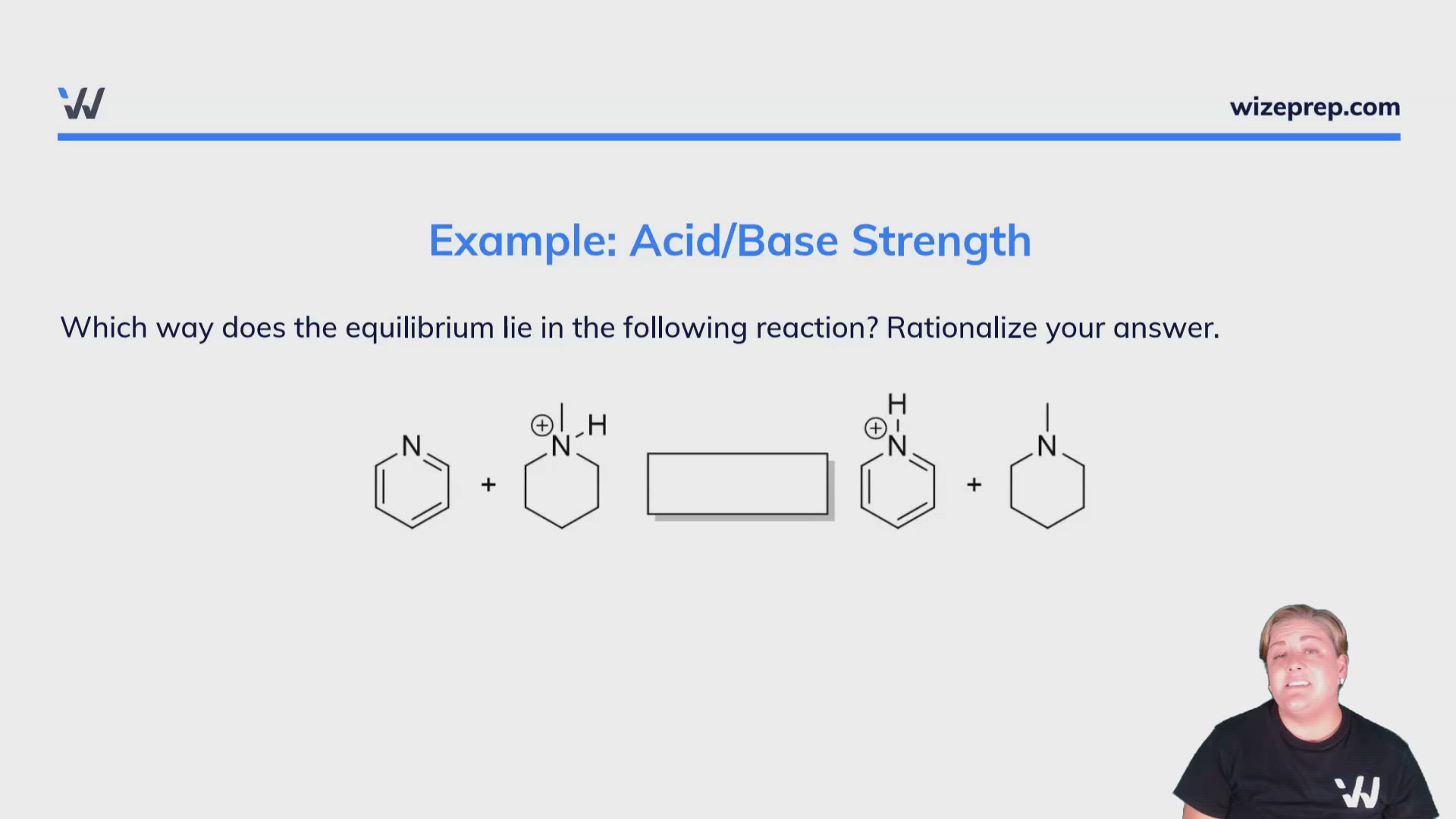
Example: Acid/Base Strength
Which way does the equilibrium lie in the following reaction? Rationalize your answer.
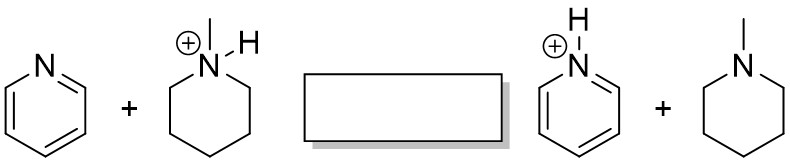
The equilibrium lies to the left because the sp2 hybridized nitrogen is more acidic than the sp3 hybridized nitrogen atom (see video solution).
Practice: Acid/Base Equilibrium
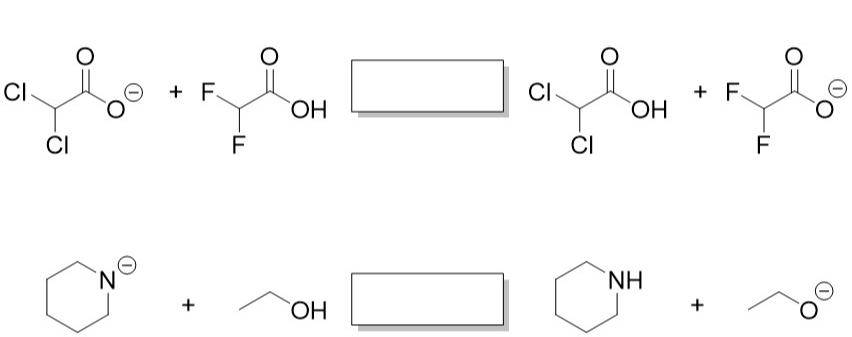
Which way does the equilibrium lie in the following reactions (right/left)?
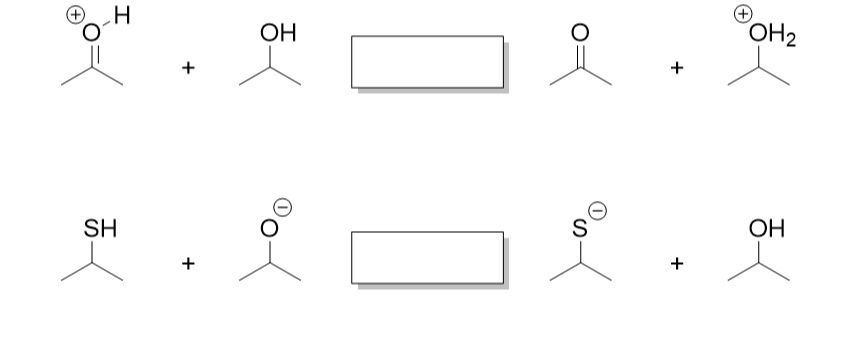
Practice: Acid/Base Equilibrium
Which way does the equilibrium lie in the following reactions?