
Cell Potentials and Gibbs Free Energy
- Free energy (ΔG°) and cell potential (E°cell) are related through the following equation:
ΔG° = Free energy difference between products and reactants in their standard states
n = # moles of electrons
F = Faraday constant
E°cell = Standard electrochemical reduction potential
** If E°cell is positive, the process is spontaneous **
- Remember that ΔG° and E° are for the cell at standard conditions (1 atm for gases and 1 M for solutions)
- Under nonstandard conditions we have:
- We can correct E° to reflect the nonstandard conditions by using the Nernst equation
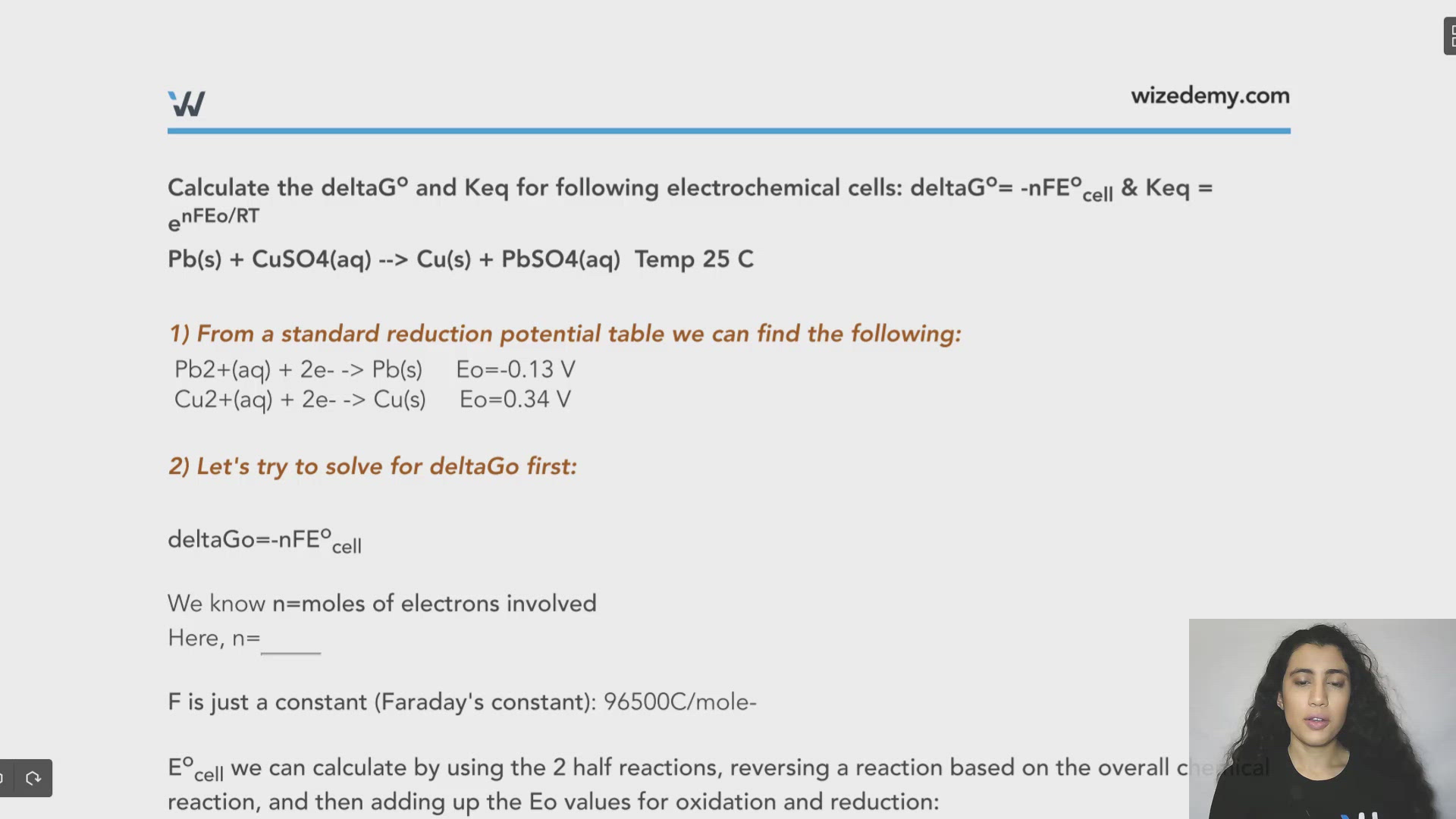
Calculate the deltaGo and Keq for following electrochemical cells: deltaGo= -nFEocell & Keq = enFEo/RT
Pb(s) + CuSO4(aq) --> Cu(s) + PbSO4(aq) Temp 25 C
1) From a standard reduction potential table we can find the following:
Pb2+(aq) + 2e- -> Pb(s) Eo=-0.13 V
Cu2+(aq) + 2e- -> Cu(s) Eo=0.34 V
2) Let's try to solve for deltaGo first:
deltaGo=-nFEocell
We know n=moles of electrons involved
Here, n=________
F is just a constant (Faraday's constant): 96500C/mole-
Eocell we can calculate by using the 2 half reactions, reversing a reaction based on the overall chemical reaction, and then adding up the Eo values for oxidation and reduction:
In our overall equation, when we look at the reactants, which is being oxidized and which is being reduced?
Pb(s) is being oxidized, Cu2+ is being reduced.
Based on this info, which equation should we reverse from the table? ________
What is the Eocell(redox)=?
Eocell=0.13 + 0.34
Eocell=0.47 V
Now we can plug these values in and solve for deltaGo:
deltaGo=-nFEocell
=(-2mole-)(96500C/mole-)(0.47V)
=-90710 J/mol
If we wanted our deltaGo to be in kJ/mol what would our answer be? ________
3) Now let's solve for Keq:
Keq = enFEo/RT
We already found n and Eo, we know F (96500C/mole-), we know R (8.314J/molK) and the temperature is given in the question (25C=298K!) Note: These equations are used for standard conditions, so the temperature would have to be 25C or 298K!
Keq = enFEo/RT
=e(2)(96500)(0.47)/8.314x298
=e36.61246
=7.95x10¹⁵

Cells Operating at Non-Standard Conditions: Nernst Equation
- If we want to operate a cell at non-standard conditions (not 1 M solutions) we need to use the Nernst equation to find new electromotive force
R: Ideal gas constant (8.314 J/molK)
T: Temperature (K)
n: # of electrons involved
F: Faraday constant (96500 C/mol e–)
Eocell: standard electromotive force
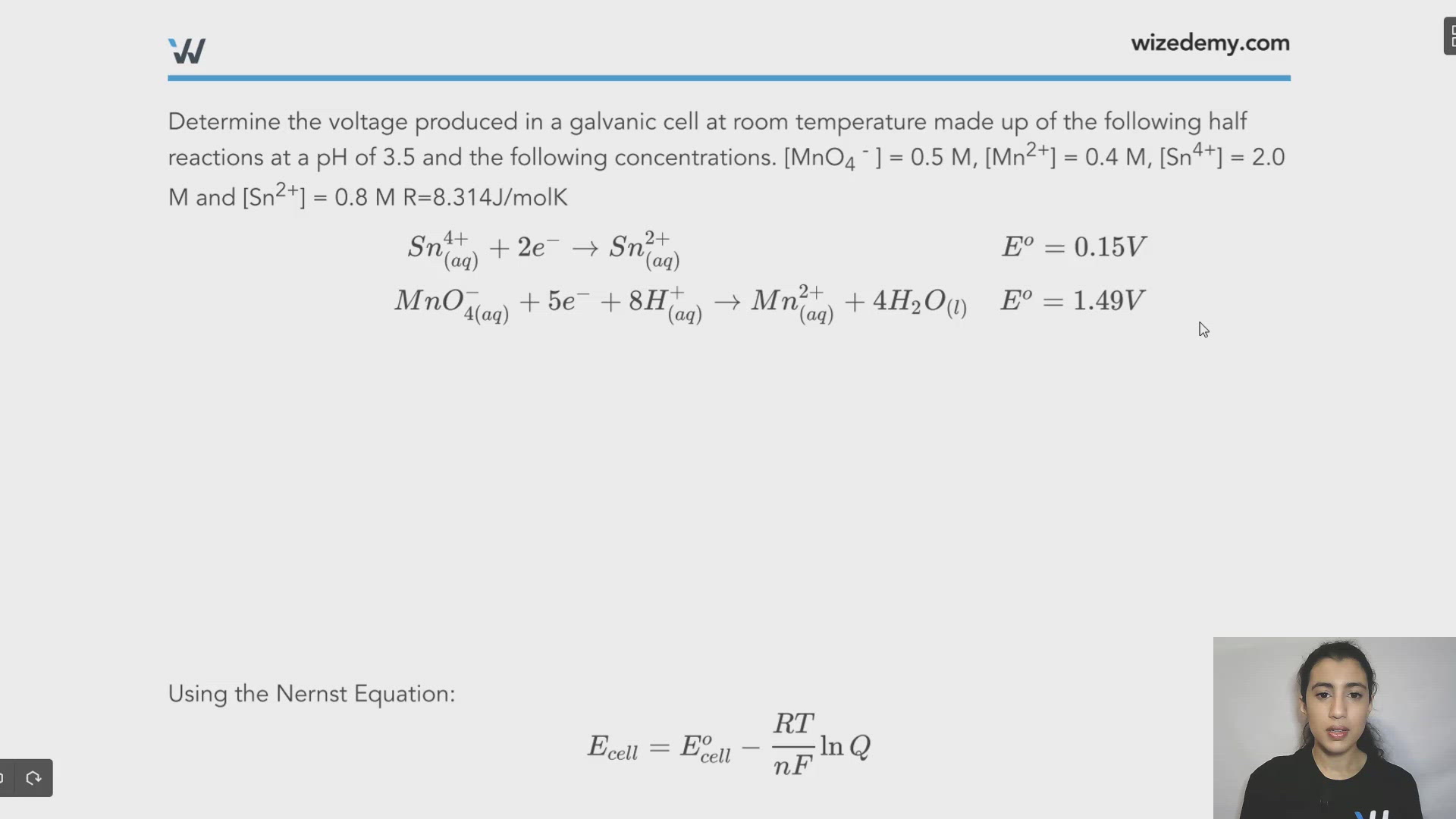
Determine the voltage produced in a galvanic cell at room temperature made up of the following half reactions at a pH of 3.5 and the following concentrations. [MnO4 - ] = 0.5 M, [Mn2+] = 0.4 M, [Sn4+] = 2.0 M and [Sn2+] = 0.8 M R=8.314J/molK
A galvanic cell must have a positive voltage so the Sn half-cell must be the oxidation half cell.
The chemical equation id shown below:
Using the Nernst Equation:
=-340V